We Help International Investors and Project Owners Deliver Major CEE Projects Without Expensive Surprises
Independent project intelligence and advisory across energy, transport, real estate and industrial construction.
Transelectrica's Congestion Income Jumped 74% to RON 263m. Romania's Grid Operator Is Being Paid for Its Own Bottleneck
Romania's transmission operator lifted first-half net profit 39 percent to RON 356m, and the single largest driver was a 74 percent surge in cross-border congestion income. Under EU law that money is not ordinary profit, it is a scarcity charge the operator is obliged to spend on removing the scarcity.
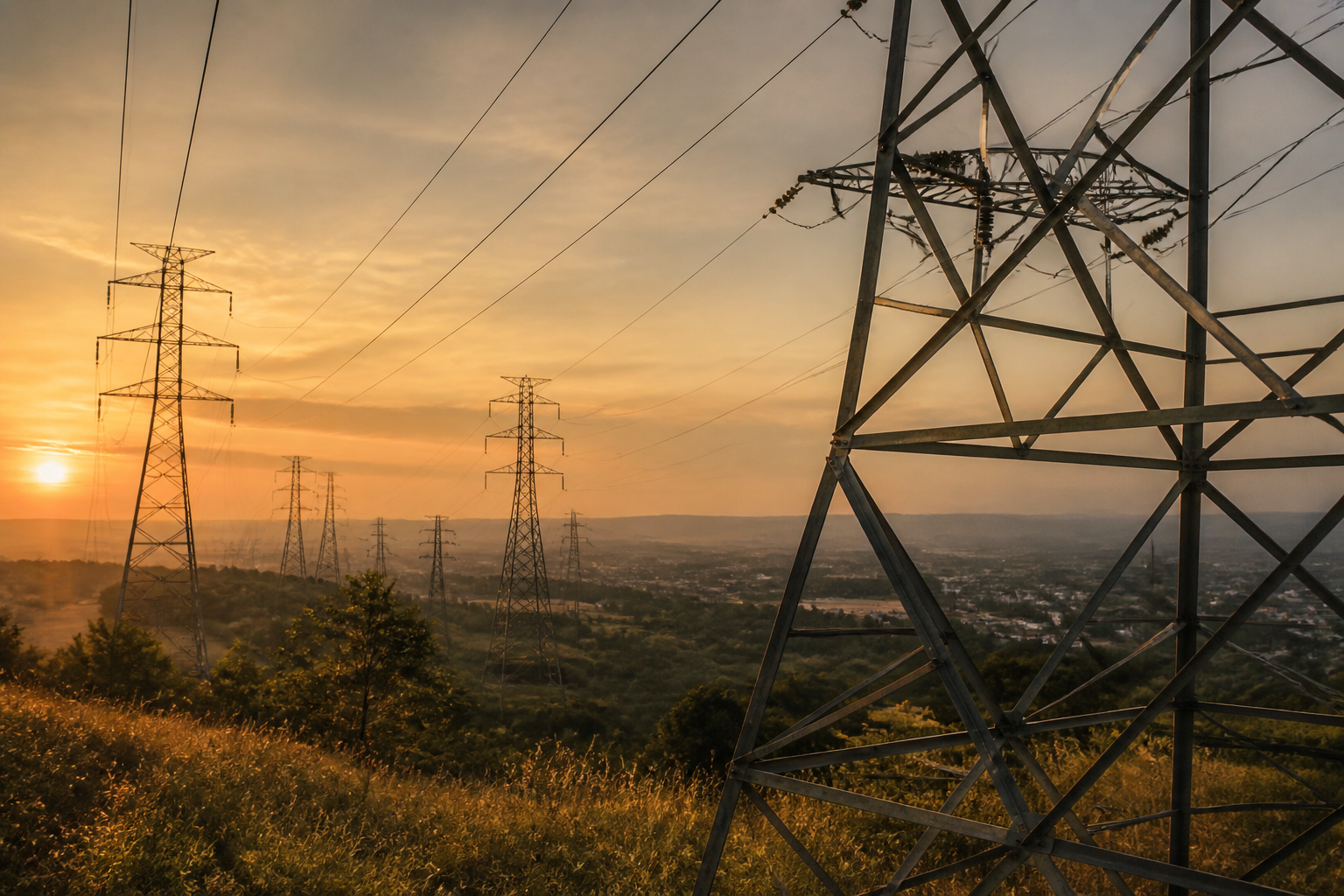
Romania's electricity transmission operator has published a set of results that read like a success story and diagnose a problem at the same time. Transelectrica reported net profit of RON 356 million for the first half of 2026, up 39 percent year on year, in a report filed with the Bucharest Stock Exchange on 14 August 2026. The largest single contributor to that increase was not the higher transmission tariff, and it was not efficiency. It was congestion.
Scarcity, priced and collected
Revenue from interconnection capacity allocation, the money a transmission system operator (TSO) collects when demand to move power across a border exceeds the wires available, reached RON 263 million between January and June 2026, against RON 151 million in the same period of 2025. That is a rise of RON 112 million, or 74 percent, and management named it the most important positive earnings contributor of the half.
Set that against the regulated business. Operating revenues rose to RON 1.365 billion from RON 1.151 billion. Within that increase, the higher transmission tariff approved by ANRE, the Romanian energy regulator, from 1 January 2026 delivered RON 77 million, an 8 percent lift in regulated tariff revenues. Congestion delivered half as much again. EBITDA from profit-allowed operations came in at RON 541 million, up 32 percent, and reported EBITDA was RON 626 million.
Congestion income is not shareholder money
Here is the part the headline hides. Under Article 19 of Regulation (EU) 2019/943, revenues from the allocation of cross-zonal capacity have a legally ranked purpose. First, guaranteeing the actual availability of allocated capacity, including firmness compensation. Second, maintaining or increasing cross-zonal capacity, either by optimising existing interconnectors through coordinated remedial actions or by covering the cost of network investment that reduces interconnector congestion. Only once those objectives are adequately met can the residual feed into tariff calculation, and that residual sits in a separate internal account.
Read the earnings release alongside the regulation and the picture inverts. A 74 percent jump in congestion income is a measurement of how badly Romania's borders are constrained, and it arrives with a spending obligation attached. The stronger the number, the larger the capital programme it implies.
The queue is growing faster than the network
Seven days after the results, on 21 August 2026, Transelectrica confirmed that Romania's National Power System had passed 2,500 MW of new generation and storage connected since the start of the year. The running total is 2,514 MW: 1,331 MW of photovoltaics, 663 MW of storage, 496 MW of wind, 20 MW of hydrocarbons and 5 MW of biogas. The threshold was crossed by a single battery site, IS Parau, at 76.76 MW and 150.288 MWh. The operator expects roughly another 1,000 MW of solar and wind and another 1,000 MW of storage by year end, alongside new gas capacity at Mintia and Iernut.
That is two and a half gigawatts of new injection in eight months, onto a network whose cross-border constraint is now visibly monetised. Congestion rent of this size is what a system looks like when generation is being built faster than the corridors that evacuate it.
Two warnings inside a strong half
Management flagged both. Transmission loss costs (CPT) reached RON 356 million in January to June, up 24 percent or RON 68 million on the RON 288 million of a year earlier, with losses running above the annual regulatory cap and the full-year rate likely to exceed target. Losses above the cap are not recoverable through tariff, so they eat regulated margin directly. Separately, tariffs are expected to be cut from 1 October 2026 so that the company stops booking excess profit on pass-through operations. Two of the effects that flattered this half therefore reverse inside the next two quarters.
Where the money is supposed to go
Romania has a live answer. Transelectrica and Georgian State Electrosystem signed a memorandum of understanding on 4 February 2026 advancing the Black Sea submarine cable between the two countries, a project already carried in ENTSO-E's Ten-Year Network Development Plans for 2022 and 2024 and added to the EU list of Projects of Mutual Interest in December 2025. The wider Green Energy Corridor vehicle, formed with AzerEnerji, Georgian State Electrosystem and Hungary's MVM, carries an initial budget of about USD 2.3 billion and a 2029 target. Neither has reached a final investment decision.
Lithuania shows the unglamorous version of the same logic. Litgrid is rebuilding an 83 km section of the 330 kV Aizkraukle to Panevezys line towards Latvia, with commissioning due by the end of 2028. Congestion rent pays for that kind of work far more reliably, and years sooner, than it pays for a subsea headline.
What to watch
For developers, congestion income is the clearest public signal of where a network hurts, and therefore where connection offers will be slow and curtailment risk real. For contractors, cable makers and substation builders, an Article 19 obligation growing at 74 percent is a forward order book that has not yet been tendered. For investors in listed CEE grid operators, the question to put to management is narrow and answerable: how much of the congestion account is committed to named projects, and on what dates. A TSO that banks the rent and defers the build is reporting earnings it will eventually have to spend.
Share it with your peers
Help your network stay ahead of CEE capital projects.
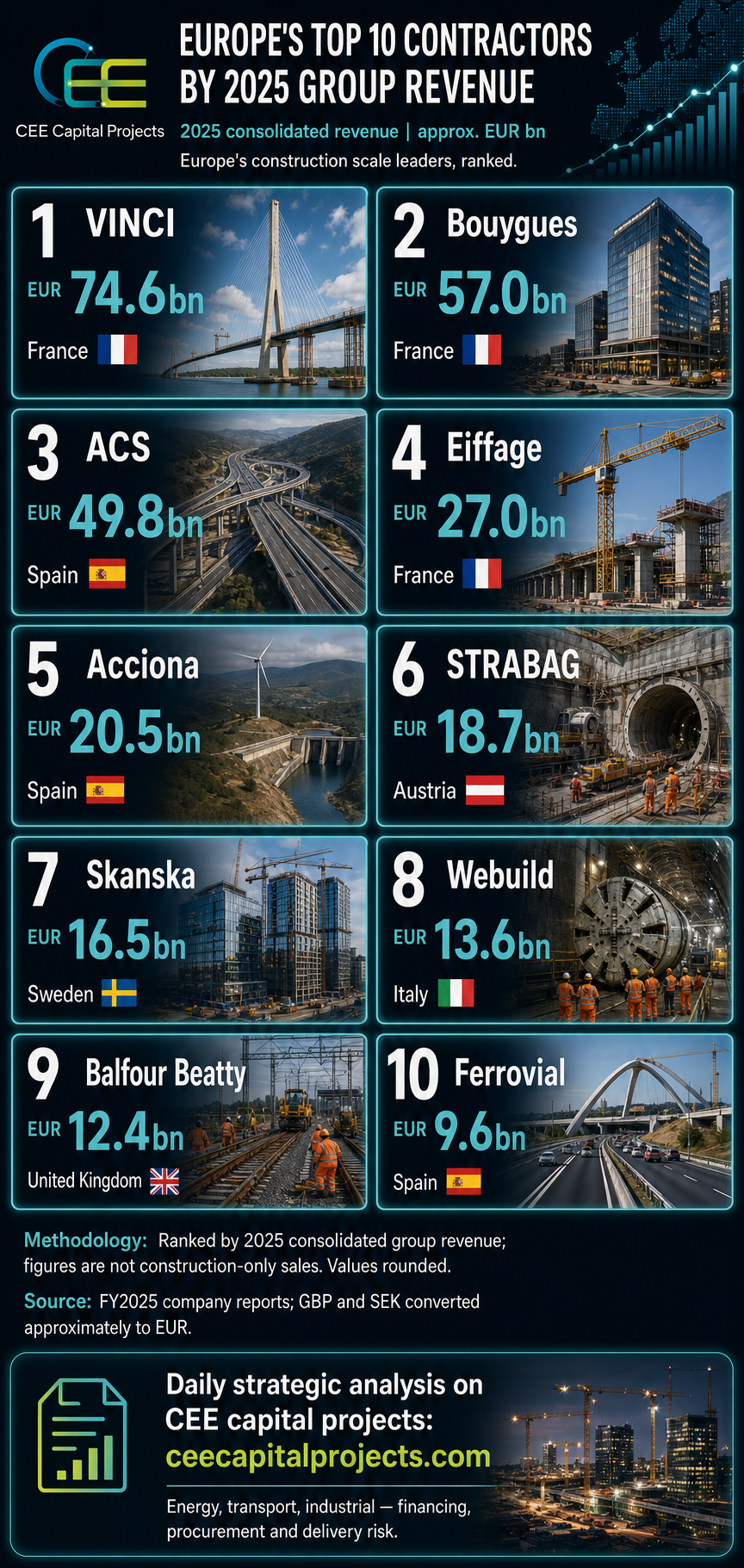
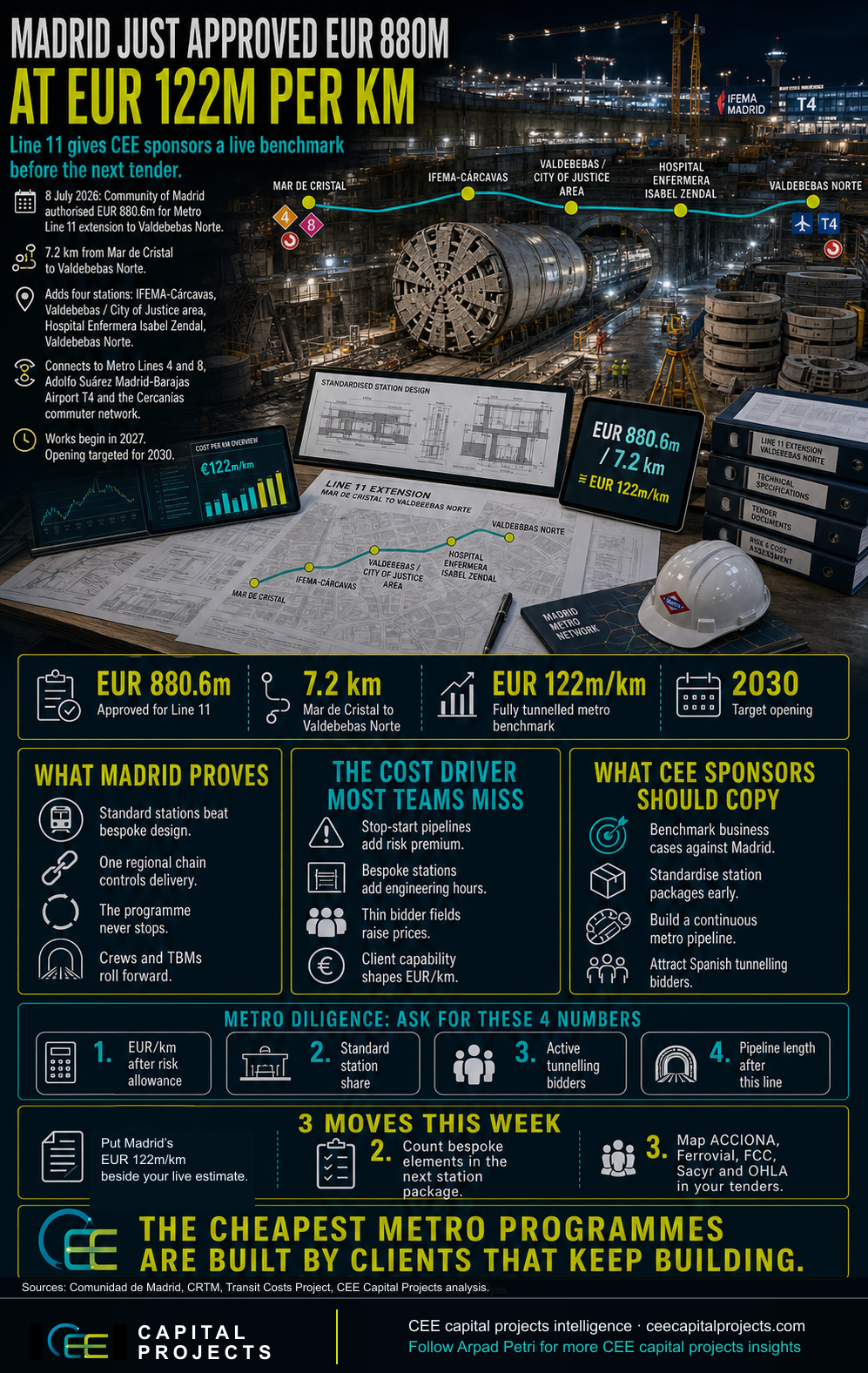
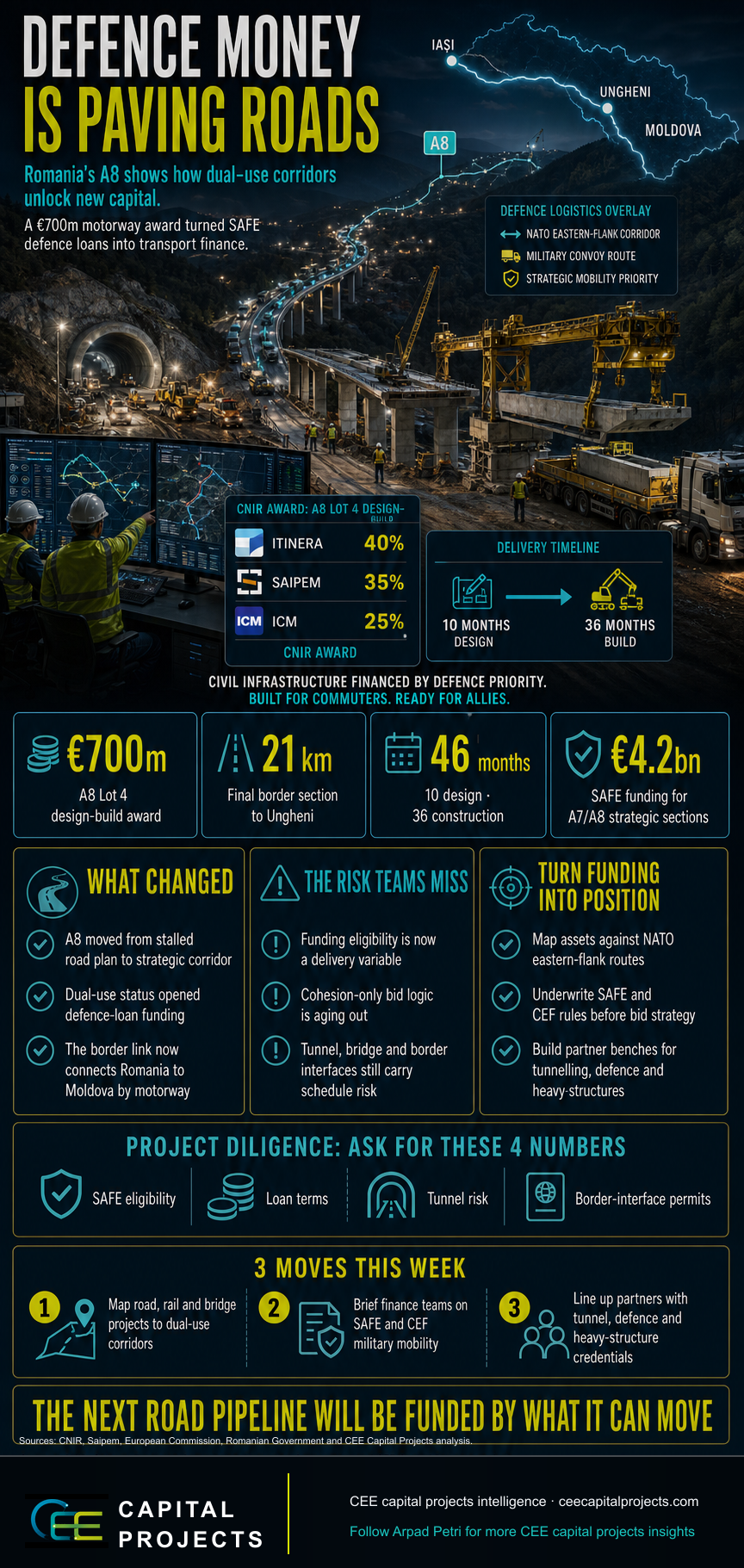
Explore our infograph library — strategic visuals for CEE capital projects leaders.
Project benchmarks, financing structures, tender dynamics and delivery risk — at a glance. Free access for investors, owners, contractors and strategy teams tracking CEE capital projects.
Browse the libraryStrategic Insights
📊 Analytics & Strategic Insight
Congestion rent is a bill that arrives looking like a bonus
The decision most in this industry are avoiding:
👉 Congestion income is being read as earnings quality when it is a defect report. Every unit of cross-zonal rent exists because a border could not carry what the market wanted to move across it. Equity desks model it as revenue growth. The regulation models it as a fund earmarked for removing the constraint that created it. Both readings cannot be right, and the regulation wins.
👉 Almost nobody sizes the evacuation corridor before signing the connection agreement. Romania added 2,514 MW of generation and storage in eight months. The corridors that carry that power to the neighbouring markets it will be sold into were sized for a different fleet. Developers optimise for the cheapest point of connection and inherit the curtailment that follows.
👉 The regulatory loss cap sits outside most investment cases, and it should not. Transmission losses above the annual ceiling are not recoverable through tariff. As more variable generation is pushed through the same conductors, the physical loss rate rises years before any reinforcement is energised. That is a permanent margin leak, not a timing difference.
Here's the full context:
→ 2019: Article 19 of Regulation (EU) 2019/943 sets the ranked uses of cross-zonal congestion income: firmness of allocated capacity first, then maintaining or increasing cross-border capacity, with any residual ring-fenced in a separate internal account before it can touch tariffs.
→ 2022 and 2024: The Georgia to Romania Black Sea submarine cable is carried in successive ENTSO-E Ten-Year Network Development Plans, establishing the corridor on paper long before any capital is committed to it.
→ December 2025: The same cable is added to the EU list of Projects of Mutual Interest, opening the door to European co-financing and a faster permitting track.
→ January and February 2026: ANRE approves a higher Romanian transmission tariff from 1 January, worth RON 77 million in the first half. On 4 February, Transelectrica and Georgian State Electrosystem sign a memorandum of understanding advancing the Black Sea link.
→ Most recent: On 14 August 2026 Transelectrica reports H1 net profit of RON 356 million, up 39 percent, with congestion income up 74 percent to RON 263 million. On 21 August it confirms 2,514 MW of new generation and storage connected in Romania so far in 2026.
What this means for infrastructure operators, contractors and investors:
✅ A congestion windfall is a pre-announced tender pipeline. The money is legally pointed at capacity that reduces interconnector congestion. Substations, reconductoring, phase shifters, coordinated remedial-action schemes and cross-border lines are the eligible spend. Contractors who read TSO congestion accounts are reading next year's procurement notices a year early.
✅ Listed CEE grid operators need the congestion line stripped out before they are valued. Cross-zonal rent is volatile, weather-driven, price-spread-driven and legally constrained. A multiple applied to a headline profit that contains it will overstate the durable regulated earnings underneath, which is the part the regulated asset base actually supports.
✅ Grid access, not permitting or panel prices, is now the binding constraint on CEE renewables. Where congestion rent rises fastest, connection queues lengthen, curtailment risk rises and merchant revenue assumptions get less reliable. Storage is being built partly as a workaround: 663 MW of it landed in Romania in eight months.
3 moves you can make this week:
1️⃣ Pull the congestion income line from every TSO you are exposed to. Two years of half-year figures, per border where it is disclosed. Rising rent marks the corridor where reinforcement is coming, and where your generation asset is most likely to be curtailed while you wait for it.
2️⃣ Ask the operator where the Article 19 account has been committed. Named projects, dates, and whether the residual has already gone into tariff reduction. An operator that cannot answer is either sitting on undeployed capital or has quietly recycled it, and both change your view of the next tariff review.
3️⃣ Re-run your curtailment case against the connection queue, not the installed base. Use the operator's own published pipeline. In Romania that means the 2,514 MW already connected this year plus roughly 2,000 MW more expected before year end, all of it ahead of the corridors that would carry it out.
Related analyses
- Energy & Power
Constellation's $4.3bn Nuclear Uprate Deal With Google: 890 MW, No New Site, and a Finite Pool
Constellation will invest more than $4.3bn to lift 890 MW out of 11 existing reactors under a 20-year Google power purchase agreement, at roughly half the per-kilowatt cost of recent American new build. The point for Europe is that the national uprate pool runs to three to five gigawatts, ČEZ banked its Dukovany headroom by 2009, and the only route left to fresh capacity is a CZK 407bn new build.
Read analysis → - Energy & Power
NEK's EUR 350 Million Yadenitsa Dam Tender Turns Bulgaria's Chaira Storage Fix Into a Civils Job
Bulgaria's NEK has put EUR 350m on the market for the Yadenitsa dam and a six kilometre tunnel at the 864 MW Chaira pumped storage plant, with bids due 4 November 2026 and 60 months to build. The civil works are costed at more than three times the EUR 102m reconstruction of all four of the plant's machines.
Read analysis → - Energy & Power
EIB and BNP Paribas Guarantee EUR 700m of Grid Equipment Bonds: Europe's Network Bottleneck Moves to the Balance Sheet
The EIB and BNP Paribas signed a EUR 700m counter-guarantee portfolio on 29 September 2026, covering advance payment and performance bonds for European manufacturers of electricity grid components. The instrument is small, and it points at the constraint that now sets delivery dates on Europe's grid build: bonding capacity rather than factory floor.
Read analysis →
Get a second opinion before it gets expensive.
Contractor selection, tender strategy, a project drifting off track — send us the situation and we'll come back with a clear plan.