We Help International Investors and Project Owners Deliver Major CEE Projects Without Expensive Surprises
Independent project intelligence and advisory across energy, transport, real estate and industrial construction.
RWE Just Paid €3.6 Billion for Majority Control of Amprion, a Grid It Sold Off in 2011. Europe's Biggest Pure-Play Generator Now Wants Boring, Regulated Returns
RWE has paid €3.6 billion to lift its stake in German grid operator Amprion to 55%, funding the move with a near-€4 billion share sale and naming regulated grids its third investment pillar. It is a striking reversal for a company that spent 15 years as Europe's biggest pure-play power generator — and a signal of how CEE grid capex will be financed.
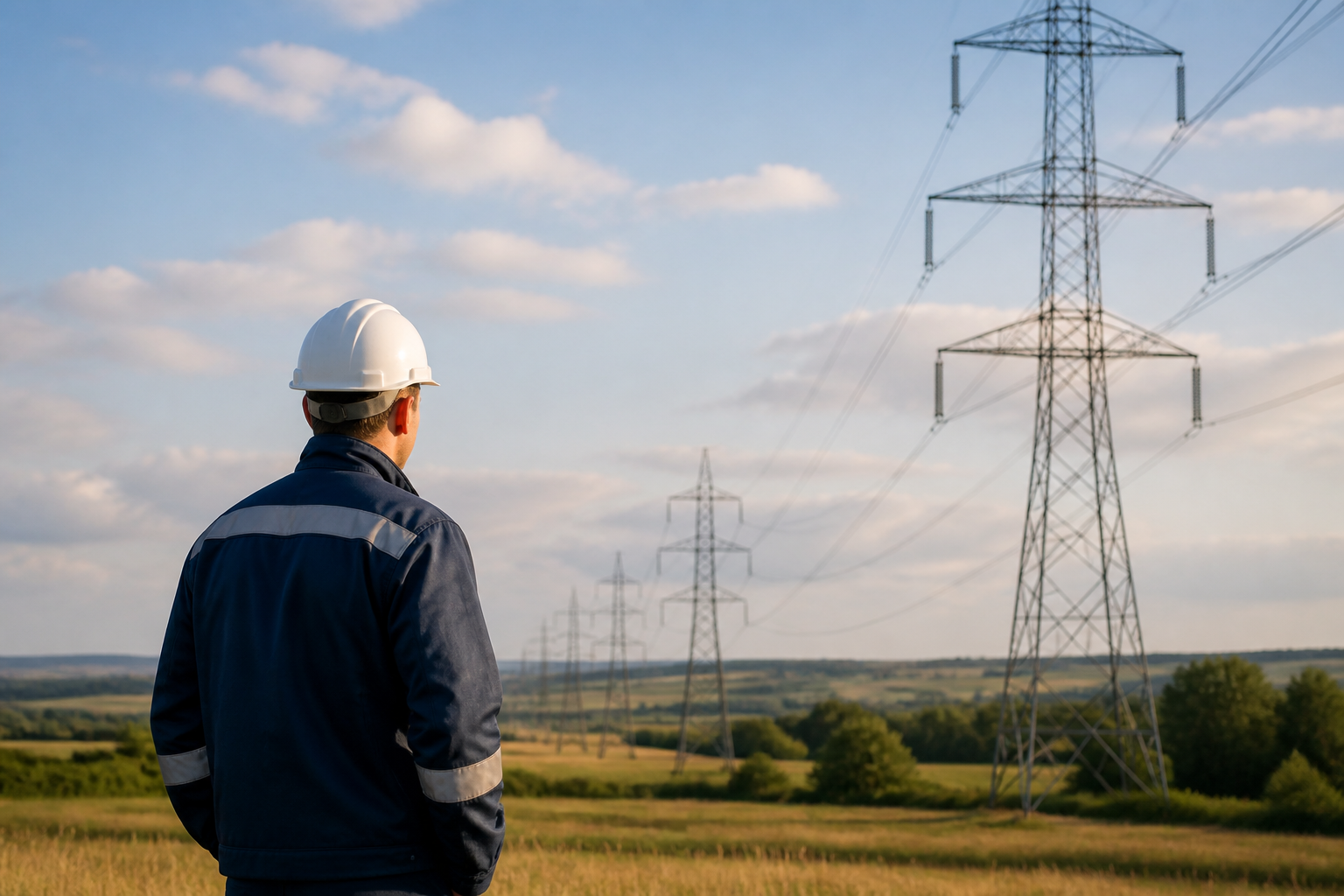
In a single afternoon on 22 June 2026, RWE placed roughly €4 billion of new stock with institutional investors and used the proceeds to do the one thing it had spent 15 years avoiding: buy back majority control of a regulated power grid.
The German utility agreed to lift its stake in transmission system operator Amprion from 25.1% to 55%, paying €3.6 billion for the extra 35% and, in the same breath, declaring regulated grid infrastructure its 'third investment pillar'. For a company that had rebuilt itself into Europe's biggest pure-play generator of wind, solar and flexible gas power, it is a striking about-face.
A grid RWE itself sold off in 2011
The irony is hard to miss. Amprion, formerly RWE Transportnetz Strom, exists because RWE was forced to unbundle its transmission network under EU rules. In 2011 it sold 74.9% to a consortium of institutional investors assembled by Commerz Real (the M31 vehicle), keeping only a 25.1% financial stake. Through the 2018–2020 asset swap with E.ON, RWE doubled down on pure generation, handing over grids and retail and taking renewables in return. Fifteen years after selling the grid down, it is paying to take control of it back.
Why boring suddenly looks attractive
The logic is written into RWE's own numbers. According to the investor presentation RWE published on 22 June 2026, the Amprion deal — closing expected in the third quarter of 2026 — lifts the share of the group's 2031 adjusted earnings per share that is contracted or regulated above 75%, and adds around 15 euro-cents of EPS accretion by 2031. RWE's pro-rata slice of Amprion's regulated asset base is guided to reach about €35 billion by 2031, throwing off roughly €930 million of adjusted EBITDA. The company is committing close to €10 billion to the acquisition and Amprion's capital needs between 2026 and 2031, while insisting its €35 billion renewables and flexible-generation plan stays untouched.
Merchant power is the reason. Wind and solar earnings have turned volatile — cannibalised capture prices, negative-price hours, offshore cost inflation and subsidy uncertainty — while a regulated transmission operator earns a stable, indexed return on an ever-growing asset base. Amprion's regulated asset base stood at €16.5 billion at the end of 2025 and is guided to compound at 27% a year to 2030, on the back of a roughly €42 billion grid-build programme and more than 9,300 km of new or upgraded lines, 60% of it tied to offshore wind connections.
The market's verdict, and the dilution question
Investors did not punish the move. RWE placed 36.1 million new shares and 38.2 million treasury shares at €54.00 each, raising close to €4 billion, and the stock held broadly steady — unusual for a raise that expands the share count from around 705 million to 780 million. That tolerance says something. Capital markets now prize regulated asset-base growth over merchant upside, and will fund a generator's pivot into networks. It also explains why private infrastructure capital is circling the same assets: Apollo committed €3.2 billion in 2025 to a joint venture supporting RWE's Amprion holding, and that structure now sits inside the financing of the majority buy-up.
What it signals for CEE grids and their investors
The read-across for Central and Eastern Europe is direct. The scarce, bankable asset in Europe's power system is no longer the megawatt; it is the regulated wire that moves it. Every CEE transmission operator faces the same wall of transition capital spending. Poland's PSE has flagged a grid programme on the order of €15 billion to 2034, and Romania's Transelectrica, the Czech ČEPS and Hungary's MAVIR all need to spend heavily to absorb renewables and new interconnectors. RWE has just shown how that capital gets mobilised: pair a strategic industrial owner with deep infrastructure funds, and let the stable regulated return do the underwriting.
For contractors and EPCs, the message is that the grid buildout now has a durable owner with a decade of committed spend behind it — Amprion alone plans to build or modernise more than 9,300 km of lines. For investors, RWE's re-rating bet is the one to watch. If the market keeps rewarding regulated earnings over merchant volatility, expect more European generators to buy their way back into networks, and more CEE system operators pushed toward the RWE–Apollo template of strategic owner plus infrastructure fund. The company that spent 15 years proving it could live on merchant power has just conceded that, in this cycle, boring pays better.
Share it with your peers
Help your network stay ahead of CEE capital projects.
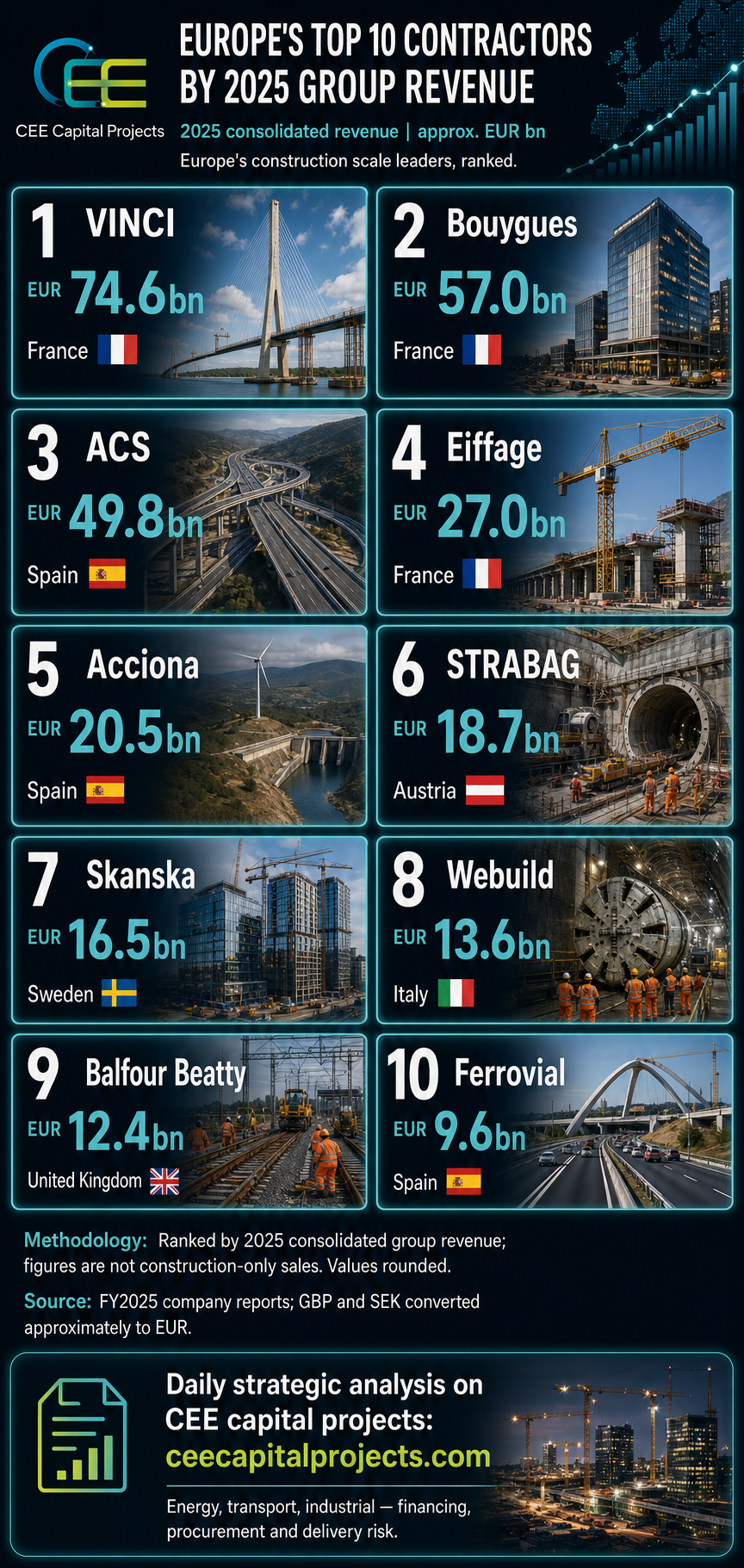
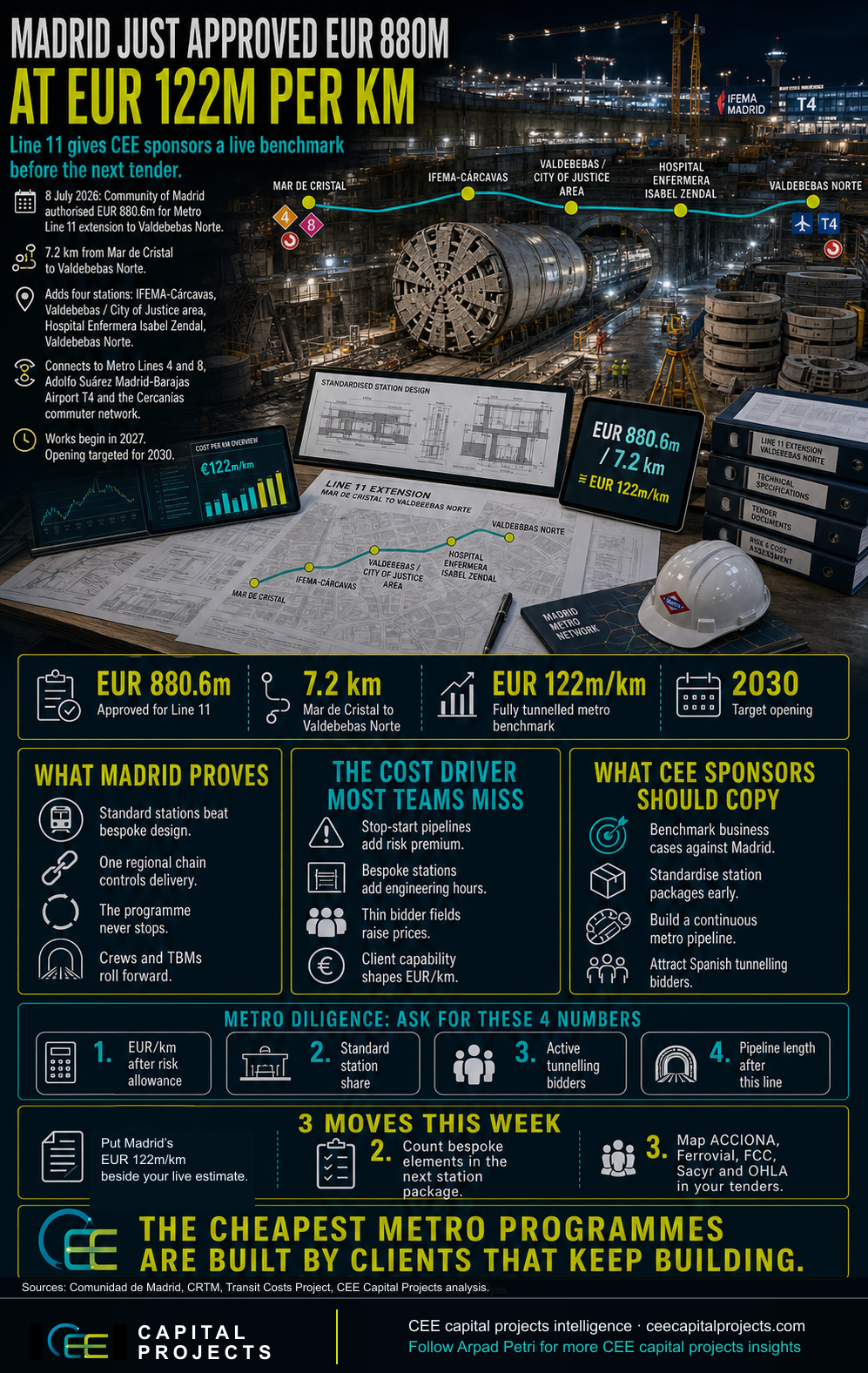
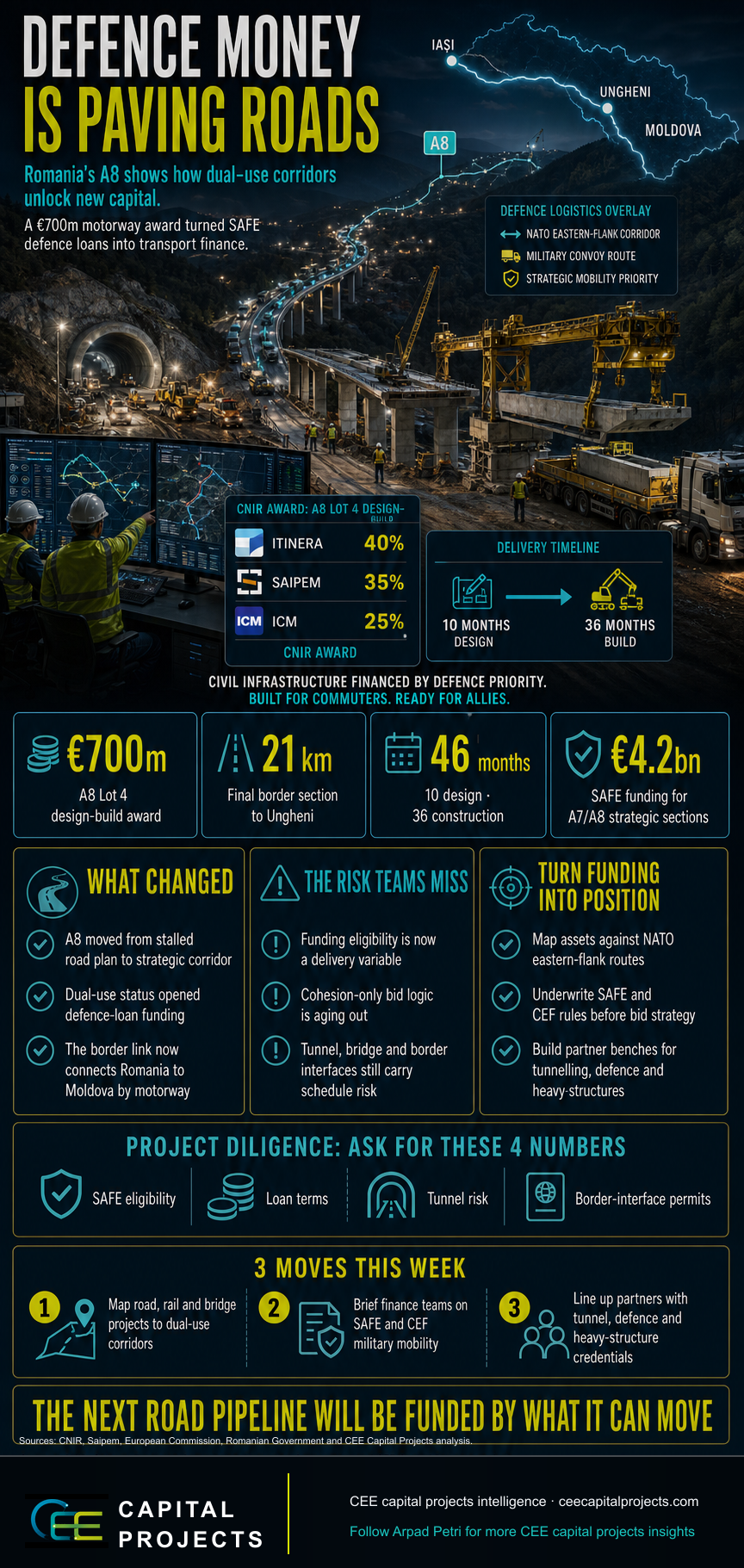
Explore our infograph library — strategic visuals for CEE capital projects leaders.
Project benchmarks, financing structures, tender dynamics and delivery risk — at a glance. Free access for investors, owners, contractors and strategy teams tracking CEE capital projects.
Browse the libraryStrategic Insights
📊 Analytics & Strategic Insight
Regulated Returns Are Repricing Europe's Utilities — and the Grid Is the Prize
The decision most in this industry are avoiding:
👉 Owning the wire now beats owning the megawatt. Most utilities still frame the transition as a race to build generation. RWE has bet the opposite — that the regulated network, not the power that flows through it, is where durable, fundable earnings now sit.
👉 The dilution everyone fears is the whole point. RWE issued about 75 million new shares and the stock barely moved, because investors would rather fund a regulated asset base compounding at 27% a year than another merchant wind farm. Cheap equity is available for regulated growth; it is not for merchant risk.
👉 Buying back what you sold is not failure — it is reading a changed cycle. The 2011 unbundling made sense when grids were sleepy, low-growth utilities. The energy transition turned them into the fastest-growing regulated assets in Europe. The hard, correct move was admitting the world had changed.
Here's the full context:
→ 2011: RWE unbundles its transmission network into Amprion under EU rules, selling 74.9% to a Commerz Real-led consortium (M31) and keeping 25.1%.
→ 2018–2020: The E.ON–RWE–innogy asset swap turns RWE into a pure-play generator of renewables, flexible gas and trading; E.ON takes grids and retail.
→ 2025: Apollo commits €3.2 billion to a joint venture supporting RWE's Amprion stake — the first sign RWE wants to scale the grid, not exit it.
→ 22 June 2026: RWE agrees to buy an additional 35% of Amprion for €3.6 billion (to 55%), raises close to €4 billion in new equity at €54.00 a share, and names regulated grids its third investment pillar.
→ Most recent: With closing expected in Q3 2026, RWE guides more than 75% of its 2031 earnings per share to contracted or regulated income and its pro-rata Amprion asset base toward €35 billion — a full re-rating from merchant generator to regulated-infrastructure owner.
What this means for infrastructure operators, contractors and investors:
✅ Value the RAB, not the output. The scarce, financeable asset is the regulated wire. Operators and investors should price grid rights, connection assets and regulated asset-base growth the way they once priced generation capacity.
✅ The financing template is now set. Strategic industrial owner plus deep-pocketed infrastructure fund (RWE plus Apollo) is how Europe's grid capex gets underwritten. Expect the same structure to reach CEE transmission operators.
✅ Contractors gain a decade-long, well-funded client. Amprion's roughly €42 billion programme and 9,300-plus km of lines mean a durable pipeline for EPCs, cable makers and substation builders — the demand side of the grid boom just got a committed owner.
3 moves you can make this week:
1️⃣ Split your revenue by regulated versus merchant. Map how much of your order book or portfolio rests on stable regulated income versus volatile market prices, and decide where the next euro of capital should go.
2️⃣ Track the CEE grid pipelines. Put PSE, Transelectrica, ČEPS and MAVIR capex plans on a watchlist; the owners funding them will need contractors, cables and equity partners on RWE-style terms.
3️⃣ Watch the RWE re-rating as a signal. If the market keeps rewarding regulated earnings, position early — as a bidder, a supplier or a co-investor — for the next generator that decides to buy back into networks.
Related analyses
- Energy & Power
Constellation's $4.3bn Nuclear Uprate Deal With Google: 890 MW, No New Site, and a Finite Pool
Constellation will invest more than $4.3bn to lift 890 MW out of 11 existing reactors under a 20-year Google power purchase agreement, at roughly half the per-kilowatt cost of recent American new build. The point for Europe is that the national uprate pool runs to three to five gigawatts, ČEZ banked its Dukovany headroom by 2009, and the only route left to fresh capacity is a CZK 407bn new build.
Read analysis → - Energy & Power
NEK's EUR 350 Million Yadenitsa Dam Tender Turns Bulgaria's Chaira Storage Fix Into a Civils Job
Bulgaria's NEK has put EUR 350m on the market for the Yadenitsa dam and a six kilometre tunnel at the 864 MW Chaira pumped storage plant, with bids due 4 November 2026 and 60 months to build. The civil works are costed at more than three times the EUR 102m reconstruction of all four of the plant's machines.
Read analysis → - Energy & Power
EIB and BNP Paribas Guarantee EUR 700m of Grid Equipment Bonds: Europe's Network Bottleneck Moves to the Balance Sheet
The EIB and BNP Paribas signed a EUR 700m counter-guarantee portfolio on 29 September 2026, covering advance payment and performance bonds for European manufacturers of electricity grid components. The instrument is small, and it points at the constraint that now sets delivery dates on Europe's grid build: bonding capacity rather than factory floor.
Read analysis →
Get a second opinion before it gets expensive.
Contractor selection, tender strategy, a project drifting off track — send us the situation and we'll come back with a clear plan.