We Help International Investors and Project Owners Deliver Major CEE Projects Without Expensive Surprises
Independent project intelligence and advisory across energy, transport, real estate and industrial construction.
RSJ and Na Jelenach Commit CZK 50bn to 5,500 Prague Rental Homes, Against a Czech Institutional Stock of 4,100
RSJ and Na Jelenach plan about 5,500 rental homes on 22 hectares in southern Prague, an investment above CZK 50bn delivered over roughly ten years. Prague's operational institutional rental stock is 4,100 flats, which moves the hard question from construction to ownership.
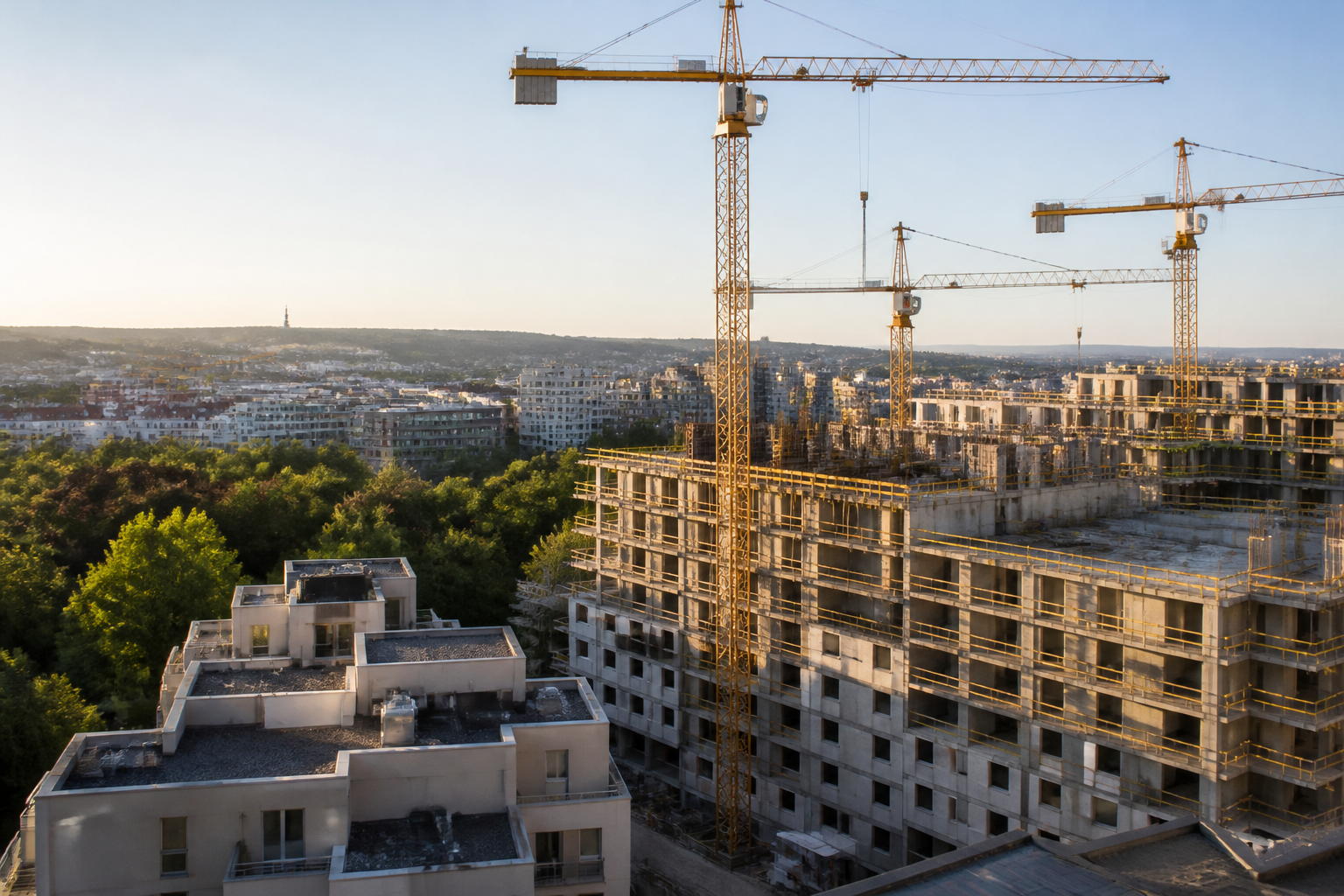
The coverage reads this as Prague's housing supply answer. I read it as a fund formation problem. Knight Frank counted about 4,100 operational institutional rental flats in Prague in its report published on 18 May 2026, with a further 2,290 under construction or refurbishment. One scheme in southern Prague now proposes 5,500.
RSJ, the Czech investment group founded in 1994, and the developer Na Jelenach announced a strategic partnership on 15 October 2026 to build a rental district at Na Jelenach in Chodov, southern Prague. Eurobuild CEE reported the scheme on 16 October 2026 at about 5,500 rental homes for up to 16,000 residents, with investment above CZK 50bn. Archiweb put the site at 220,000 sqm, roughly 22 hectares, with delivery over about ten years and first phase construction starting in 2027.
Phases one and two are waiting on permit approvals. Na Jelenach brings the site and the preparatory work. RSJ brings the capital, and board member Lukas Musil said the group will fund several billion koruna of the first phase while it seeks partners. The intention is that the finished district ends up under a single institutional rental fund.
What is genuinely new about this scheme
Prague has seen large master plans before. Sekyra Group's Smichov City runs to about CZK 35bn and roughly 1,600 flats. The district planned around Vltavska and Nadrazi Holesovice by AKIPIA with Penta Real Estate and J&T is costed near CZK 90bn to 2050. The difference at Na Jelenach is tenure. The whole district is designed for rent, which follows the Vienna and Berlin template rather than the Czech one.
That is a structural break for the Czech market. Residential development here has run on sales to owner occupiers. Michal Kocian, who bought this part of the project from Finep and owns Na Jelenach, co-owns a developer built on exactly that model. Switching tenure switches the counterparty at the end of the job, from thousands of mortgage borrowers to one fund with one investment committee.
The stock number is the story
Set 5,500 against the market it would enter. Knight Frank's institutional rental report, published 18 May 2026 and covering the fourth quarter of 2025 and the first quarter of 2026, counted 4,100 operational institutional rental flats in Prague and a pipeline of 2,290. A single project therefore carries about 134 per cent of today's stock, and about 86 per cent of stock and pipeline combined. Average rent in Prague build to rent projects sat at CZK 600 per square metre per month, almost unchanged over the previous six months.
The rent line is what the fund buys. Flat rents and a yield near the bottom of the Czech range leave the business plan leaning on growth that the last six months did not deliver. Knight Frank also noted that premium rental listings sit about 21 per cent above standard ones, which tells a sponsor where the only available rent headroom is and how narrow that segment is.
A CZK 50bn asset needs a CZK 50bn buyer
At 24.31 koruna to the euro on 21 October 2026, CZK 50bn is about EUR 2.06bn. The whole Czech commercial property investment market transacted EUR 1.47bn in the first half of 2026, and Knight Frank's forecast, reported by Property Forum on 16 July 2026, put the full year near EUR 3bn. Residential rental took 41 per cent of second quarter volume, the largest single share, at a yield of 4.25 per cent. Domestic investors drove 74 per cent of transactions.
So one district, built out over ten years, is worth roughly seven months of all Czech property trading at the 2026 run rate, on a capital base where domestic money supplies three quarters of the flow. RSJ says the project has already drawn interest from major funds, including international investors, and that is the right instinct. It also means the equity story depends on a buyer pool that does not yet trade at this ticket size in Czechia.
Permits set the drawdown
Phases one and two are still in permitting, and the Czech Statistical Office recorded Prague apartment approvals falling more than 15 per cent year on year between January and May 2026, to 2,878 units. Two readings follow. Scarce approvals support the rent and the value of anything that does get built. They also mean the sponsor carries land and design cost for longer before any income arrives.
For scale, 5,500 units is close to two full years of Prague apartment approvals at that rate. On a ten year programme the permit calendar decides when capital goes to work, long before any question of construction method or contractor selection.
What to watch from here
The groundbreaking in 2027 is the least informative milestone in this programme. The signal is the first institutional partner signing at a defined yield, and the first phase reaching stabilised occupancy at a rent that proves the CZK 600 line can move. Contractors should read a ten year, single tenure programme as framework work, which changes how they price repeat detailing and how they staff a decade on one site. Lenders will want phase level ring fencing, because a rental district stabilises in pieces rather than all at once.
Public sponsors in Prague, Brno and Bratislava should note what the structure implies for their own affordable rental ambitions. Institutional rental at this scale needs an exit market before it needs a site. Building that market is a capital markets job as much as a planning one, and the cities that get there first will be the ones where pension and insurance money can buy a stabilised block without leaving the country.
📊 Analytics & Strategic Insight
Czechia is building institutional rental faster than it is building the market that buys it
The decision most in this industry are avoiding:
👉 The exit is the product. A build to rent district is underwritten on a sale that happens eight to twelve years out, to a buyer type that barely trades in the market today. Most sponsors price the build and assume the buyer.
👉 Flat rents break the model before cost inflation does. Prague build to rent rents held near CZK 600 per square metre per month through late 2025 and early 2026. A 4.25 per cent yield on a flat rent line leaves the equity nothing to absorb a cost move with.
👉 Single tenure removes the release valve. A for sale scheme can switch phases to rent when sales slow. A district designed entirely for rent, managed by one fund, has no second channel if the institutional bid fails to appear.
Here's the full context:
→ 1994: RSJ is founded as a Czech investment group, later spreading across residential, office, logistics and industrial construction as well as technology, healthcare and land.
→ 2020: Prague 11 and the city work through land exchanges in the Na Jelenach development area, the groundwork that makes a single large developable estate possible.
→ May 2026: Knight Frank counts 4,100 operational institutional rental flats in Prague with 2,290 in the pipeline, and average build to rent rent of CZK 600 per square metre per month, almost unchanged over six months.
→ July 2026: Property Forum reports Knight Frank data showing Czech investment volume above EUR 1bn in the second quarter and EUR 1.47bn in the first half, residential rental at 41 per cent of quarterly volume and a 4.25 per cent yield, with domestic investors driving 74 per cent of transactions.
→ Most recent: On 15 and 16 October 2026 RSJ and Na Jelenach announce a partnership of more than CZK 50bn for about 5,500 rental homes on 22 hectares in Chodov, southern Prague, with first phase construction from 2027 and phases one and two still awaiting permits.
What this means for infrastructure operators, contractors and investors:
✅ Contractors should price this as a ten year programme. One sponsor, one tenure and one management fund mean repeatable product, fixed detailing and staff continuity. That is worth a tighter price per phase than a sequence of unrelated tenders.
✅ Lenders should ring fence by phase. A rental district stabilises in pieces. Debt structured across the whole estate carries the lease up risk of 5,500 units at once, which no first phase cash flow can support.
✅ Investors should test the depth of the buyer pool before the rent assumption. Residential rental at 4.25 per cent is priced for scarcity. The live question for a 5,500 unit pipeline is how many funds can write a koruna ticket above EUR 200m, and how many of those are already invested in Prague.
3 moves you can make this week:
1️⃣ Date your rent assumption. Pull the last four quarters of achieved rent on your own rental assets and write the pricing month on the front of the model. A rent line that held flat for six months is a repricing signal, and it compounds across a ten year drawdown.
2️⃣ Name your buyer. List every fund that has closed a residential rental deal in your market in the last 24 months, with ticket sizes beside each name. If fewer than four can write your exit cheque, restructure the phasing so each phase is separately saleable.
3️⃣ Map the permit calendar onto the capital call schedule. For every phase in planning, record the consent outstanding and the authority that grants it, then test what a twelve month slip does to your land carry. In Prague that test is live, with apartment approvals down more than 15 per cent year on year to 2,878 units between January and May 2026.
Share it with your peers
Help your network stay ahead of CEE capital projects.
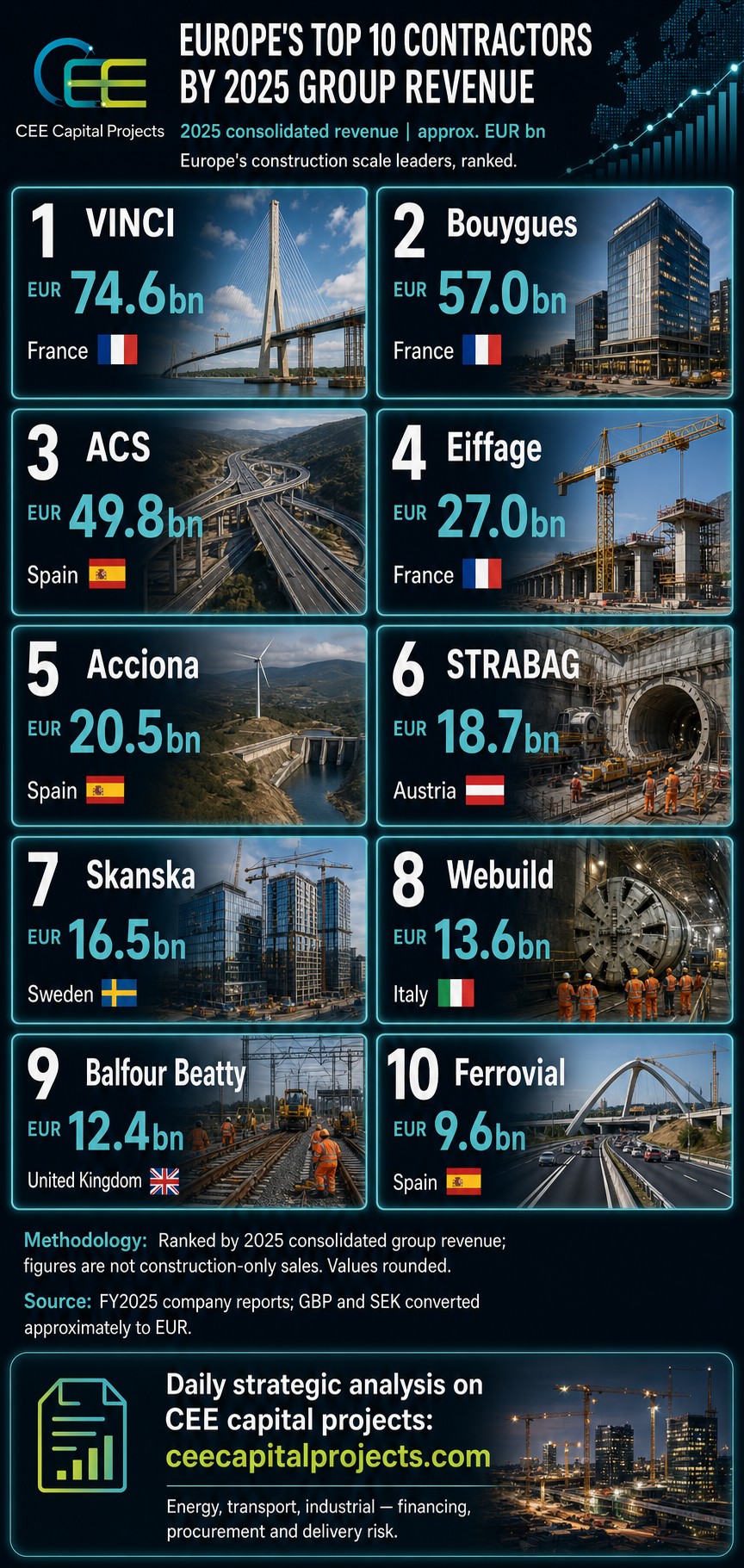
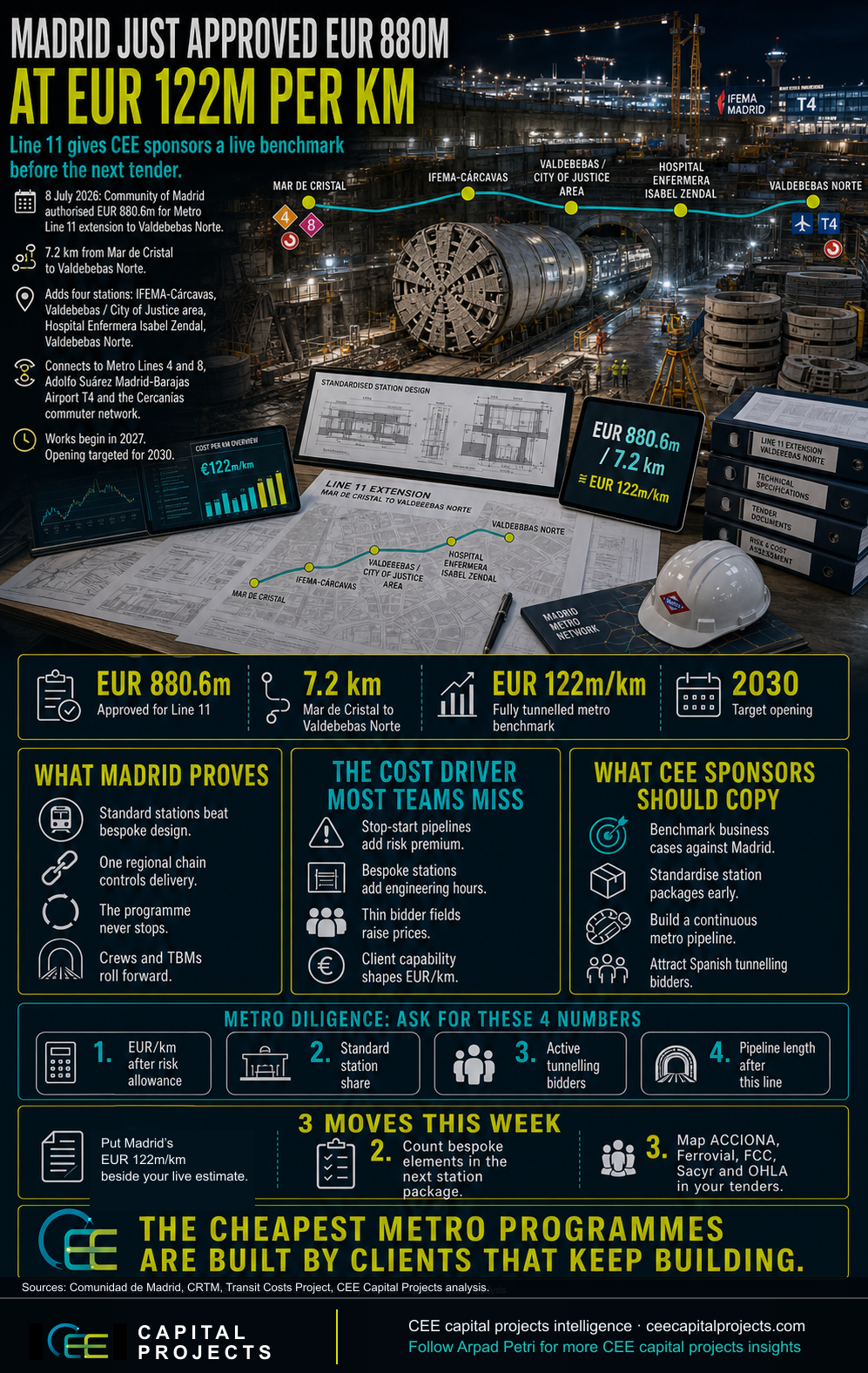
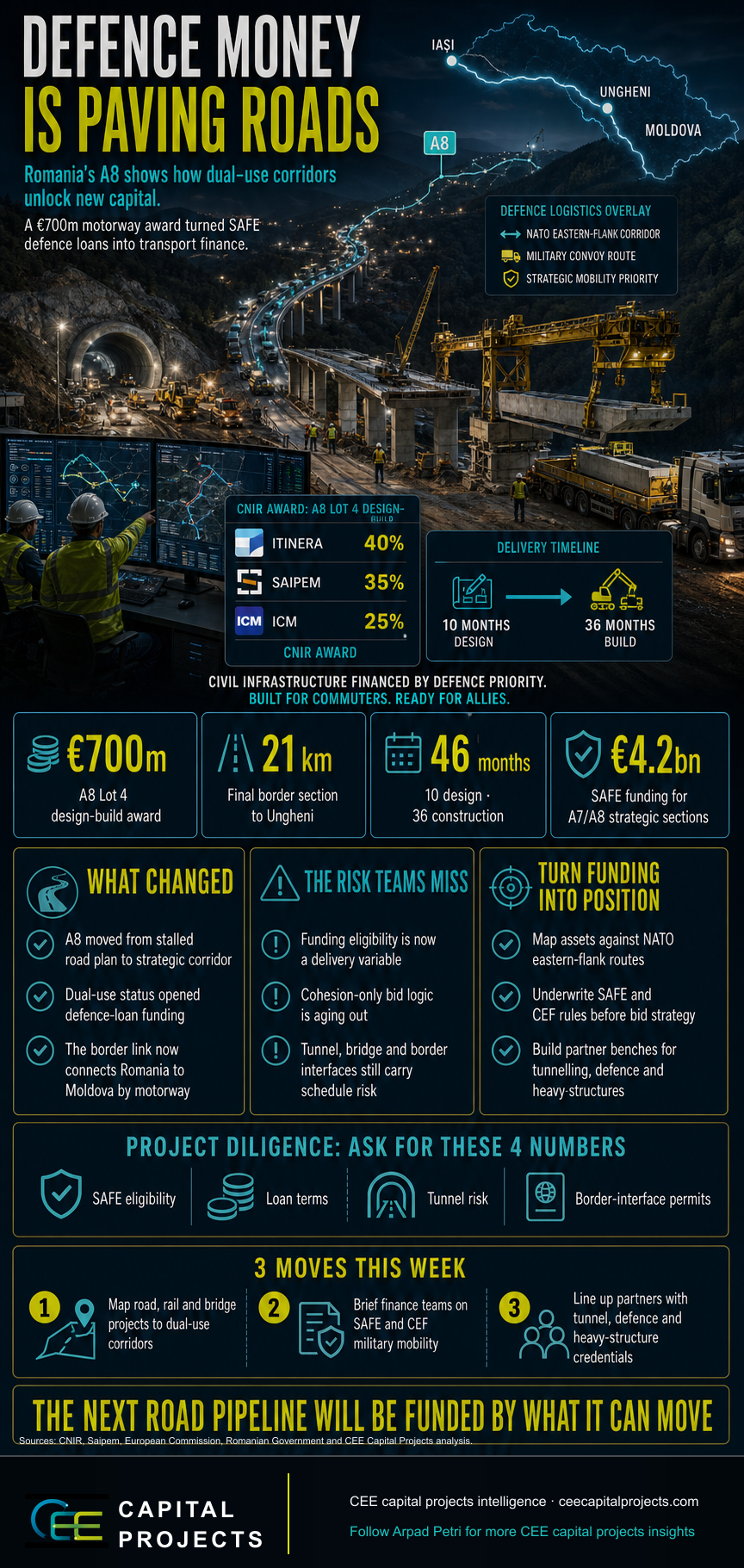
Explore our infograph library — strategic visuals for CEE capital projects leaders.
Project benchmarks, financing structures, tender dynamics and delivery risk — at a glance. Free access for investors, owners, contractors and strategy teams tracking CEE capital projects.
Browse the libraryRelated analyses
- Real Estate & Construction
Atenor Sells 87 Perspectiv Homes to the Luxembourg State: The Presale Threshold Is Now a Public Instrument
Atenor and Tracol Immobilier have sold 87 residential units at Perspectiv in Esch-sur-Alzette to the Luxembourg State, months before main construction starts. The deal shows how a public off-plan buyer now supplies the presale certainty that development banks demand.
Read analysis → - Real Estate & Construction
Futureal Bought Hungary's Largest Outlet Centre at 99.7% Occupancy Instead of Building One. Budapest Developers Just Repriced New Build
Futureal Group has closed on Premier Outlet Budapest, 23,000 sqm of lettable space at 99.7% occupancy, and its chief investment officer says income-producing property can beat new development on risk and return. For Hungarian contractors the risk is the start date, not the award.
Read analysis → - Real Estate & Construction
One United Properties' EUR 10m Floreasca Plot: A EUR 130m Bucharest Tower Buyers No Longer Pre-Fund
One United Properties has paid EUR 10m for a 5,755 sqm plot on Barbu Vacarescu in Bucharest, for a 25-storey tower with a gross development value of about EUR 130m. Law 207/2025 caps reservations at 5 per cent and defers the rest of the buyer money to structure and installations, so land, permit and frame are now funded from the balance sheet.
Read analysis →
Get a second opinion before it gets expensive.
Contractor selection, tender strategy, a project drifting off track — send us the situation and we'll come back with a clear plan.