We Help International Investors and Project Owners Deliver Major CEE Projects Without Expensive Surprises
Independent project intelligence and advisory across energy, transport, real estate and industrial construction.
One United Properties' EUR 10m Floreasca Plot: A EUR 130m Bucharest Tower Buyers No Longer Pre-Fund
One United Properties has paid EUR 10m for a 5,755 sqm plot on Barbu Vacarescu in Bucharest, for a 25-storey tower with a gross development value of about EUR 130m. Law 207/2025 caps reservations at 5 per cent and defers the rest of the buyer money to structure and installations, so land, permit and frame are now funded from the balance sheet.

If this were my development board, the first thing I would refuse to sign is a buyer-funded cash flow. In Romania that assumption stopped being true in December 2025.
On 12 October 2026 One United Properties announced a plot purchase on Barbu Vacarescu in Bucharest. The site is 5,755 sqm and the price was EUR 10m. The preliminary concept is four basement levels, a ground floor and 25 upper floors. Above-ground built area is about 25,900 sqm and the tower would pass 100 metres. Gross development value is put at about EUR 130m. An international architecture competition will choose the design.
The land is the smallest cheque in the file
EUR 10m across 5,755 sqm is about EUR 1,738 per square metre of site. Spread over 25,900 sqm of planned above-ground area it is about EUR 386 per buildable square metre. Against a EUR 130m development value the land is under 8 per cent of the programme. The remaining 92 per cent now arrives on a schedule the developer controls less than it used to.
One has already built heavily in this district. Completed schemes around Floreasca and Barbu Vacarescu carry about EUR 536m of development value. One Floreasca Sunset, One Peninsula and One Floreasca Club are under construction with about EUR 360m more. That makes the new plot an infill addition to a cluster the group already controls.
Law 207/2025 moved the buyer money to the end of the job
Law 207/2025 was published in the Official Gazette on 8 December 2025 and took effect on 11 December 2025. It rewrote off-plan selling. Promises to sell must be notarial and registered in the Land Register within one business day. Before any promise is signed a cadastral procedure must be complete. The building permit has to be noted and individual land books opened for each unit. Reservation fees are capped at 5 per cent of the price. A further 25 per cent falls due once the structure is finished. Another 20 per cent follows when installations are done.
Read that as a funding schedule. The land, the design competition, the permit and the frame are financed by equity and debt alone. Under the old rules a 30 per cent down payment released revenue and paid for concrete at the same time.
The half-year numbers show what the switch cost
One reported first-half turnover of RON 440m, down 47 per cent year on year. Net profit fell 68 per cent to RON 79.2m. On a like-for-like basis, stripping out the law, management put turnover at RON 742.5m and net profit at RON 178.1m. Reservations stood at about EUR 103m on 30 June 2026. Group cash fell to RON 371m.
Unit economics did not deteriorate. First-half residential transactions reached EUR 106.1m across 229 residential and commercial units. The average contracted price was EUR 3,853 per square metre, up 24 per cent year on year. Buyers kept signing. They simply signed reservations instead of promises.
Unit subdivision now sits on the critical path
The step that matters is pre-apartamentare, the subdivision of a finished building into separately registered units. Until that is done a developer can take reservations and nothing more. One finalised its first subdivisions in mid-June 2026. That was six to seven months after the law passed.
Then the registry broke. A cyberattack on ANCPI, the national cadastre and land registration agency, disrupted the system from 14 July 2026. Property transactions were blocked across the country. One resumed subdivision work only in the fortnight before its August results call. A public IT system is now a revenue dependency for every residential developer in Romania.
What this changes for the next land deal
Buying a plot in this regime is a longer and lonelier commitment than it was two years ago. Land, consent, design competition and structure should be underwritten as one unfunded block. Lenders will ask for more sponsor equity ahead of the frame. They will also want proof that the subdivision route is clear. Public sponsors have a sharper interest here than they realise. Permitting speed and registry uptime are now direct inputs into housing supply. Contractors should read the new tranches as a payment-risk change on every residential job they price. The developers that keep buying land through this window share one trait. Their balance sheets can carry a site with no buyer in sight.
Share it with your peers
Help your network stay ahead of CEE capital projects.
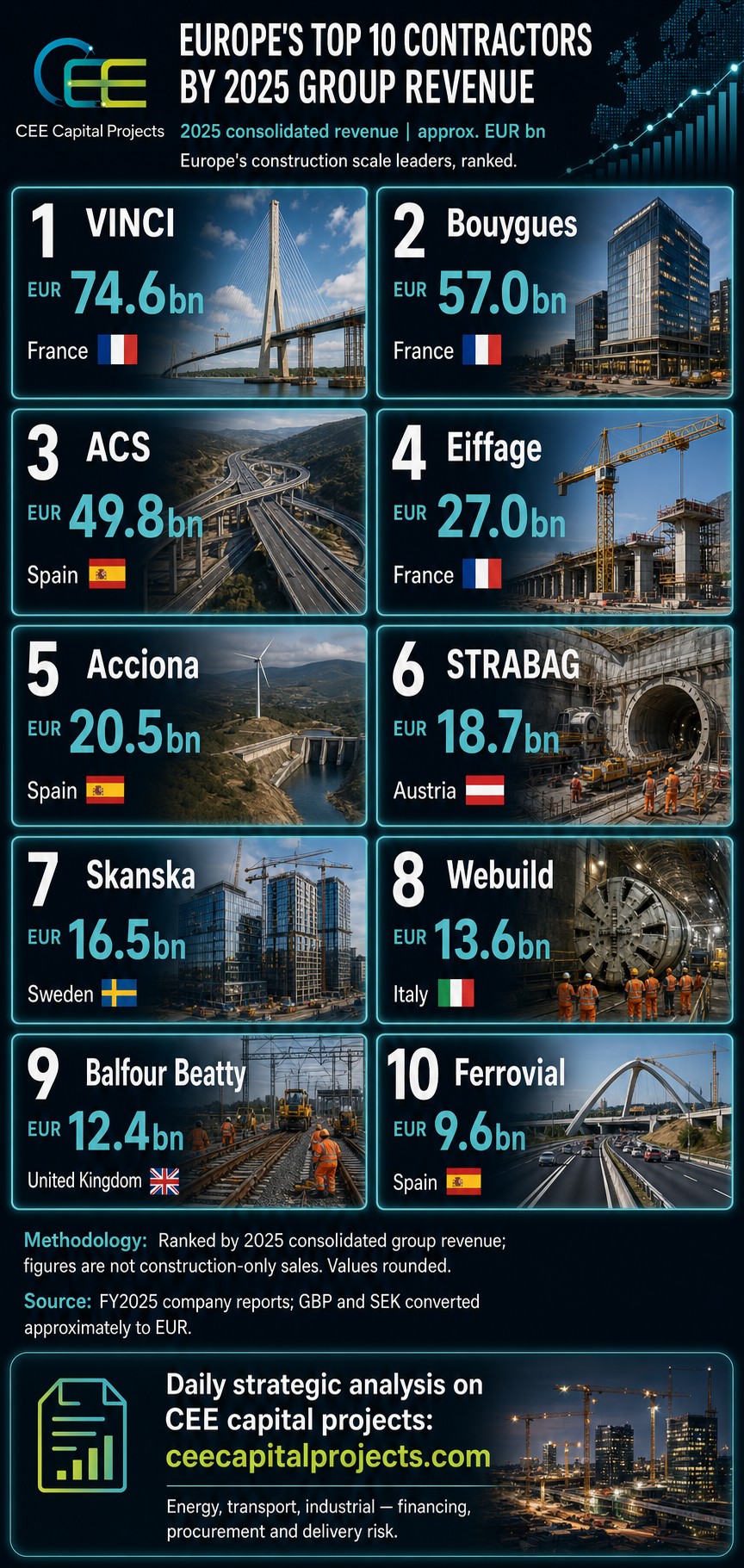
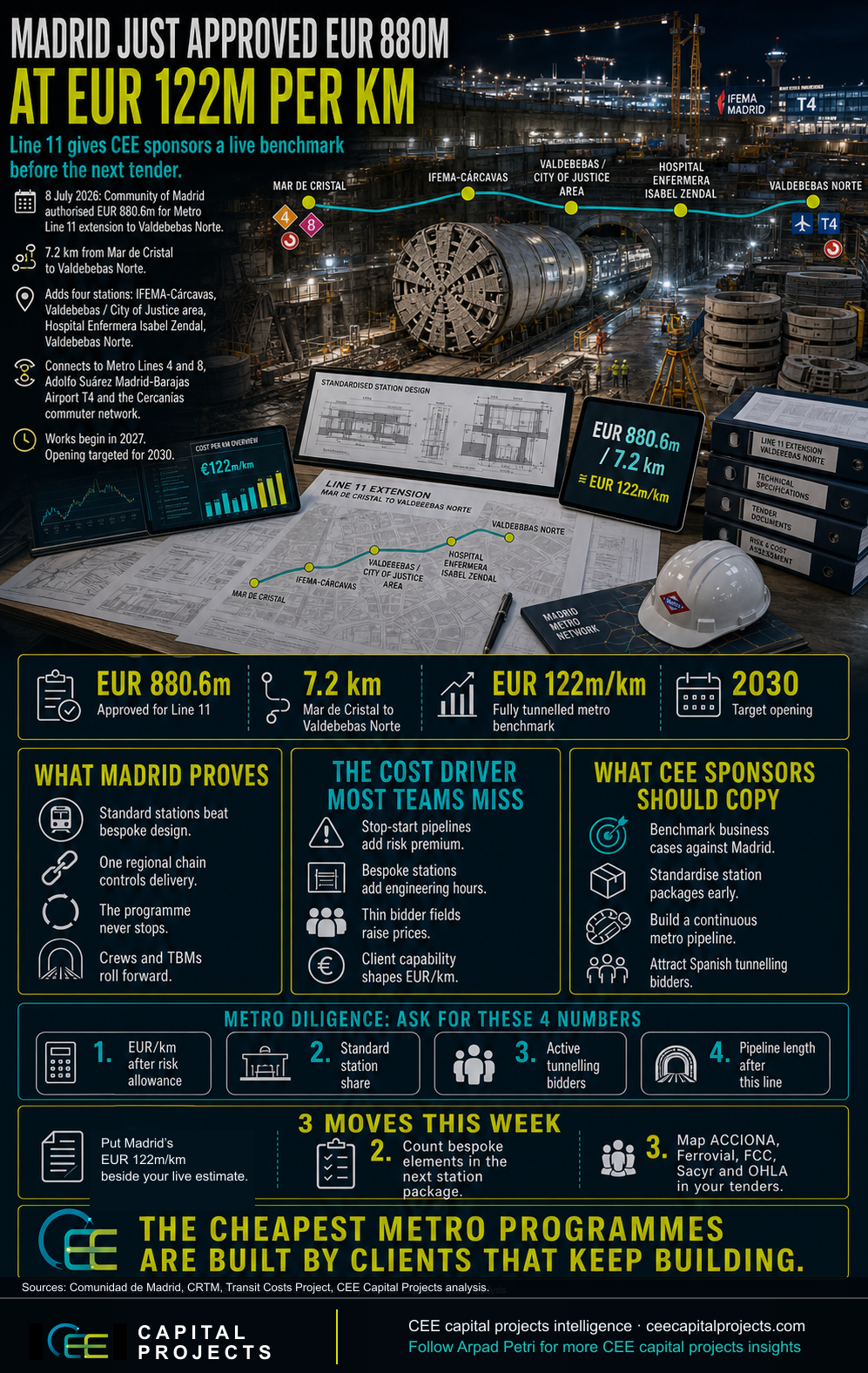

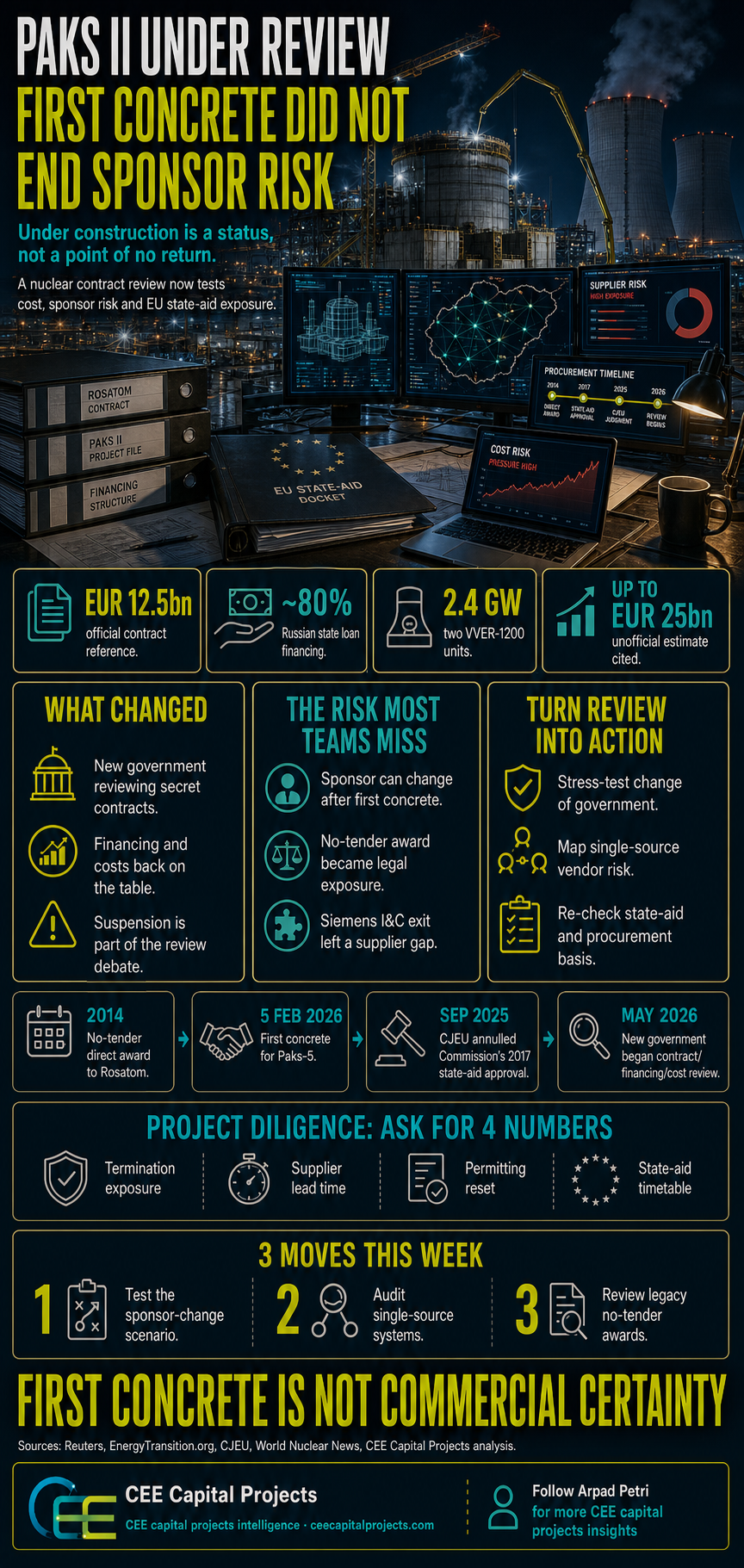
Explore our infograph library — strategic visuals for CEE capital projects leaders.
Project benchmarks, financing structures, tender dynamics and delivery risk — at a glance. Free access for investors, owners, contractors and strategy teams tracking CEE capital projects.
Browse the libraryStrategic Insights
📊 Analytics & Strategic Insight
Romania has turned off-plan housing into a balance-sheet business
The decision most in this industry are avoiding:
👉 Deferred is not free. Management calls the shortfall a delay rather than a loss, and for the profit line that is fair. Carrying land, permits and a frame for an extra year is a financing cost nobody books as a loss.
👉 The land registry is a counterparty. A state agency with no service level now sits inside the pre-sale chain. Valuations and covenant tests rarely price an outage there, and one has already happened.
👉 The rule selects for big balance sheets. Moving funding from buyers to developers favours groups that can hold land without income. Consolidation is the likely market effect, whatever the consumer aim was.
Here's the full context:
→ 2024: The insolvency of Nordis Group left buyers of unbuilt apartments with neither units nor money. It set the political agenda.
→ December 2025: Law 207/2025 is published on 8 December and takes effect on 11 December. It brings notarial promises, land-register entry within one business day, project accounts and capped advances.
→ June 2026: One United Properties finalises its first unit subdivisions, six to seven months after the law passed.
→ July 2026: A cyberattack on ANCPI disrupts the national land registry from 14 July and blocks property transactions across Romania.
→ Most recent: On 12 October 2026 One pays EUR 10m for 5,755 sqm on Barbu Vacarescu. The tower is valued at EUR 130m and first-half turnover fell 47 per cent.
What this means for infrastructure operators, contractors and investors:
✅ Equity goes in earlier. Fund land, consent and structure from the balance sheet and bank debt. Build a cash plan where the first meaningful buyer payment lands after the frame is up.
✅ The permit is a sales document. It has to be noted in the cadastre before promises can be signed. A permit slipping two quarters now slips revenue as well as the programme.
✅ Land becomes a long-dated option. Price a plot on the cost of carry to a signable contract rather than on the cost per buildable metre. The second number flatters every site.
3 moves you can make this week:
1️⃣ Rebuild one live cash flow on the new tranches. Take your largest residential scheme. Model 5 per cent at reservation, 25 per cent at structure and 20 per cent at installations. Find the month the funding gap peaks.
2️⃣ Get the subdivision timetable in writing. Ask counsel and the surveyor how long cadastral subdivision takes in your market today. Put that duration on the programme between practical completion and first revenue.
3️⃣ Stress test a registry outage. Assume the land registry is unavailable for one month during your busiest sales quarter. Agree with your lender now what happens to the covenant if it is.
Related analyses
- Real Estate & Construction
Atenor Sells 87 Perspectiv Homes to the Luxembourg State: The Presale Threshold Is Now a Public Instrument
Atenor and Tracol Immobilier have sold 87 residential units at Perspectiv in Esch-sur-Alzette to the Luxembourg State, months before main construction starts. The deal shows how a public off-plan buyer now supplies the presale certainty that development banks demand.
Read analysis → - Real Estate & Construction
Futureal Bought Hungary's Largest Outlet Centre at 99.7% Occupancy Instead of Building One. Budapest Developers Just Repriced New Build
Futureal Group has closed on Premier Outlet Budapest, 23,000 sqm of lettable space at 99.7% occupancy, and its chief investment officer says income-producing property can beat new development on risk and return. For Hungarian contractors the risk is the start date, not the award.
Read analysis → - Real Estate & Construction
RSJ and Na Jelenach Commit CZK 50bn to 5,500 Prague Rental Homes, Against a Czech Institutional Stock of 4,100
RSJ and Na Jelenach plan about 5,500 rental homes on 22 hectares in southern Prague, an investment above CZK 50bn delivered over roughly ten years. Prague's operational institutional rental stock is 4,100 flats, which moves the hard question from construction to ownership.
Read analysis →
Get a second opinion before it gets expensive.
Contractor selection, tender strategy, a project drifting off track — send us the situation and we'll come back with a clear plan.