We Help International Investors and Project Owners Deliver Major CEE Projects Without Expensive Surprises
Independent project intelligence and advisory across energy, transport, real estate and industrial construction.
PPC Signed Amazon Into a Dead Lignite Plant for Fifteen Years. The Greek Utility Just Bought Itself a Customer
PPC has signed a binding memorandum with Amazon Web Services for a 300 MW data centre in Western Macedonia. The site is a retired lignite station, and the commercial content is a fifteen-year lease with an anchor load.
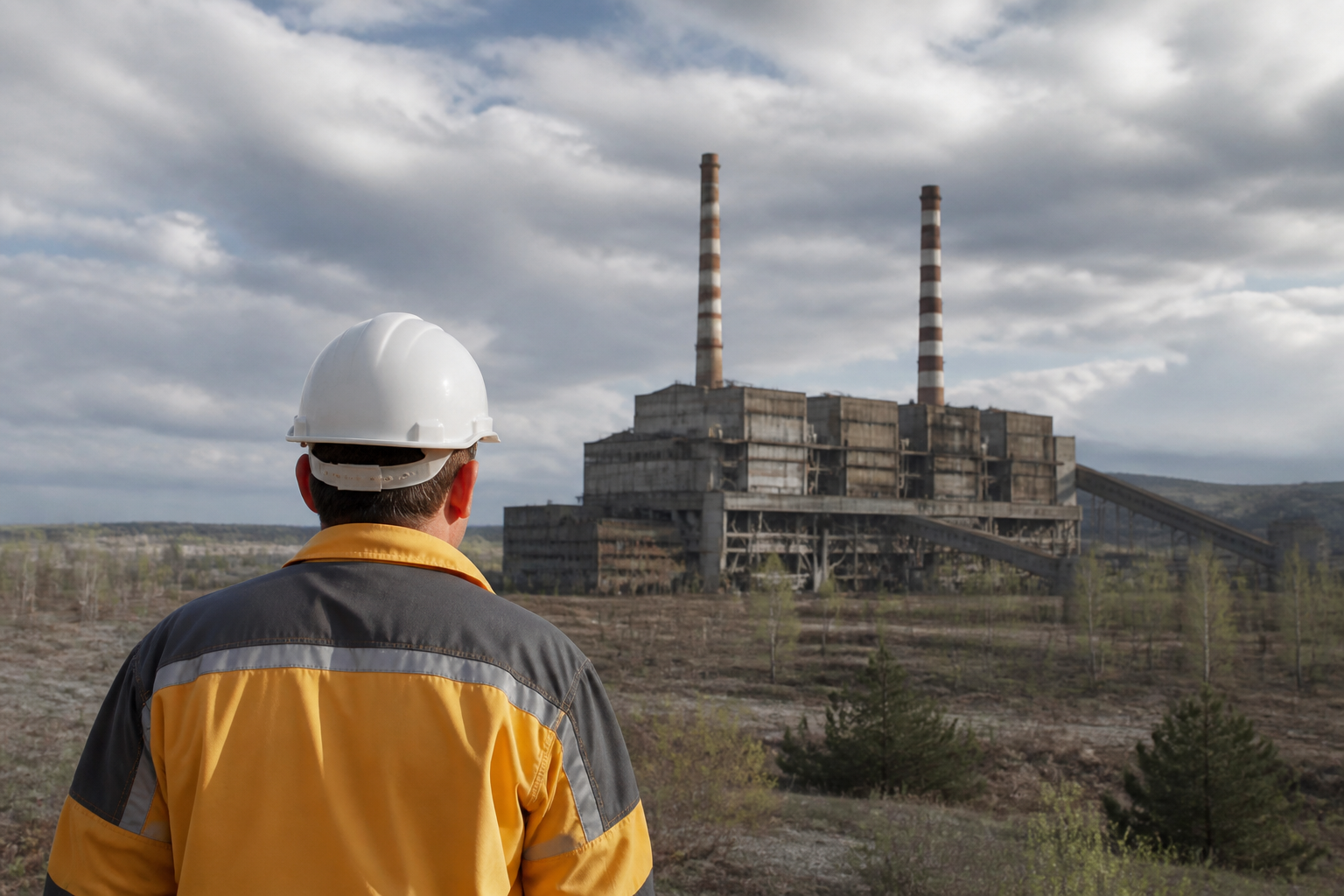
If this were my portfolio, I would stop shopping for the next gigawatt of generation. I would shop for a customer sitting on the same substation. PPC has just done that.
Greece's Public Power Corporation signed a binding memorandum of cooperation with Amazon Web Services on 17 September 2026. The subject is a 300 MW data centre at the retired Agios Dimitrios lignite station near Kozani. AWS would lease the building for fifteen years and run its own computing equipment inside it.
PPC has put the first phase at about EUR 1.2 billion. It targets around EUR 170 million of annual EBITDA by 2030. That target covers the first two phases, which take the site to as much as 1 GW. It excludes electricity sold under the long-term power purchase agreements (ot.gr English Edition, 18 September 2026, sourced to tovima.com).
A generator that decided to become a landlord
The structure is plain. PPC owns the land, the buildings and the supporting energy infrastructure. AWS installs and operates the computing hardware. Balkan Green Energy News put each side's spend at close to EUR 1 billion.
Money reaches PPC through three lines. There is rent on a fifteen-year lease. There is a power purchase agreement running beyond ten years. There is fibre connectivity. Only the rent sits inside that EUR 170 million target.
A fifteen-year lease is a financing instrument in its own right. It converts merchant power risk into contracted income from one large counterparty. That is a different credit story from selling into the Greek day-ahead market.
The scarce thing here is the customer
Look at the megawatts already sitting on the other side of the fence. PPC has completed a solar portfolio of about 2.13 GW peak. The major clusters sit in Western Macedonia. Its joint venture with RWE, Meton Energy, commissioned 930 MW peak inside the former Amynteo open-cast mine. Another 567 MW peak is under construction in Central Macedonia (Balkan Green Energy News, 30 June 2026).
PPC also plans two pumped storage plants of 320 MW and 240 MW in the same region. Battery storage of 300 MW is planned alongside them.
Concentrating that much generation in one area creates a price problem. Midday output arrives when the local price is weakest. Curtailment risk grows with every cluster added. A steady 300 MW load at the same node answers both.
So the data centre is a demand-side asset bought to defend supply-side economics. The computing is the tenant's business. The offtake belongs to PPC.
Behind the meter, and still wired to the grid
PPC intends to supply much of the site locally. The mix combines solar, batteries and pumped hydro with a high-efficiency gas plant. The site keeps its connection to the national grid. PPC is targeting a power usage effectiveness of 1.2.
That last number deserves attention. A ratio of 1.2 means total site consumption runs about a fifth above the computing load. At this scale the overhead alone runs to tens of megawatts. Hot inland summers in Kozani are where that ratio gets tested.
What has to be true before 2028
The memorandum binds the parties, and the definitive agreements are still to come. Expansion beyond the first phase depends on them. PPC holds preliminary permit approval and has applied for a grid connection. The environmental impact assessment is running. Equipment tendering has started, and construction could begin by the end of 2026.
The build is staged as four units of 75 MW. That sequencing matters more than the headline capacity. It lets PPC match capital to committed demand. The alternative is betting a whole campus on one forecast.
Concentration is the other half of the trade. One tenant takes the entire campus. If that tenant leaves at year fifteen, the re-letting market in Kozani is thin.
The site carries politics as well as cable. Agios Dimitrios was one of the last lignite plants running in Greece. Its closure left the country with a single coal station. A data centre employs a fraction of a lignite complex. The local case therefore rests on construction work, the tax base and the supply chain.
What this changes for sponsors, contractors and lenders
PPC has said it could provide up to 2 GW of data centre capacity in Greece. Athens and Crete are under study. It has identified a further 2 GW across markets including Romania and Italy. Data centres account for about 5 per cent of a roughly EUR 24 billion plan for 2026 to 2030.
Every European utility holding a retired coal site now has a template to copy. What is being sold is a connected site with a creditworthy tenant attached. Contractors should expect more shell and core work procured by energy companies. Lenders should expect to underwrite lease covenants beside power purchase agreements. The first question on any scheme of this kind stays the same. Who signs the lease, and for how long?
📊 Analytics & Strategic Insight
The load is the asset, and the lease is the credit
The decision most in this industry are avoiding:
👉 Stop underwriting generation without naming the buyer. Most renewable business cases still rest on a forecast price curve. A named load at the same node replaces the forecast with a signature.
👉 Price the node before the country. National capture prices hide what happens where the cluster actually sits. A fifth gigawatt in one valley earns very differently from the first.
👉 Treat the tenancy as the main security. On a scheme like this the building is ordinary and the covenant is not. Anyone pricing the concrete and ignoring the lease is pricing the wrong asset.
Here's the full context:
→ 2021: PPC entered its largest joint venture, with RWE, to redevelop Greek coal land.
→ 2025: PPC began setting out plans to use its land, generation and network assets to attract data centre operators.
→ June 2026: Meton Energy commissioned 930 MW peak of solar inside the former Amynteo open-cast mine.
→ 2026: PPC completed a solar portfolio of about 2.13 GW peak and raised EUR 4.5 billion in a capital offering.
→ Most recent: On 17 September 2026 PPC signed a binding memorandum with AWS for 300 MW at Agios Dimitrios.
What this means for infrastructure operators, contractors and investors:
✅ Retired plant sites are now income property. Land, a high-voltage connection and cooling water together beat a greenfield plot that has none of them.
✅ Shell and core is becoming a utility procurement. The client on these jobs is an energy company with different approvals, different contract forms and a different pace.
✅ An anchor load changes the cost of capital on generation. A contracted buyer next door lifts debt sizing on the solar, the batteries and the pumped storage behind it.
3 moves you can make this week:
1️⃣ Map your own connected sites. List every plot you control that already holds a grid connection, water and a road. That list is your pipeline.
2️⃣ Ask where the buyer is. On every generation scheme in your book, write down the name of the offtaker. Blank entries are your real risk register.
3️⃣ Read the staging plan before the headline number. Ask how the capacity is broken into units, and what has to happen before each one starts.
Share it with your peers
Help your network stay ahead of CEE capital projects.




Explore our infograph library — strategic visuals for CEE capital projects leaders.
Project benchmarks, financing structures, tender dynamics and delivery risk — at a glance. Free access for investors, owners, contractors and strategy teams tracking CEE capital projects.
Browse the libraryRelated analyses
- Energy & Power
Constellation's $4.3bn Nuclear Uprate Deal With Google: 890 MW, No New Site, and a Finite Pool
Constellation will invest more than $4.3bn to lift 890 MW out of 11 existing reactors under a 20-year Google power purchase agreement, at roughly half the per-kilowatt cost of recent American new build. The point for Europe is that the national uprate pool runs to three to five gigawatts, ČEZ banked its Dukovany headroom by 2009, and the only route left to fresh capacity is a CZK 407bn new build.
Read analysis → - Energy & Power
NEK's EUR 350 Million Yadenitsa Dam Tender Turns Bulgaria's Chaira Storage Fix Into a Civils Job
Bulgaria's NEK has put EUR 350m on the market for the Yadenitsa dam and a six kilometre tunnel at the 864 MW Chaira pumped storage plant, with bids due 4 November 2026 and 60 months to build. The civil works are costed at more than three times the EUR 102m reconstruction of all four of the plant's machines.
Read analysis → - Energy & Power
EIB and BNP Paribas Guarantee EUR 700m of Grid Equipment Bonds: Europe's Network Bottleneck Moves to the Balance Sheet
The EIB and BNP Paribas signed a EUR 700m counter-guarantee portfolio on 29 September 2026, covering advance payment and performance bonds for European manufacturers of electricity grid components. The instrument is small, and it points at the constraint that now sets delivery dates on Europe's grid build: bonding capacity rather than factory floor.
Read analysis →
Building in Central Europe?
Tell us what you're building. We'll tell you what can go wrong — and how to prevent it.