We Help International Investors and Project Owners Deliver Major CEE Projects Without Expensive Surprises
Independent project intelligence and advisory across energy, transport, real estate and industrial construction.
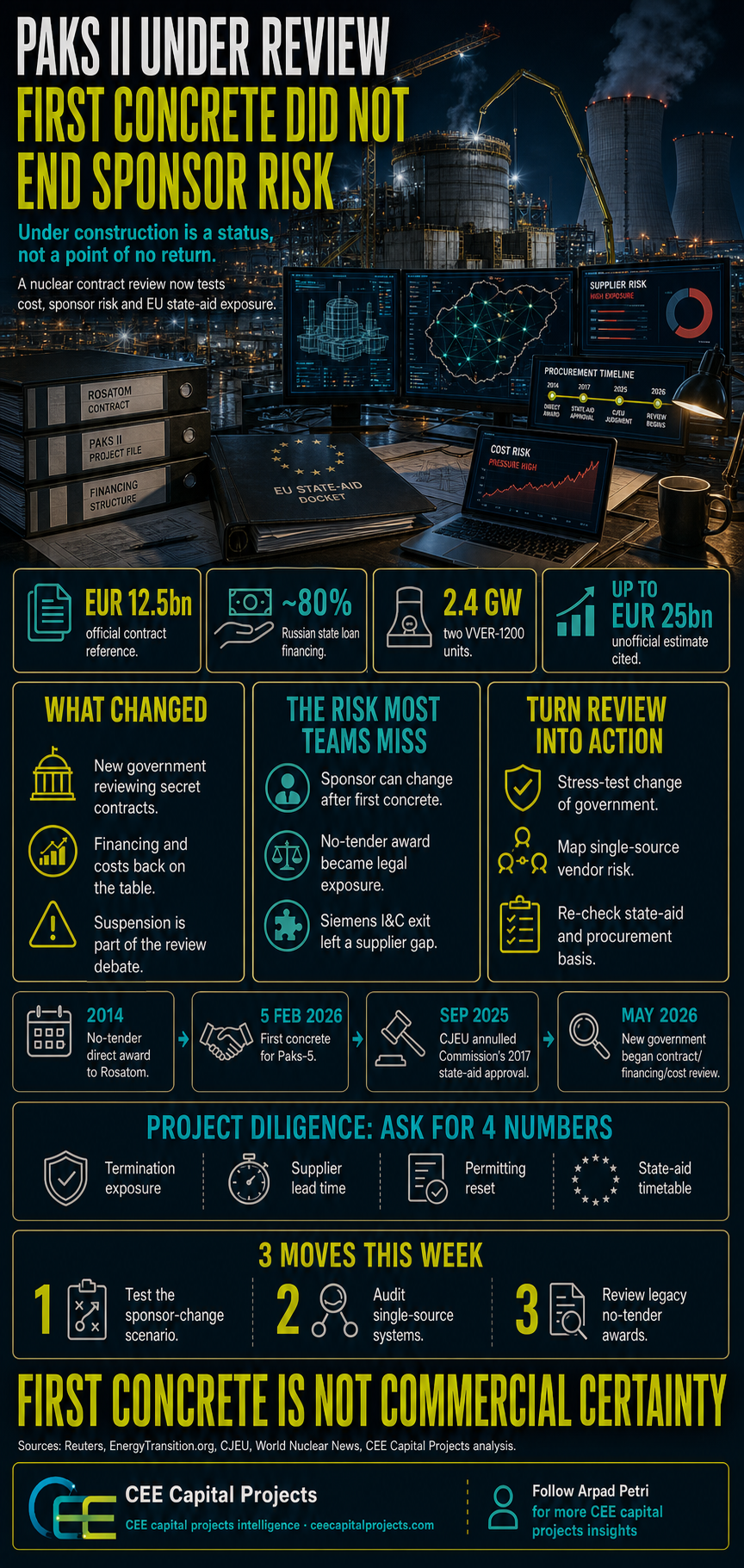
Paks II Under Review: Hungary's New Government Reopens the EUR 12.5bn Rosatom Nuclear Contract
Five months after pouring first concrete, Hungary's Paks II nuclear project faces suspension as the country's new government reopens the EUR 12.5 billion Rosatom contract. Here is what the review of Europe's biggest live nuclear order means for megaproject finance, sponsor risk and EU state-aid compliance.
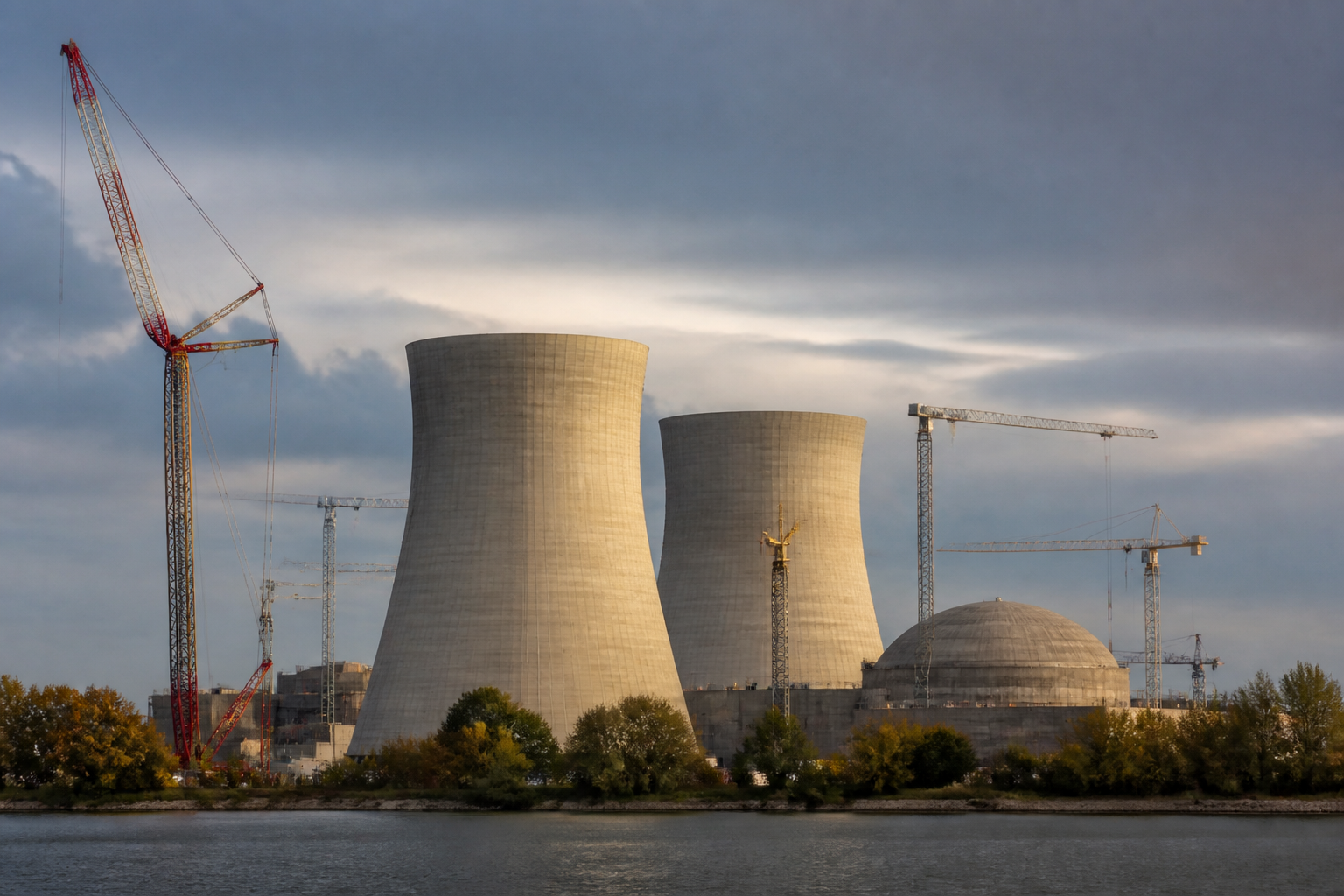
In megaproject finance, 'under construction' is supposed to mean the risky decisions are behind you. Hungary is about to prove otherwise. Five months after crews poured first concrete at Paks II, the country's new government wants construction suspended and every contract reopened. Europe's largest live nuclear order, roughly EUR 12.5 billion on paper and perhaps double that in reality, has become an open question.
The order that outlived the government that signed it
Paks II was a political decision before it was an engineering one. Hungary awarded the two-unit, 2.4 GW VVER-1200 project to Russia's Rosatom in 2014 without a public tender, with about 80% of the EUR 12.5 billion financed by a Russian state loan. The change of government in May 2026 changed the sponsor. Incoming Economy and Energy Minister Istvan Kapitany told parliament the administration would reassess 'the financing and costs of Paks II and the conditions of its implementation,' adding: 'These are secret contracts that we have not yet seen, and we need to examine them.' (Reuters, 11 May 2026.) A government decree laying the groundwork for the review has already been issued, and the analysts closest to it argue construction should stop while it runs.
What the review is actually testing
The headline number is cost. The original EUR 12.5 billion budget is no longer credible, and unofficial estimates now run as high as EUR 25 billion, with several related costs sitting outside the official total, according to an 8 July 2026 analysis by Perger Andras for the Heinrich-Boll-Stiftung's EnergyTransition.org. Against the original schedule the project is roughly a decade late; units meant to be generating by 2026 are now vaguely dated to the 'early-to-mid 2030s.'
Two harder problems sit underneath the cost. First, the instrumentation and control (I&C) system, the plant's nervous system, lost its supplier when Siemens exited, and no EU-compliant replacement is yet visible. Second, in September 2025 the Court of Justice of the EU annulled the European Commission's 2017 approval of state aid for Paks II, in a case brought by Austria, on the grounds that the Commission never properly examined whether the no-tender direct award to a Russian contractor complied with procurement rules. That reopens the state-aid file and threatens another multi-year standstill whatever Budapest decides.
Three exits, none of them clean
The review's own logic points to three scenarios, and each carries a bill. Cancel outright, and Hungary faces compensation claims on ordered work and equipment, softened only partly by sanctions and force-majeure arguments, plus the cost of making a half-built site safe. Swap the contractor, and a new reactor type means fresh licensing, fresh EU scrutiny and years of delay, with much of the completed work unusable. Continue with Rosatom on revised terms, and the track record of delays, quality issues, sanctions exposure and lost suppliers makes that the least feasible option of all. Rosatom, for its part, has said it is ready to answer every question and justify the price (World Nuclear News).
The real lesson is sponsor risk
Paks II is a reminder that on politically sponsored megaprojects, the contract is only as durable as the government behind it. Lenders and contractors priced Russian financing and geopolitical exposure into this deal; almost nobody priced the sponsor itself changing and demanding to read the fine print. For anyone financing or building state-backed infrastructure across Central and Eastern Europe, the takeaways are immediate. Assume contracts signed without competitive tender carry latent legal risk that can surface a decade later. Treat single-source technology suppliers as a first-order project risk, not a footnote. Model a change-of-government scenario the way you already model currency and interest rates. The next few months of disclosure from Budapest will tell contractors and investors how much of the EUR 12.5 billion, and how much political capital, is recoverable. Watch whether construction is formally suspended, whether the contracts are published, and how Brussels handles the reopened state-aid case. Each answer will reprice nuclear and large EU-funded builds well beyond Hungary.
Share it with your peers
Help your network stay ahead of CEE capital projects.
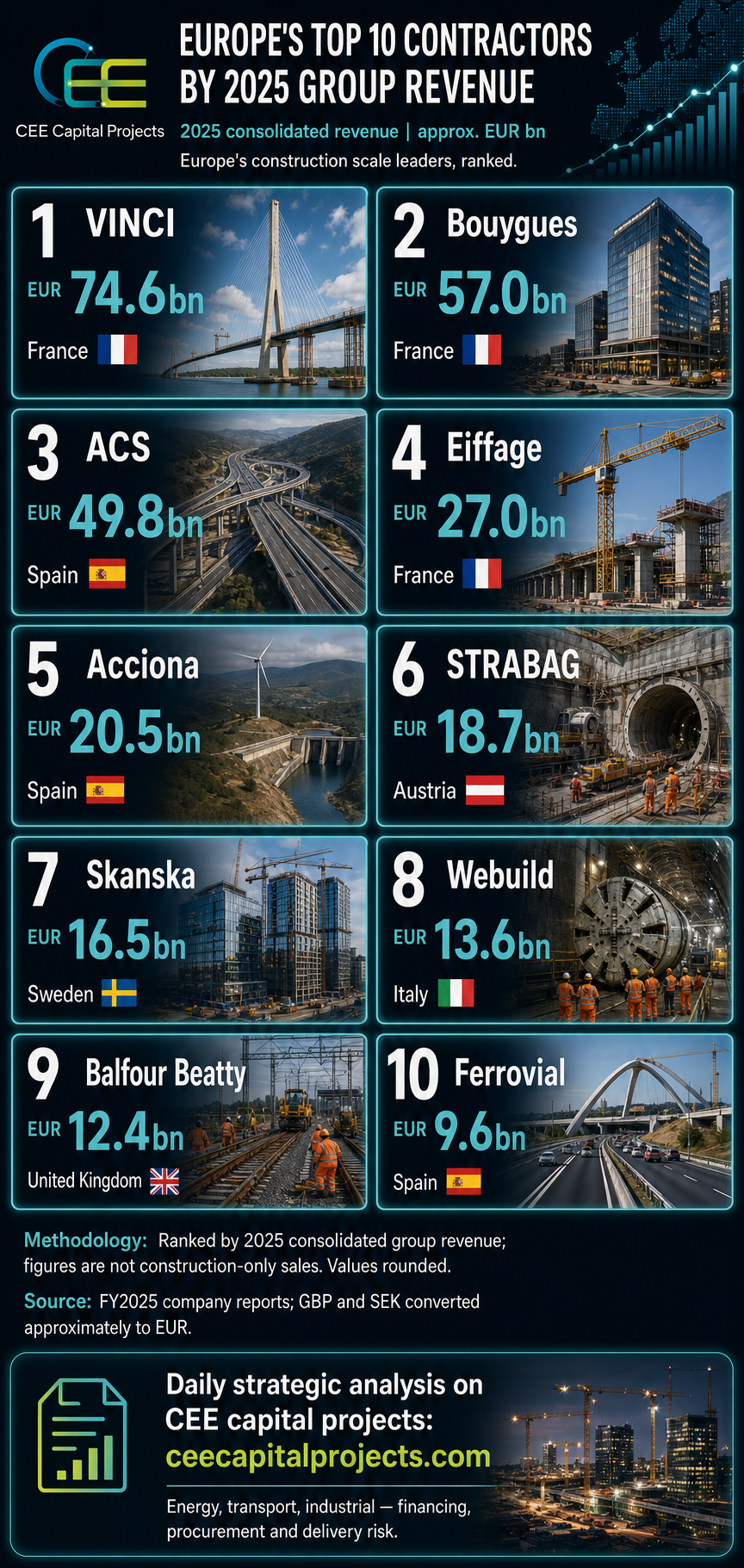
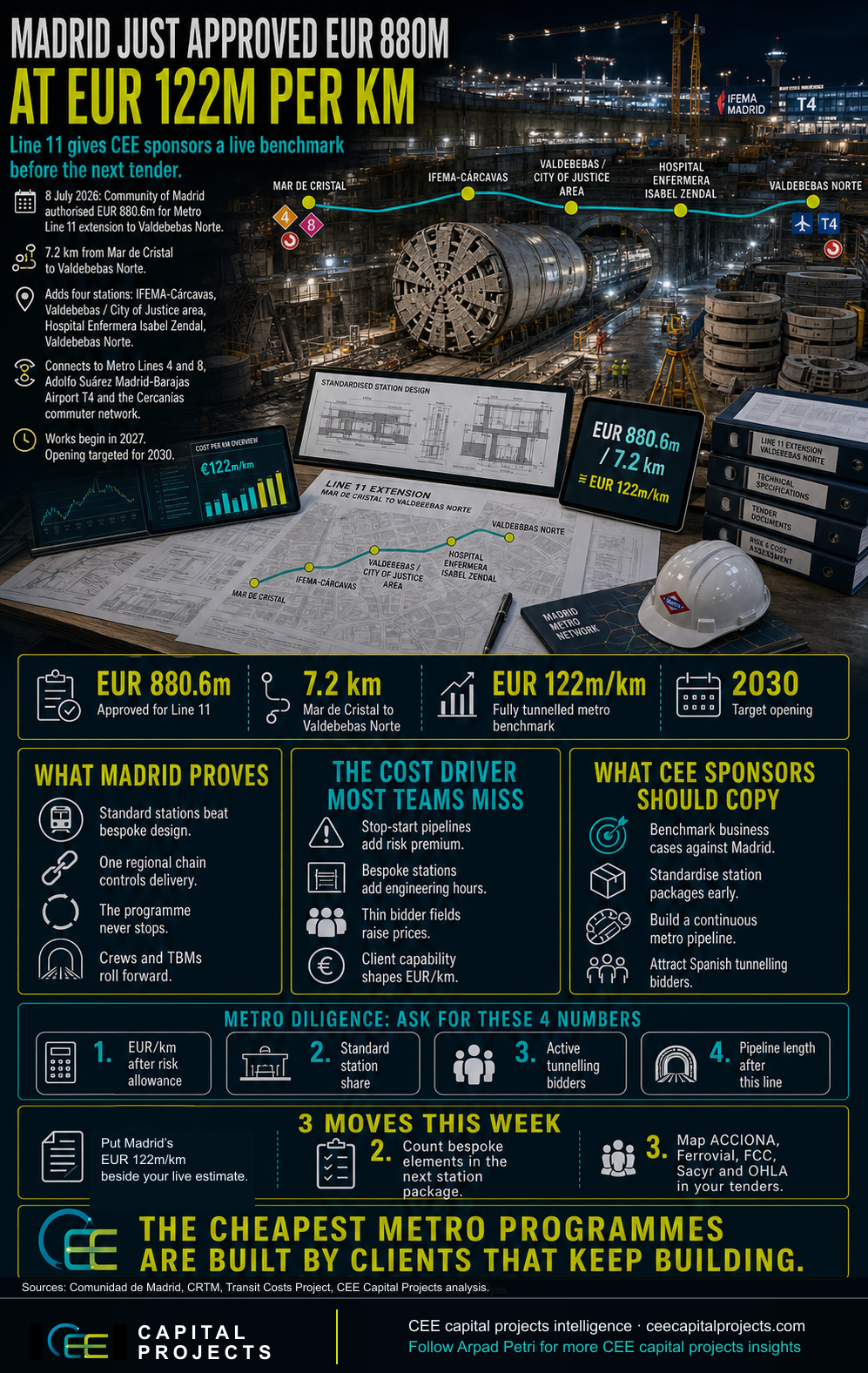
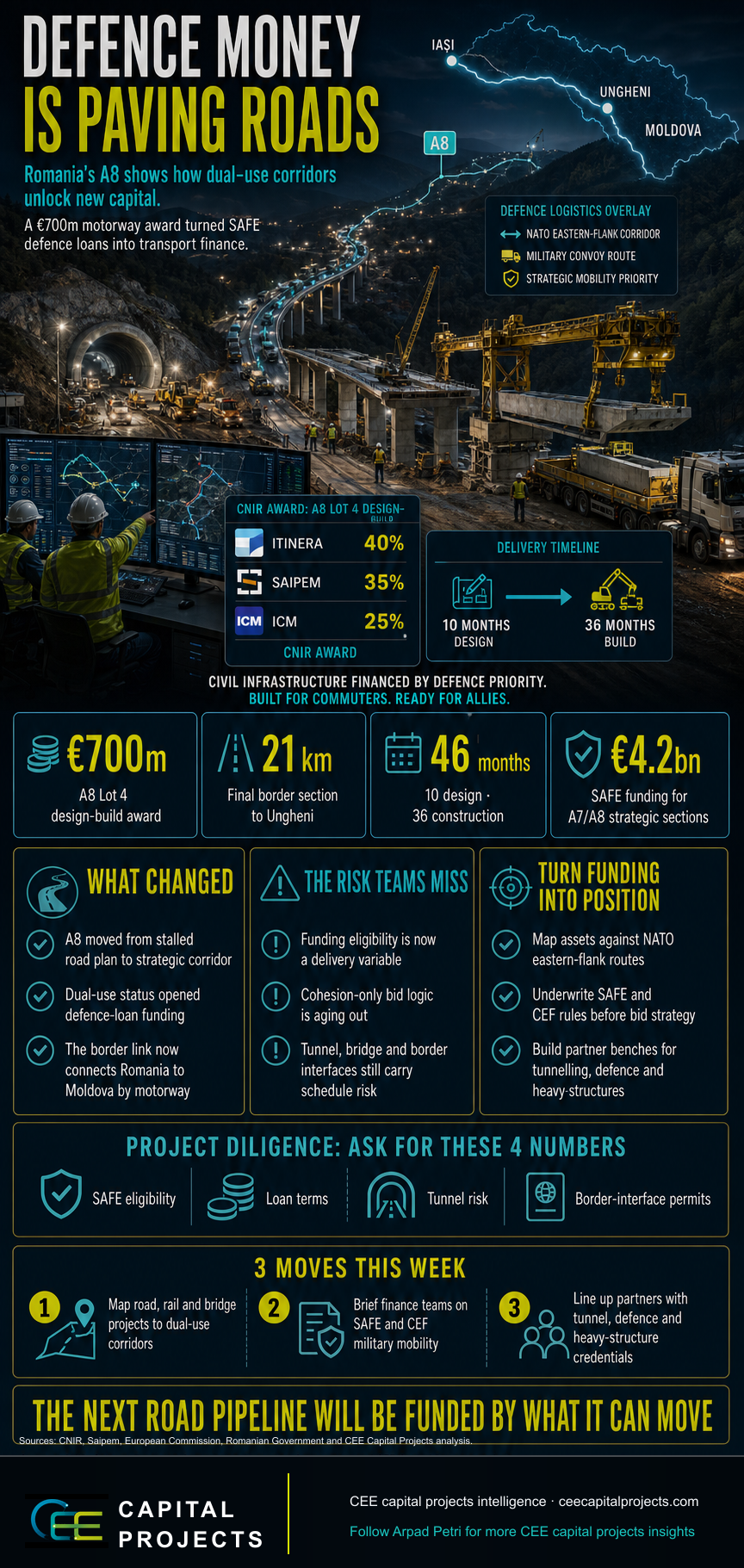
Explore our infograph library — strategic visuals for CEE capital projects leaders.
Project benchmarks, financing structures, tender dynamics and delivery risk — at a glance. Free access for investors, owners, contractors and strategy teams tracking CEE capital projects.
Browse the libraryStrategic Insights
📊 Analytics & Strategic Insight
Political risk just repriced Europe's biggest live nuclear order
The decision most in this industry are avoiding:
👉 'Under construction' is a status, not a point of no return. First concrete is a licensing milestone, not proof a project is safe from reversal. Treating IAEA status as commercial certainty is how sponsors and lenders get surprised.
👉 The biggest risk here was never Russian technology; it was the ballot box. Sanctions and supplier exits were modelled for years. A new government reading the contracts was not, and it is the variable now driving the outcome.
👉 A no-tender award is a deferred liability. The 2014 direct award looked settled until a court reopened it in 2025. Procurement shortcuts do not expire; they wait.
Here's the full context:
→ 2014: Hungary awards the two-unit VVER-1200 project to Rosatom with no public tender, EUR 12.5 billion, about 80% funded by a Russian state loan.
→ September 2025: The Court of Justice of the EU annuls the Commission's 2017 state-aid approval after Austria's challenge, citing the un-examined no-tender award.
→ 5 February 2026: First concrete is poured for unit Paks-5; the site enters IAEA 'under construction' status.
→ May 2026: A change of government brings in a minister who pledges to review the 'secret contracts,' financing and costs.
→ Most recent: An 8 July 2026 Heinrich-Boll-Stiftung analysis puts unofficial cost estimates as high as EUR 25 billion and argues construction should be suspended during the review.
What this means for infrastructure operators, contractors and investors:
✅ Sponsor risk is now a line item. On state-backed megaprojects, model a change of government alongside FX and rates; the political sponsor is part of the credit.
✅ Single-source suppliers are a first-order risk. Losing the Siemens I&C system left a hole no one can yet fill on EU terms. Map every irreplaceable vendor before financial close.
✅ Procurement and state-aid compliance is a long-tail exposure. A direct award can be annulled years later, freezing a live site. Competitive tenders are cheaper insurance than they look.
3 moves you can make this week:
1️⃣ Run a change-of-government stress test. Take your largest state-sponsored exposure and price the cost of a full contract review, suspension and possible cancellation.
2️⃣ Audit your single-source suppliers. List every component with one qualified vendor and a sanctions or exit risk, and line up a compliant alternative now.
3️⃣ Re-check the legal basis of legacy awards. Where a contract was directly awarded without tender, get counsel to assess state-aid and procurement exposure before it surfaces on its own.
Related analyses
- Energy & Power
Constellation's $4.3bn Nuclear Uprate Deal With Google: 890 MW, No New Site, and a Finite Pool
Constellation will invest more than $4.3bn to lift 890 MW out of 11 existing reactors under a 20-year Google power purchase agreement, at roughly half the per-kilowatt cost of recent American new build. The point for Europe is that the national uprate pool runs to three to five gigawatts, ČEZ banked its Dukovany headroom by 2009, and the only route left to fresh capacity is a CZK 407bn new build.
Read analysis → - Energy & Power
NEK's EUR 350 Million Yadenitsa Dam Tender Turns Bulgaria's Chaira Storage Fix Into a Civils Job
Bulgaria's NEK has put EUR 350m on the market for the Yadenitsa dam and a six kilometre tunnel at the 864 MW Chaira pumped storage plant, with bids due 4 November 2026 and 60 months to build. The civil works are costed at more than three times the EUR 102m reconstruction of all four of the plant's machines.
Read analysis → - Energy & Power
EIB and BNP Paribas Guarantee EUR 700m of Grid Equipment Bonds: Europe's Network Bottleneck Moves to the Balance Sheet
The EIB and BNP Paribas signed a EUR 700m counter-guarantee portfolio on 29 September 2026, covering advance payment and performance bonds for European manufacturers of electricity grid components. The instrument is small, and it points at the constraint that now sets delivery dates on Europe's grid build: bonding capacity rather than factory floor.
Read analysis →
Building in Central Europe?
Tell us what you're building. We'll tell you what can go wrong — and how to prevent it.