We Help International Investors and Project Owners Deliver Major CEE Projects Without Expensive Surprises
Independent project intelligence and advisory across energy, transport, real estate and industrial construction.
OMV Petrom Is Delivering the EU's Biggest New Gas Field On Time and On Budget. Romania Took RON 162 Million Out of It in One Quarter
OMV Petrom and Romgaz installed a 16,500-tonne platform and 160 km of subsea pipeline on schedule, keeping Neptun Deep on track for first gas in 2027. Half-year net income still fell 14%, because Romania changed the tax.
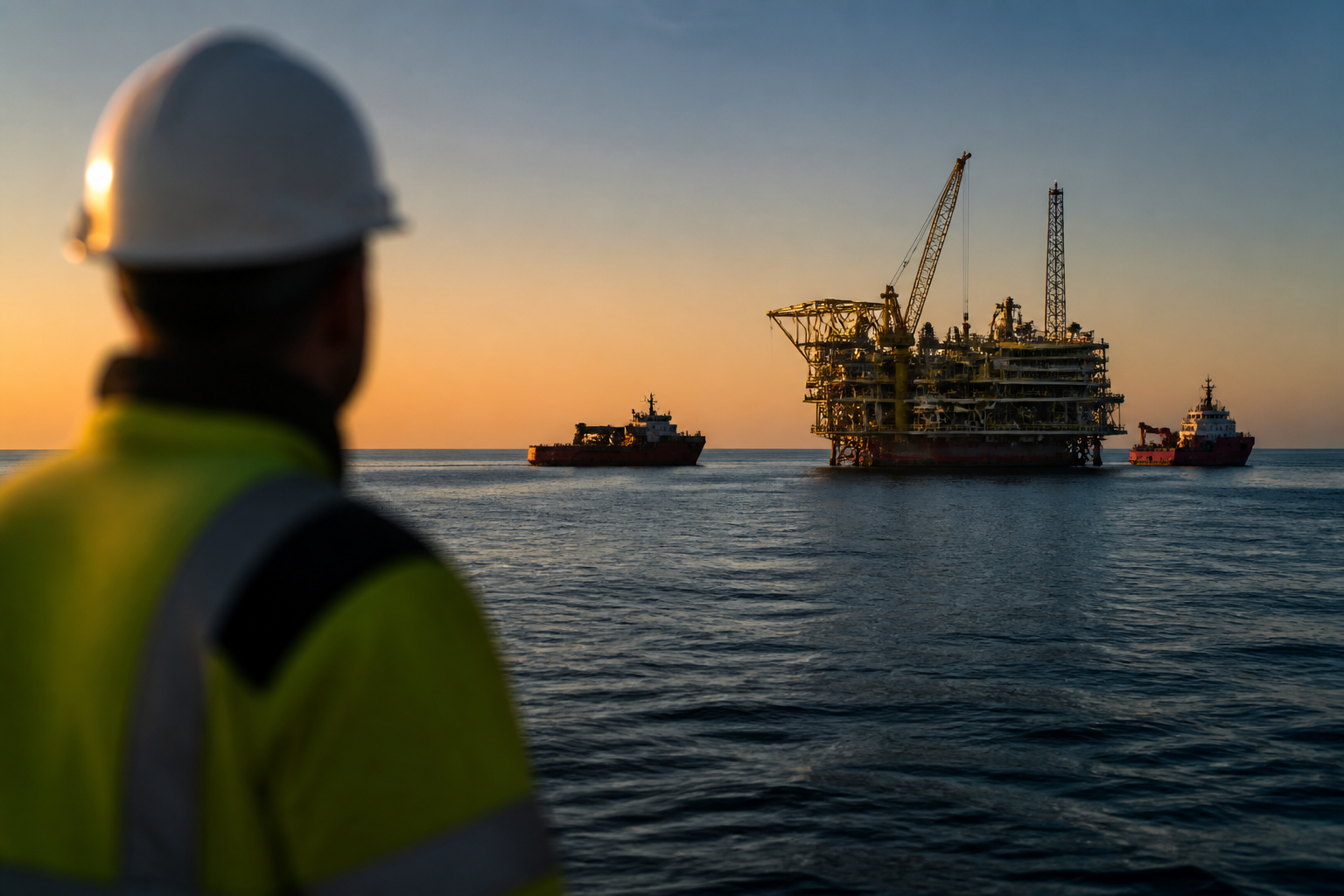
Europe has spent a decade learning that big energy projects run late: Flamanville, Olkiluoto, Hinkley Point C, Northvolt. Then there is Neptun Deep, where OMV Petrom and Romgaz have installed a 16,500-tonne platform, drilled six of ten wells and laid 160 km of subsea pipeline in the Romanian Black Sea, on schedule and on budget for first gas in 2027. The reward, reported on 31 July 2026, was a 14% fall in half-year net income.
A EUR 4 billion project that keeps hitting its dates
OMV Petrom's clean CCS operating result rose 21% to RON 3bn in the first half of 2026, the second quarter up 27% at RON 1.5bn, and capital expenditure climbed 13% to RON 3.7bn. Net income attributable to shareholders went the other way, down 14% to RON 1.8bn, on weaker net interest income and Romania's solidarity tax on exploration and production.
The physical progress is the part worth studying. The shallow-water platform is set, six of ten development wells at the Domino and Pelican South fields are drilled, and the 160 km pipeline to Tuzla is laid. What remains is subsea tie-in, integration and testing. Management held the 2027 date and declined to narrow the window, which is what disciplined offshore operators do while still inside the risk envelope.
At plateau the field should deliver around 8 billion cubic metres a year from roughly 100 bcm of recoverable resource. That makes Romania the EU's largest gas producer and, for the first time, a net gas exporter.
The reason it is on time is that there is almost no site
The Neptun Alpha platform weighs 16,500 tonnes and stands over 225 metres, in about 120 metres of water. Its jacket was fabricated by Saipem at Arbatax in Sardinia, its topsides at Karimun in Indonesia. Both were lifted into position by the Saipem 7000, the world's third-largest semi-submersible crane vessel, over eight driven piles each more than two metres across. The topsides are fully automated and normally unmanned, run remotely, with a purpose-built support vessel for maintenance campaigns.
Read that list as a construction manager, not a geologist. Almost none of the value was created where the asset now sits. Fabrication happened in two controlled yards on two continents, where labour is resident, weather is irrelevant and quality is inspected under a roof. Installation was a fleet operation measured in weeks. Romgaz deputy CEO Aristotel Jude called it an offshore mobilisation of unprecedented magnitude for Romania and the EU.
Onshore infrastructure rarely gets that option, and it shows in the schedule statistics. The direction of travel across European construction, from modular hospital cores to small modular reactors, is an attempt to import this model. Neptun Deep is proof it holds at megaproject scale.
The profit fell anyway
Romania's solidarity contribution cost OMV Petrom RON 162m in the second quarter alone, booked as a special item in exploration and production. From August a further three-month package applies, extendable: fuel margin caps at inflation-adjusted 2025 levels, a progressive solidarity tax indexed to whichever of Brent or diesel gives the higher rate, and a dynamic excise mechanism. The refining margin cap was dropped.
Management told analysts it could not yet quantify the third-quarter impact because the detail was too recent. That deserves attention. The operator of the EU's largest new gas development cannot forecast its own tax bill one quarter ahead, while running a project whose completion date it forecasts to the year.
When the state is sponsor, shareholder and tax authority
The Romanian state holds 20.7% of OMV Petrom directly, and state-controlled Romgaz owns half of Neptun Deep. OMV AG holds 51.2% of Petrom. Every leu of tax the state collects, it partly pays itself.
In December 2025 the government and OMV Petrom signed a 15-year cooperation framework precisely to end this ambiguity. Royalties on privatisation-era licences rose 40%, Romania stopped paying for abandoning unused wells and for past-dispute penalties, and OMV Petrom waived its Neptun Deep arbitration and accepted the current Black Sea offshore gas law. In exchange the exploration period was extended by two years and onshore licences by 15. Prime Minister Ilie Bolojan called it a rebalancing 20 years on.
Eight months later an emergency measure from a different law took RON 162m in a single quarter. Both are legitimate. Only one was sold as durable. That gap, between a negotiated settlement and an emergency levy, is what this results set really tells anyone underwriting a long-life CEE energy asset.
What to watch next
For contractors and the offshore supply chain, Neptun Deep proves the CEE offshore pipeline is deliverable: Romgaz has flagged the deepwater Anaconda-1 exploration well once the development wells are done. For investors the implication is sharper. Construction risk on this asset class is now close to manageable. Fiscal duration is not, and most discount rates still do not reflect that.
For governments, the uncomfortable finding is that you can tax a half-built project hard and still get your gas on time. The bill arrives at the next final investment decision, when the same sponsor prices in a regime it has watched change twice. Romania becomes a net exporter in 2027 into a contested Southeast European transit market, a point underlined on 8 August 2026 when a drone exploded near the Trans-Balkan pipeline at the Bulgarian-Romanian border. The molecules will arrive on schedule. The terms on which they are sold are still being written.
Share it with your peers
Help your network stay ahead of CEE capital projects.
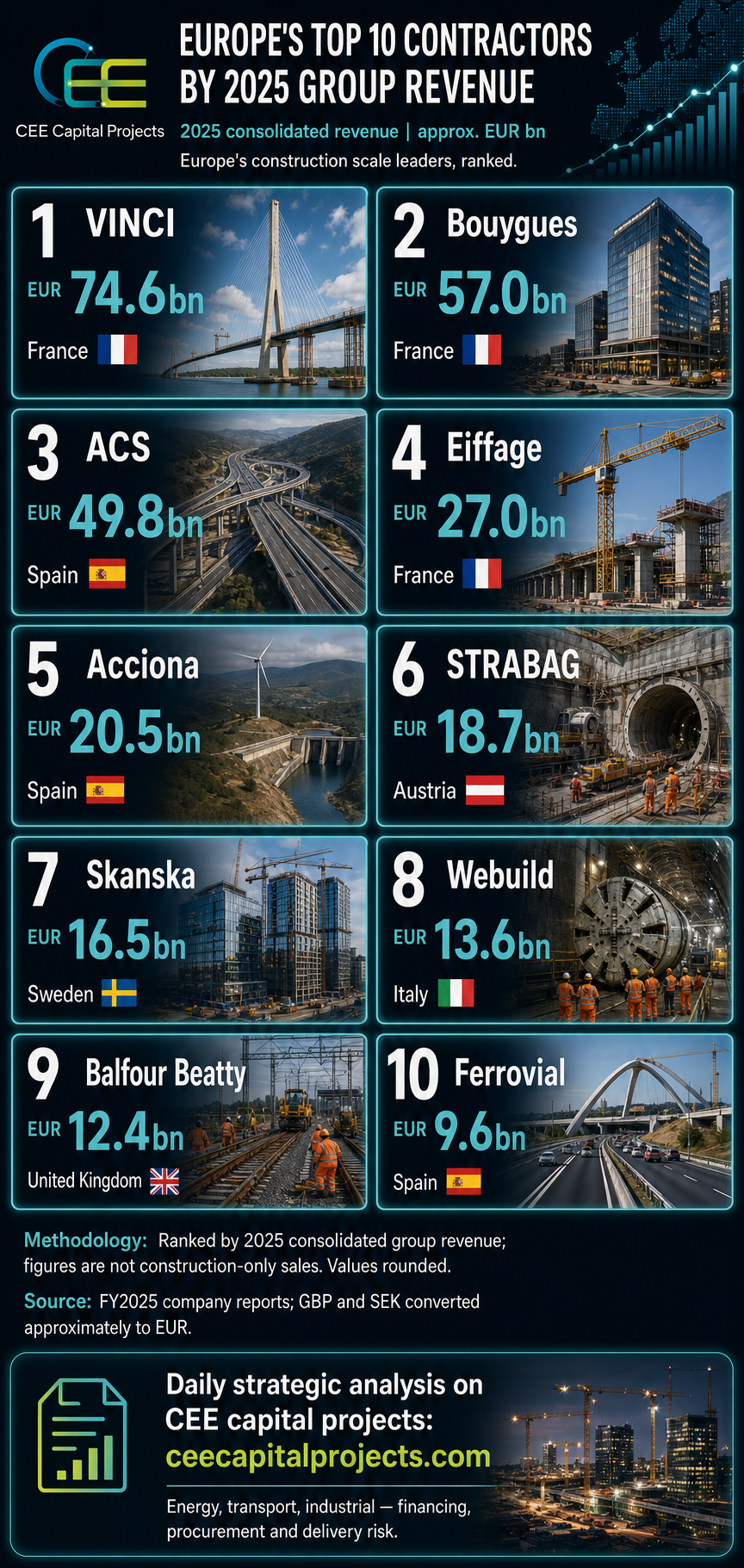
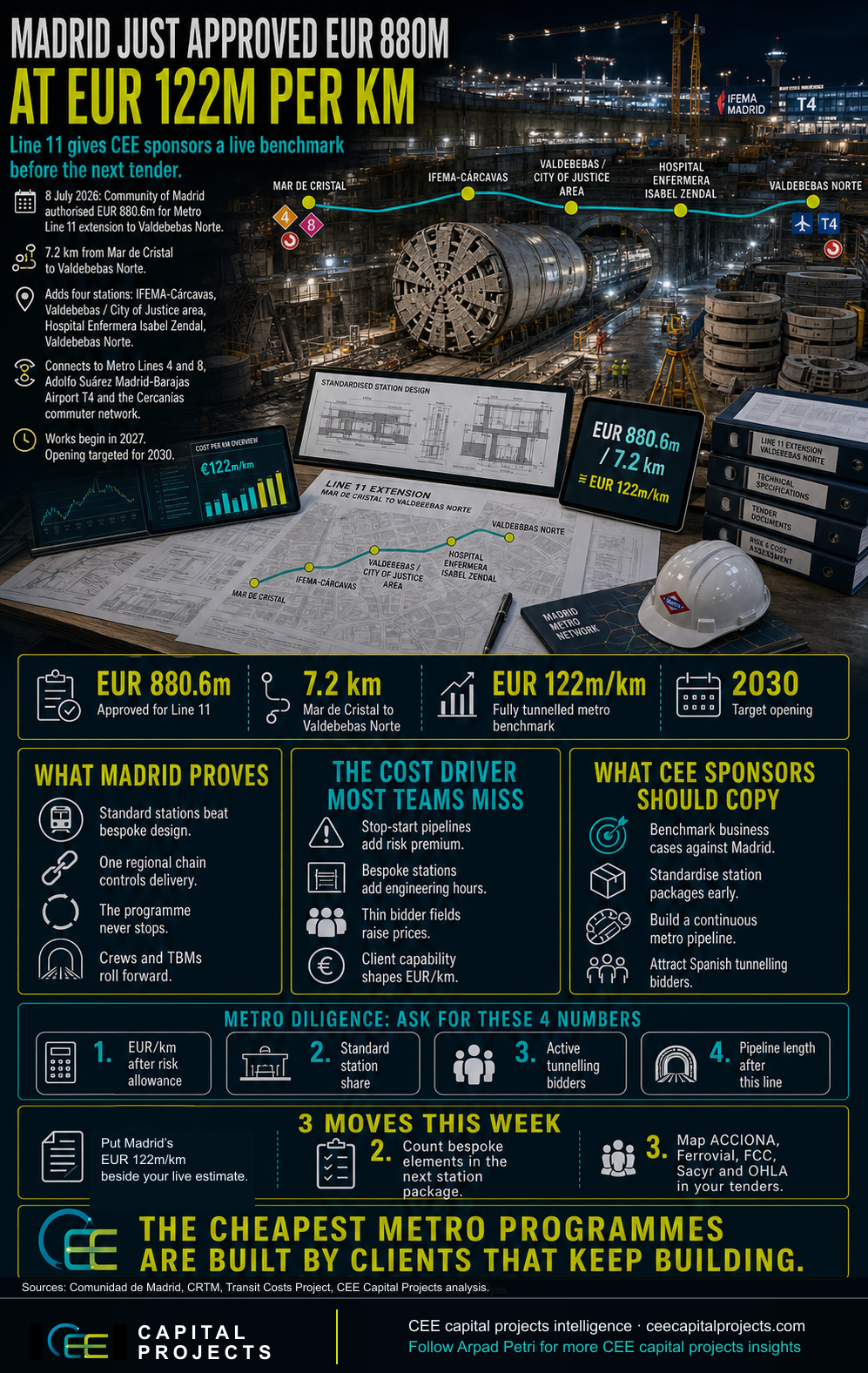
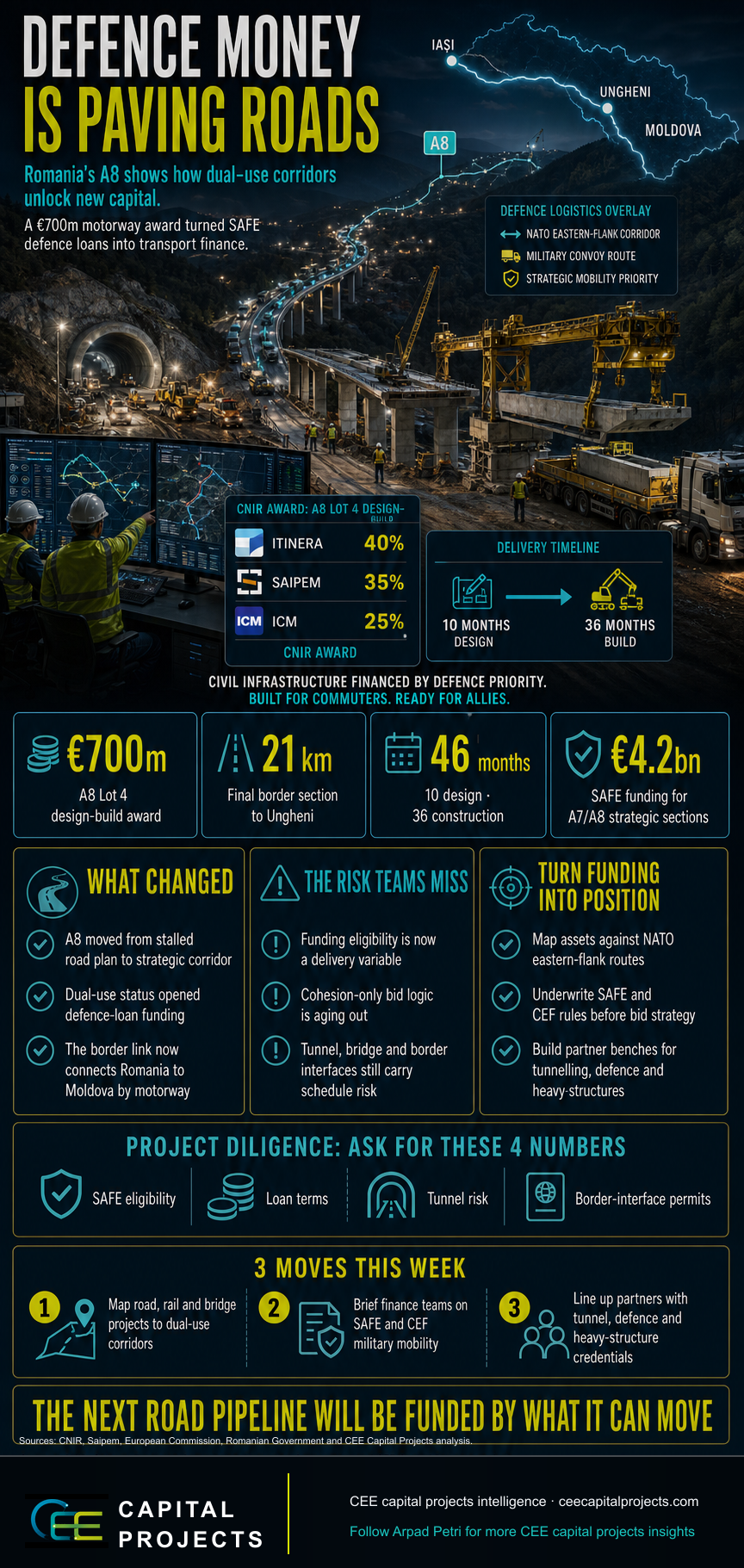
Explore our infograph library — strategic visuals for CEE capital projects leaders.
Project benchmarks, financing structures, tender dynamics and delivery risk — at a glance. Free access for investors, owners, contractors and strategy teams tracking CEE capital projects.
Browse the libraryStrategic Insights
📊 Analytics & Strategic Insight
The build was the easy part. The tax code is the hard part.
The decision most in this industry are avoiding:
👉 Stop treating the build as the main risk. On this project the steel arrived on time. The profit still fell. Most boards spend nearly all their risk effort on the schedule and almost none on tax.
👉 A signed deal with a government is not the same as a stable one. Romania and OMV Petrom signed a 15-year framework in December 2025. Eight months later a new tax arrived from a different law. Both are legal. Only one was sold as lasting.
👉 Sites are what make projects late. This platform was built in two shipyards on two continents and lifted into place by one vessel. There was almost no site to go wrong. Onshore work does not get that luxury, and closing that gap is worth more than any new planning tool.
Here's the full context:
→ 2019 to 2023: Romania sat on large Black Sea gas fields but kept changing the rules for getting the gas out. The offshore law was rewritten more than once, and nobody committed.
→ 2023: OMV Petrom and Romgaz gave the final go-ahead to Neptun Deep. Cost about EUR 4 billion, split 50/50, aiming for roughly 8 billion cubic metres of gas a year.
→ December 2025: The government and OMV Petrom signed a 15-year framework. Royalties on old licences went up 40%. The company dropped its Neptun Deep arbitration and accepted the current offshore law. Romania extended the licences.
→ 20 July 2026: The 16,500-tonne Neptun Alpha platform was installed in 120 metres of water. Six of ten wells are drilled. The 160 km pipeline to shore is laid. First gas stays set for 2027.
→ Most recent: On 31 July 2026 OMV Petrom reported half-year net income of RON 1.8 billion, down 14%. A solidarity tax took RON 162 million in the second quarter alone. New crisis rules run from August to October, and the company said it cannot yet work out what they will cost.
What this means for infrastructure operators, contractors and investors:
✅ Price the tax, not just the timetable. In this region the thing most likely to move your return is a law, not a delay. Build a downside case where the tax changes twice while you are still building.
✅ Yard-built beats site-built. Work done in a controlled factory or shipyard runs closer to plan than work done in a field. Every hour you move off site is an hour of weather, labour and permit risk you delete.
✅ Watch what happens at the next go-ahead. A government can tax a half-built project hard and still get its gas on time. The cost shows up later, when the next project needs a decision and the sponsor remembers.
3 moves you can make this week:
1️⃣ Split your risk register in two. Put cost and schedule on one side, and law, tax and licence terms on the other. Most registers barely have the second column.
2️⃣ Ask your team where the work actually happens. List your five biggest work packages and mark each one yard or site. If most say site, you have found your schedule risk.
3️⃣ Read the fine print on your host-country deal. Check whether it protects you from new taxes, or only from the ones that existed the day you signed. There is usually a difference.
Related analyses
- Energy & Power
Constellation's $4.3bn Nuclear Uprate Deal With Google: 890 MW, No New Site, and a Finite Pool
Constellation will invest more than $4.3bn to lift 890 MW out of 11 existing reactors under a 20-year Google power purchase agreement, at roughly half the per-kilowatt cost of recent American new build. The point for Europe is that the national uprate pool runs to three to five gigawatts, ČEZ banked its Dukovany headroom by 2009, and the only route left to fresh capacity is a CZK 407bn new build.
Read analysis → - Energy & Power
NEK's EUR 350 Million Yadenitsa Dam Tender Turns Bulgaria's Chaira Storage Fix Into a Civils Job
Bulgaria's NEK has put EUR 350m on the market for the Yadenitsa dam and a six kilometre tunnel at the 864 MW Chaira pumped storage plant, with bids due 4 November 2026 and 60 months to build. The civil works are costed at more than three times the EUR 102m reconstruction of all four of the plant's machines.
Read analysis → - Energy & Power
EIB and BNP Paribas Guarantee EUR 700m of Grid Equipment Bonds: Europe's Network Bottleneck Moves to the Balance Sheet
The EIB and BNP Paribas signed a EUR 700m counter-guarantee portfolio on 29 September 2026, covering advance payment and performance bonds for European manufacturers of electricity grid components. The instrument is small, and it points at the constraint that now sets delivery dates on Europe's grid build: bonding capacity rather than factory floor.
Read analysis →
Get a second opinion before it gets expensive.
Contractor selection, tender strategy, a project drifting off track — send us the situation and we'll come back with a clear plan.