We Help International Investors and Project Owners Deliver Major CEE Projects Without Expensive Surprises
Independent project intelligence and advisory across energy, transport, real estate and industrial construction.
Netherlands Building Permit Surge Meets the Grid Queue: 234,000 Permitted Homes and No Connection Date
Statistics Netherlands data reported on 23 August 2026 shows permits for 8,500 homes in April and 10,800 in May, against a monthly average of 7,100 since January 2022. The rush came ahead of a 1 July rule change that lets Dutch grid operators put unprioritised housing schemes on a connection waiting list.
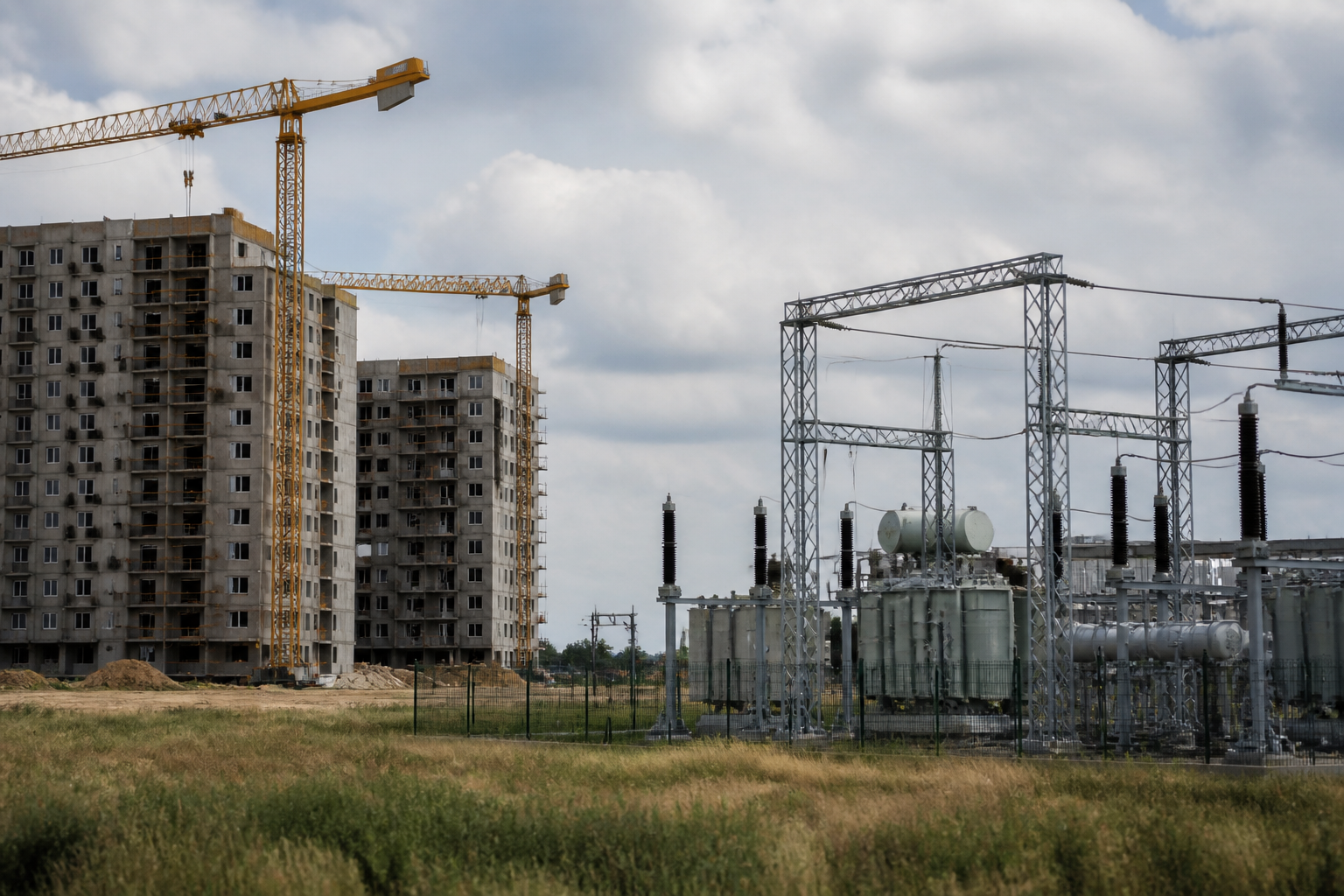
I would ask any Dutch housing sponsor the same question first. What date does your grid connection arrive? The building permit answers a different question now.
On 23 August 2026 the news agency ANP reported preliminary second-quarter data from Statistics Netherlands. Permits were issued for 8,500 homes in April and 10,800 in May. The monthly average since January 2022 is 7,100. Planned residential construction value reached EUR 6.3 billion in the quarter. A year earlier the same figure was EUR 3.2 billion.
The 1 July switch that pulled permits forward
Dutch grid operators used to hold back capacity for small connections up to 3x80 amps. Households and most housing schemes sat inside that reserve. They were shielded from the waiting lists that had already stopped large industrial users.
That protection narrowed on 1 July 2026. The reserved pool is now open only to users with priority under the framework set by the Authority for Consumers and Markets. Housing and schools sit in the third priority category, basic needs. Ahead of them come congestion mitigators, then safety and security. The Netherlands Enterprise Agency puts full operation of the new method at 1 January 2027.
Municipalities appear to have read the calendar. Statistics Netherlands has held back its June figures because of the rule change. The April and May spike is already visible in the data.
A permit is no longer a start date
At the end of May 2026, 234,000 newly built homes held a permit and remained uncompleted. That count already nets off cancelled schemes. Permits have run ahead of completions in the Netherlands for years. The gap now has a second cause sitting behind the first.
The first cause is nitrogen. Dutch permitting requires proof that a scheme adds no nitrogen deposition near Natura 2000 sites. DutchNews reported in March 2025 that 244,000 of the 631,000 homes planned to 2030 were exposed to that test. The second cause is the connection queue, and the queue is measurable.
The queue, in gigawatts
On 4 February 2026 the Minister for Climate Policy and Green Growth sent parliament the Aansluitoffensief letter. Regional grid operators were holding 14,044 offtake requests worth more than 9 GW. TenneT was holding 212 requests worth 38 GW. Set that against demand today. TenneT puts current peak offtake across the whole Dutch grid near 19 GW, rising to about 27 GW by 2030.
The letter sets out eight measures. Their combined effect is put at 5 to 10 GW freed by 2030, and 10 to 20 GW by 2035. Grid operators are asked to procure an extra EUR 500 million of flexibility a year in 2026 and 2027. New high-voltage infrastructure carries lead times of eight to twelve years. The report attached to the letter prices the social cost of congestion at EUR 10 billion to EUR 40 billion.
Where the Dutch money is actually going
Heijmans reported first-half 2026 results on 24 July. Underlying EBIT rose 27 per cent to EUR 104 million on revenue of EUR 1.5 billion. The order book grew 36 per cent to EUR 4.1 billion. Management guided to around EUR 3.1 billion of revenue for the year at a 7.3 per cent underlying margin.
The mix matters more than the margin here. Growth came from the Connecting segment, which builds and renews high-voltage grid. The Living segment stayed profitable, and management expects the Dutch housing market to remain subdued through 2026 and 2027. A Dutch contractor is currently paid better for building the cable than for building the house.
What sponsors and lenders should do with this
The permit surge creates a stock of options. It does not create a pipeline of starts. For a lender that distinction sits directly on the drawdown schedule, because interest accrues while a scheme waits for capacity. For a developer, land carry now runs against a queue position. The construction programme no longer answers the question. For a public sponsor, a permit issued in May 2026 is a weaker delivery signal than one issued in May 2024.
The lesson travels well beyond the Netherlands. Ireland and the United Kingdom are both rationing connections in their densest demand pockets. Any market that puts housing behind industry in a connection queue will see the same shape. Permit series look healthy, unbuilt stock widens, and contractors quietly reprice toward grid work. Dutch practice is the useful leading indicator, because the Dutch rules are written down and dated. Either the eight measures bite, or the 234,000 keeps growing.
Share it with your peers
Help your network stay ahead of CEE capital projects.
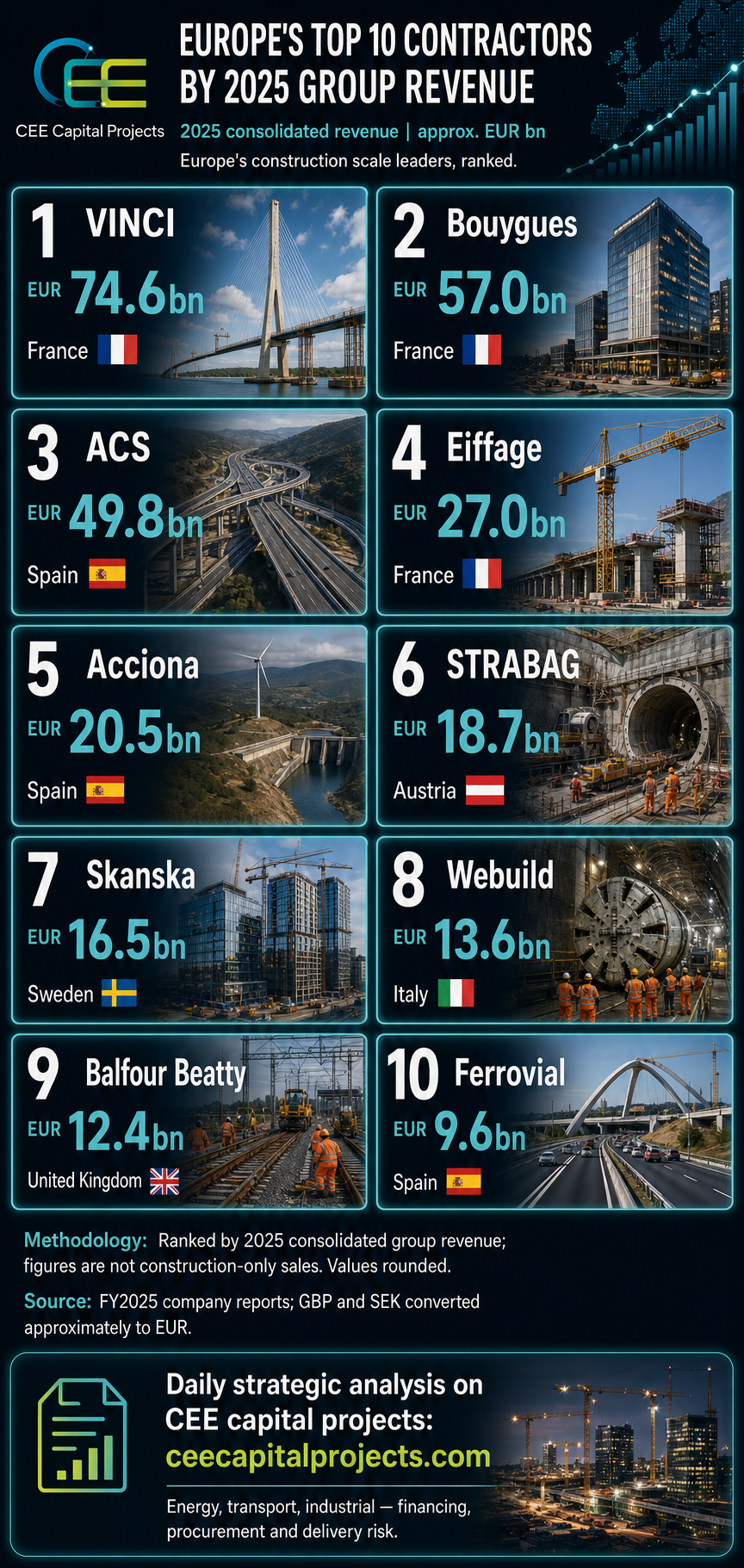
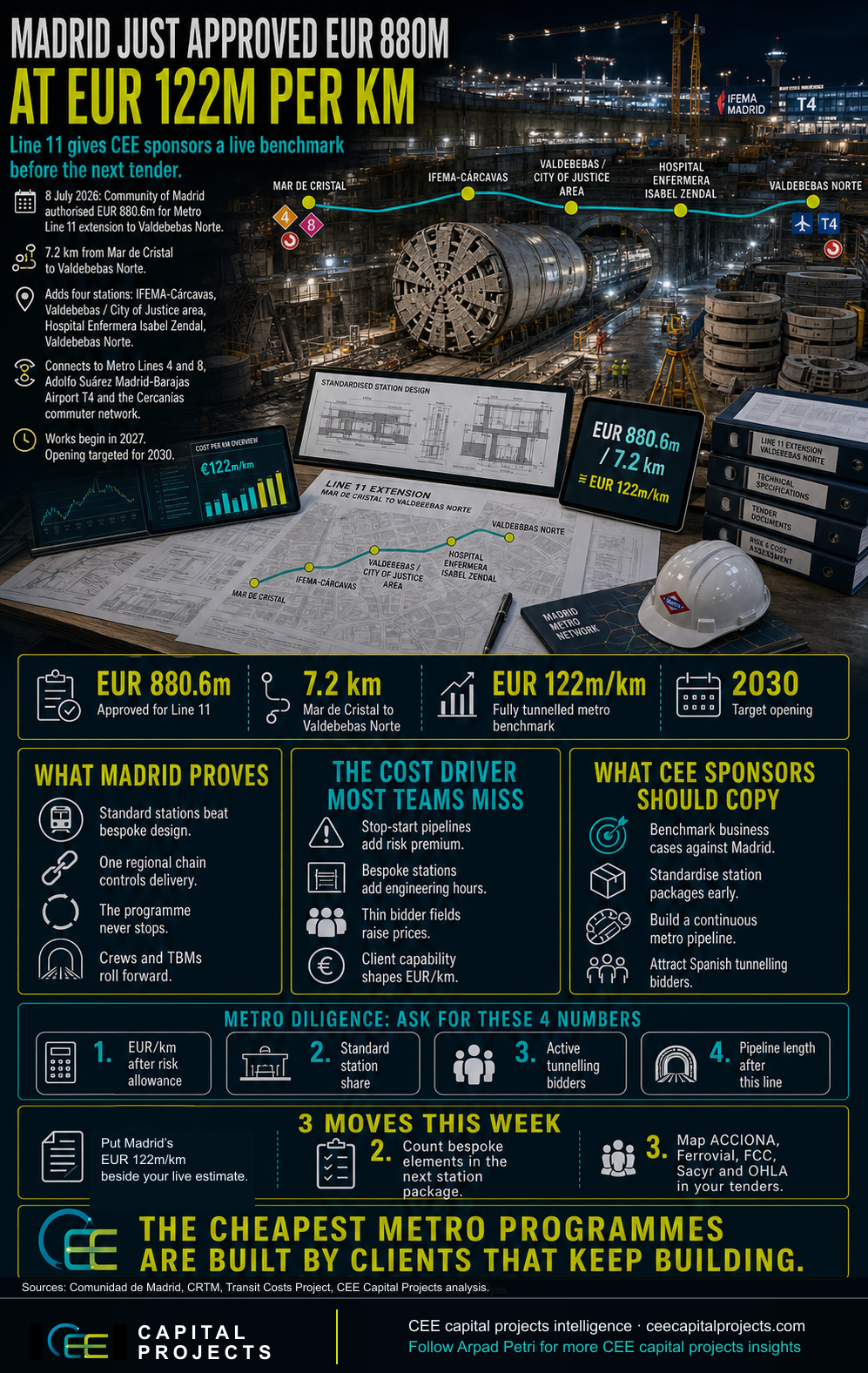
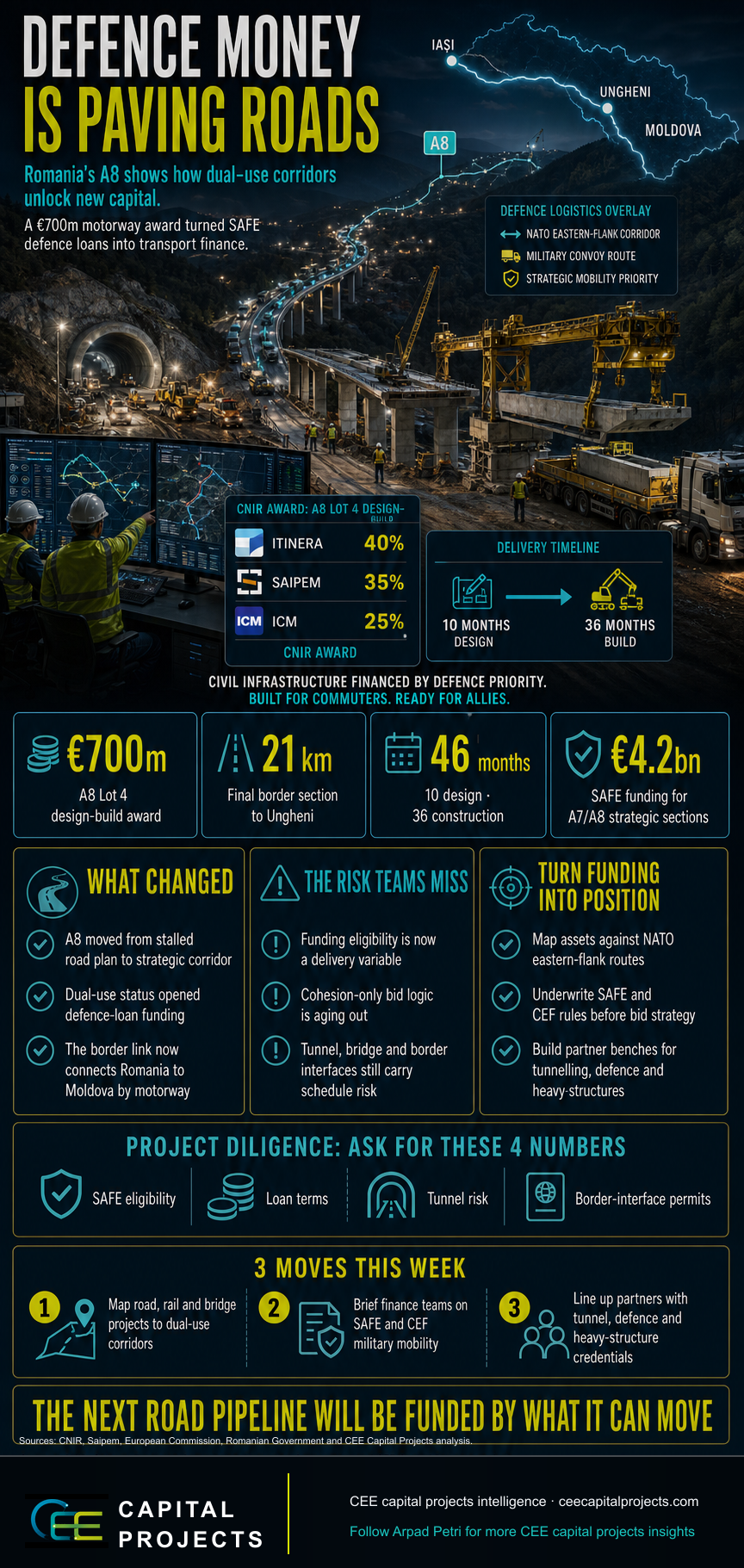
Explore our infograph library — strategic visuals for CEE capital projects leaders.
Project benchmarks, financing structures, tender dynamics and delivery risk — at a glance. Free access for investors, owners, contractors and strategy teams tracking CEE capital projects.
Browse the libraryStrategic Insights
📊 Analytics & Strategic Insight
The consent that binds has moved from the planning office to the substation
The decision most in this industry are avoiding:
👉 Stop treating the permit as the milestone that de-risks a scheme. A permit proves planning compliance and nothing more. It carries no information about when power arrives, and power now sets handover. Underwriting models that trigger on permit date are measuring the wrong event.
👉 Priority status buys a queue position. It does not buy an exemption. Housing sits third in the Dutch framework, behind congestion mitigators and behind safety and security. Third place is thin protection in a system carrying 14,044 regional offtake requests.
👉 The flexibility contract is becoming a condition of building at all. Capacity restriction and capacity steering contracts began as industrial instruments. Mixed-use and residential schemes loaded with heat pumps and chargers will meet them next, and the tariff discount will not cover the operational constraint.
Here's the full context:
→ 2019 onward: Dutch nitrogen case law tightens. Construction near Natura 2000 sites must prove it adds no deposition, and previously permitted schemes fall back into scope.
→ 2022 to 2025: Grid operators begin waitlisting large offtake requests while reserving capacity for connections up to 3x80 amps, which keeps housing moving.
→ 4 February 2026: The Aansluitoffensief letter reaches parliament. Regional operators hold 14,044 requests worth more than 9 GW; TenneT holds 212 requests worth 38 GW.
→ 1 July 2026: The small-user reserve narrows to priority categories only. Unprioritised small connections join the same waiting list as industry.
→ Most recent: Statistics Netherlands data reported on 23 August 2026 shows April and May permits at 8,500 and 10,800 homes, with 234,000 permitted homes still unbuilt at the end of May.
What this means for infrastructure operators, contractors and investors:
✅ Sequencing risk has overtaken price risk on residential and mixed-use work. A well-priced contract that cannot energise is a worse asset than an average-priced contract with a confirmed connection date. Bid comparisons that ignore utility sequencing are incomplete.
✅ Grid and connection work is the defensive earnings line. Heijmans grew underlying EBIT 27 per cent to EUR 104 million while calling the housing market subdued into 2027. Contractors with substation, cable and HV capability can hold margin through a residential slowdown.
✅ Land in congested zones needs an explicit queue discount. Site value assumes a build date. Where the connection date is unknown, the residual land value calculation is carrying an unpriced option, and the holding cost is real.
3 moves you can make this week:
1️⃣ Pull the written connection position for every scheme in your pipeline. Ask the operator for queue position, priority category and indicative energisation date, in writing. Rank the pipeline by that date rather than by permit date.
2️⃣ Re-read your time-risk wording on utility connection. Under FIDIC, check whether delayed third-party energisation is an employer risk event, and whether extension of time carries cost. If it is silent, it will be litigated.
3️⃣ Price a flexibility contract into the next scheme you bid. Model a capacity restriction on the site supply and on the finished asset. Quantify what curtailment does to the commissioning programme and to the end user's running cost.
Related analyses
- Energy & Power
Constellation's $4.3bn Nuclear Uprate Deal With Google: 890 MW, No New Site, and a Finite Pool
Constellation will invest more than $4.3bn to lift 890 MW out of 11 existing reactors under a 20-year Google power purchase agreement, at roughly half the per-kilowatt cost of recent American new build. The point for Europe is that the national uprate pool runs to three to five gigawatts, ČEZ banked its Dukovany headroom by 2009, and the only route left to fresh capacity is a CZK 407bn new build.
Read analysis → - Energy & Power
NEK's EUR 350 Million Yadenitsa Dam Tender Turns Bulgaria's Chaira Storage Fix Into a Civils Job
Bulgaria's NEK has put EUR 350m on the market for the Yadenitsa dam and a six kilometre tunnel at the 864 MW Chaira pumped storage plant, with bids due 4 November 2026 and 60 months to build. The civil works are costed at more than three times the EUR 102m reconstruction of all four of the plant's machines.
Read analysis → - Energy & Power
EIB and BNP Paribas Guarantee EUR 700m of Grid Equipment Bonds: Europe's Network Bottleneck Moves to the Balance Sheet
The EIB and BNP Paribas signed a EUR 700m counter-guarantee portfolio on 29 September 2026, covering advance payment and performance bonds for European manufacturers of electricity grid components. The instrument is small, and it points at the constraint that now sets delivery dates on Europe's grid build: bonding capacity rather than factory floor.
Read analysis →
Get a second opinion before it gets expensive.
Contractor selection, tender strategy, a project drifting off track — send us the situation and we'll come back with a clear plan.