We Help International Investors and Project Owners Deliver Major CEE Projects Without Expensive Surprises
Independent project intelligence and advisory across energy, transport, real estate and industrial construction.
MVM Starts Piling at the 1,000 MW Tisza CCGT in Tiszaújváros: the Turbine Date Now Sets Hungary's Civils Window
Piling has begun at MVM's 1,000 MW Tisza combined cycle plant in Tiszaújváros, seventeen months after the turnkey contract with Çalık Enerji Swiss and Ansaldo Energia was signed. The more useful reading is the sequence: EUR 1.2 billion of SACE-covered debt and the equipment order were both fixed long before the ground was touched.
I had this down as a late start. Then I counted the months between the EPC signature and the first pile. There are seventeen, on a plant that must deliver power in 2029.
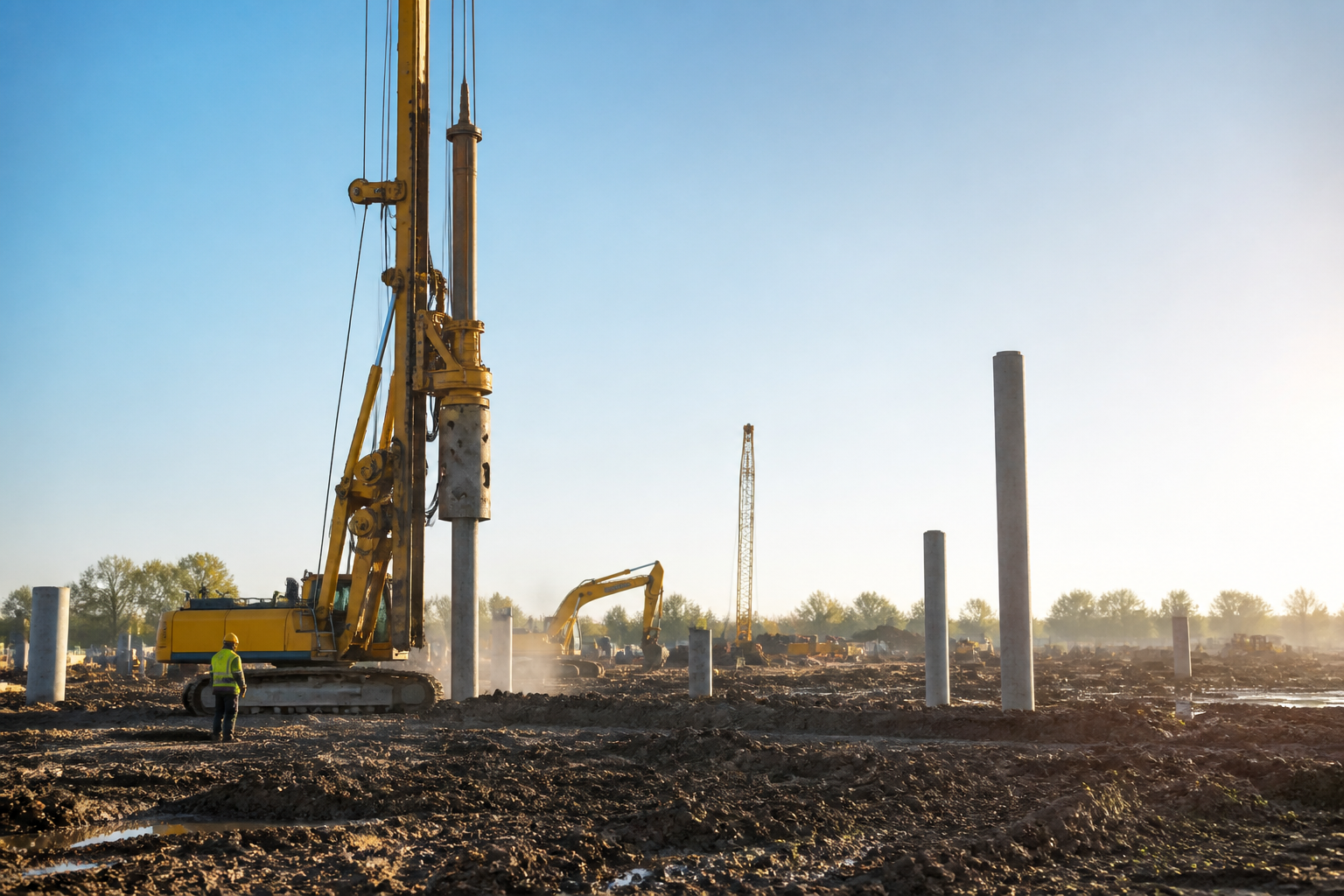
Világgazdaság reported on 25 September 2026 that piling has begun at MVM's Tisza combined cycle site in Tiszaújváros. The job uses more than 2,000 concrete piles. Each is 21 metres long and 800 millimetres in diameter, installed by continuous flight auger. Piling alone takes about three months. The turnkey contract with Çalık Enerji Swiss and Ansaldo Energia was signed on 30 April 2025.
A 1,000 MW brownfield rebuild
The plant has two blocks of 499 MW gross each. Both gas turbines are specified as hydrogen capable. Expected output is about 7,500 GWh a year. The site is the former Tisza II station, which makes this a brownfield rebuild.
Serbia Energy reported on 28 September 2026 that the first unit is due in the third quarter of 2029. The second follows in the first quarter of 2030. Site activity is expected to step up from 2027. At the signing, energy minister Csaba Lantos set the context. Hungary had not built a new baseload plant in fifteen years.
The dates tell you where the critical path sits
Line the milestones up. EPC signed 30 April 2025. Financing agreed 5 December 2025. Project start January 2026. Foundation stone laid 26 March 2026. First piles late September 2026.
Six months passed between the ceremony and the first pile. That gap is normal on a plant of this type. It also tells you that the civils are being timed to meet the equipment.
The turbine date sets the civils window
On a combined cycle plant the schedule is written backwards from commissioning. Gas turbines, heat recovery boilers and generators arrive in a fixed sequence. Each one needs its foundation complete and cured, and its access route clear, on a date the supplier sets.
That makes the civils window a fixed slot with very little float. Here the slot runs from late 2026 to roughly 2028, with first power in 2029. Two blocks inside that window is tight work on a used site.
Brownfield ground is the risk to watch. Old foundations, demolition arisings and variable fill are common on decommissioned power station land. More than 2,000 piles at 21 metres suggests weak bearing at depth. Ground conditions usually stay with the sponsor under a turnkey contract, so delay there lands on MVM.
The funding was settled before the ground was
Magyar Építők reported on 5 December 2025 that MVM had signed a EUR 1.2 billion syndicated facility for the plant. The tenor is 16 years. Eleven banks took part. Citibank N.A. London Branch and ING led the arranging. Intesa Sanpaolo S.p.A. London Branch acts as facility agent and ECA agent. The Italian export credit agency SACE provides the insurance cover.
Read that list beside the equipment list. An Italian turbine supplier, an Italian export credit insurer and an Italian agent bank sit on the same project. There is no EIB loan, no EBRD and no domestic development bank in the lead role.
The practical lesson is simple. Picking the OEM also picks the funding market. On a large thermal project the export credit wrap travels with the bid, so that choice belongs at prequalification.
Three gas plants, one open question
Tisza is one of three. Serbia Energy reported on 10 September 2025 on a second site. MVM had started a 540 MW plant at Visonta in the Mátra region. Elsewedy Electric, West Hungária Bau and Status KPRIA hold that contract. Completion is scheduled for 2028, with output of 2 to 2.5 TWh a year. Together the sites add roughly 1,600 MW of gas capacity.
The open question is running hours. These plants are built to follow solar output, so they earn on flexibility and availability as much as on energy. A 16-year loan signed in 2025 is repaid from markets nobody has seen yet.
For contractors, the message is the civils slot. Work priced against a turbine delivery date carries no float. Ground investigation and piling output matter more than headline tonnage. For MVM and its lenders, the next test is the 2027 ramp. Mechanical and electrical trades will arrive on a site still being prepared. For sponsors elsewhere in the region planning dispatchable capacity, Tiszaújváros is the current benchmark on sequencing. Fix the equipment and the money first, then carry the ground risk at your own price.
📊 Analytics & Strategic Insight
Hungary's largest thermal build in fifteen years is a sequencing story
The decision most in this industry are avoiding:
👉 The ground risk is still the sponsor's. A turnkey price covers the plant. It rarely covers what sits under a demolished one. More than 2,000 piles at 21 metres is a disclosure about bearing capacity, and someone has already paid for it.
👉 The OEM choice is a financing decision. Export credit cover follows equipment origin. A Hungarian utility funded this through an Italian agency because it bought Italian turbines. The bid list and the bank list were the same list.
👉 Nobody is pricing the running hours. Three plants, roughly 1,600 MW, built to follow solar. The debt is fixed for 16 years. The dispatch pattern that repays it is an assumption, and it is the weakest number in the file.
Here's the full context:
→ 2025: MVM signs the turnkey contract for the Tisza CCGT with Çalık Enerji Swiss and Ansaldo Energia on 30 April. Two blocks of 499 MW gross, specified as hydrogen capable.
→ 2025: MVM starts a second gas plant, 540 MW at Visonta in the Mátra region. The contractors are Elsewedy Electric, West Hungária Bau and Status KPRIA, with completion in 2028.
→ 2025: The EUR 1.2 billion syndicated facility is signed on 5 December. Sixteen-year tenor, eleven banks, Citibank N.A. London Branch and ING arranging, SACE cover.
→ 2026: The project formally starts in January and the foundation stone goes down at Tiszaújváros on 26 March.
→ Most recent: Piling begins in late September 2026. More than 2,000 piles, 21 metres long, about three months of work. First power is due in the third quarter of 2029.
What this means for infrastructure operators, contractors and investors:
✅ Civils on thermal projects run to a fixed slot. The equipment date is set years ahead. Everything in the ground has to clear that date, so float belongs in the enabling works and nowhere else.
✅ Export credit cover is a competitive weapon for the supplier. A bidder arriving with a national agency behind it brings tenor the sponsor cannot buy locally. Price that in when you lose on headline cost.
✅ A 16-year tenor on a flexible plant is a view on market design. Lenders are underwriting a decade of operation after 2030. Watch Hungary's balancing and capacity arrangements, because they carry the repayment.
3 moves you can make this week:
1️⃣ Pull your own ground risk position. On every brownfield thermal or industrial job, check who carries unforeseen conditions below the slab. Put a number against the piling variation you would accept.
2️⃣ Map your lender to your equipment. List the export credit agencies behind each shortlisted supplier. If one brings sixteen-year cover and another brings seven, your bid comparison is already decided.
3️⃣ Stress the running hours. Take your dispatchable asset case and halve the operating hours. If debt service fails, the project is a capacity bet and should be governed as one.
Share it with your peers
Help your network stay ahead of CEE capital projects.




Explore our infograph library — strategic visuals for CEE capital projects leaders.
Project benchmarks, financing structures, tender dynamics and delivery risk — at a glance. Free access for investors, owners, contractors and strategy teams tracking CEE capital projects.
Browse the libraryRelated analyses
- Energy & Power
Constellation's $4.3bn Nuclear Uprate Deal With Google: 890 MW, No New Site, and a Finite Pool
Constellation will invest more than $4.3bn to lift 890 MW out of 11 existing reactors under a 20-year Google power purchase agreement, at roughly half the per-kilowatt cost of recent American new build. The point for Europe is that the national uprate pool runs to three to five gigawatts, ČEZ banked its Dukovany headroom by 2009, and the only route left to fresh capacity is a CZK 407bn new build.
Read analysis → - Energy & Power
NEK's EUR 350 Million Yadenitsa Dam Tender Turns Bulgaria's Chaira Storage Fix Into a Civils Job
Bulgaria's NEK has put EUR 350m on the market for the Yadenitsa dam and a six kilometre tunnel at the 864 MW Chaira pumped storage plant, with bids due 4 November 2026 and 60 months to build. The civil works are costed at more than three times the EUR 102m reconstruction of all four of the plant's machines.
Read analysis → - Energy & Power
EIB and BNP Paribas Guarantee EUR 700m of Grid Equipment Bonds: Europe's Network Bottleneck Moves to the Balance Sheet
The EIB and BNP Paribas signed a EUR 700m counter-guarantee portfolio on 29 September 2026, covering advance payment and performance bonds for European manufacturers of electricity grid components. The instrument is small, and it points at the constraint that now sets delivery dates on Europe's grid build: bonding capacity rather than factory floor.
Read analysis →
Is your project leaking money through its subcontractors?
Most owners lose 3–8% in vendor packages without noticing. Tell us about your project — we'll tell you where we'd look first.