We Help International Investors and Project Owners Deliver Major CEE Projects Without Expensive Surprises
Independent project intelligence and advisory across energy, transport, real estate and industrial construction.
MVM's Paks Reactors Came Within 10 Centimetres of a Full Stop. Hungary's HUF 6bn Fix Rebuilds the Danube, Not the Plant
Hungary spent August watching its only nuclear station lose most of its output to a falling river. The fix was not new pumps or a new intake, but 145,000 cubic metres of rock laid across the Danube in 30 days, on donated stone and without a tender.
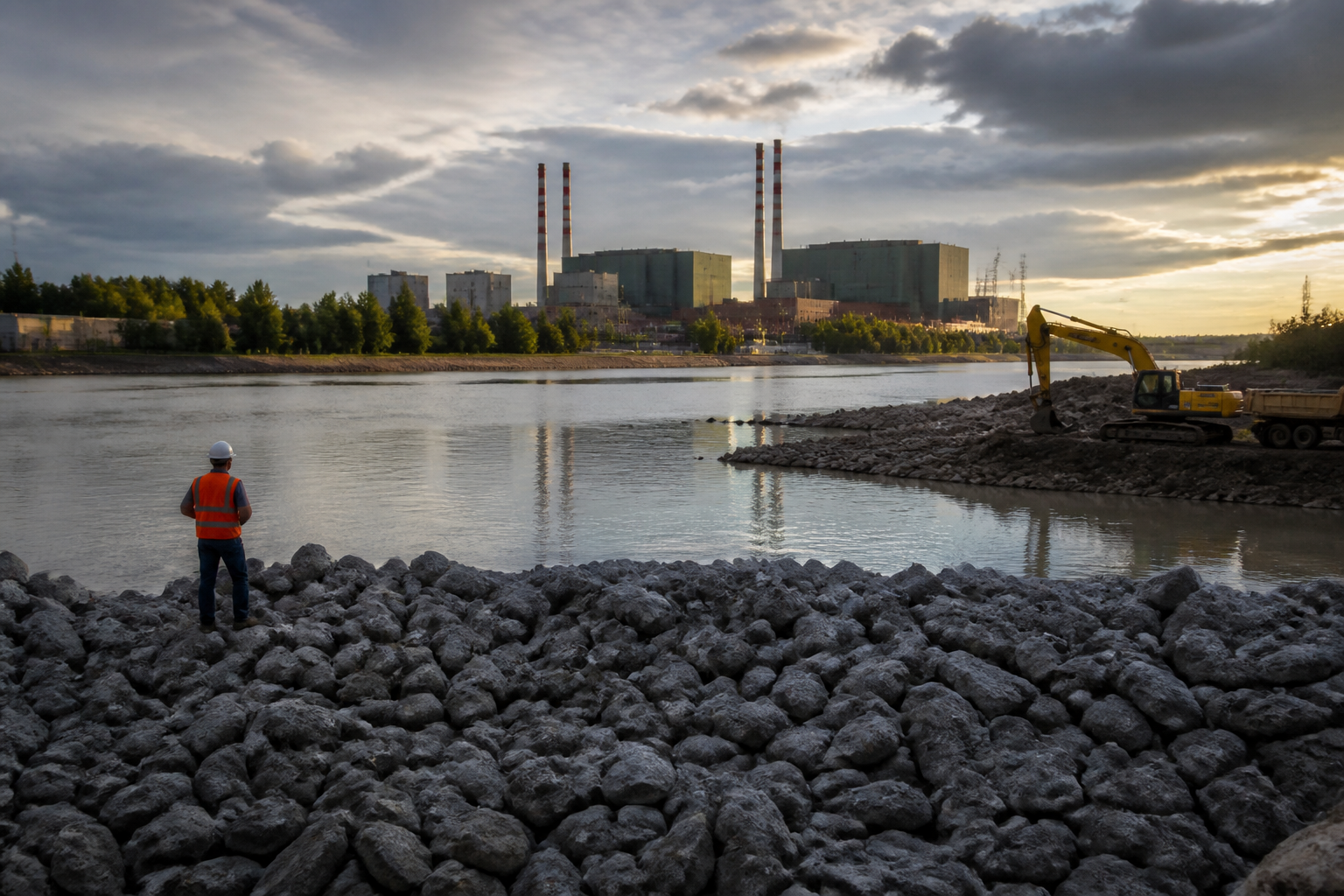
A 2,000 MW nuclear station lost most of its output this month. There was no fault, no fuel problem and no order from the regulator. The river simply dropped about 10 centimetres too far.
The margin was measured in centimetres
On 3 August 2026 the Danube gauge at Paks read minus 140 centimetres, 43 centimetres below the 2018 record of minus 97 centimetres. Attila Aszódi, professor at the Budapest University of Technology and Economics (BME), set out what that meant in Portfolio.hu on 14 August 2026: at that level the cooling-water pump of the last running turbine sat a few centimetres above its operability limit, and the pumps of the safety cooling-water system had just 10 centimetres of margin left.
MVM Paksi Atomerőmű Zrt. runs four VVER-440 units for 2,000 MW, close to half of Hungary's electricity generation. Output fell to 965 MW at the start of August. By 18 August only Unit 2 was still turning, at half load, with restart of the idle turbines flagged for the following Sunday. It is the first time in the plant's operating life that a complete stop has been on the table.
Rebuilding the river was cheaper than rebuilding the plant
The intuitive engineering answer is to lower the pumps. Aszódi is blunt about that route: dropping the cooling-water pumps to the lowest practical level buys at most 50 centimetres of headroom, and the work runs to several years. Inside a 30-day window it is not an option at all.
So Hungary went the other way and re-engineered the river. A bottom sill is being built at Danube river-kilometre 1526.33, between Paks and Dunaszentbenedek, across roughly 300 metres of reach between the plant's cold-water and warm-water channels. Cost is put at around HUF 6bn. Against that, Prime Minister Péter Magyar put a full plant shutdown at a minimum HUF 50bn a month to the budget, a prime-ministerial estimate rather than a booked loss, but the ratio is what drove the decision. The first phase places 35,000 cubic metres of rock, with a further 110,000 to follow, and the target is to hold the level at the intake above minus 90 centimetres.
Two construction methods, 30 days, no tender
The programme splits at the centreline. On the Paks side, where the bed is deeper and the flow stronger, quarry stone of 40 to 200 kg is trucked in, stockpiled on the bank and released into the bed from vessels. That section is a submerged sill about 200 metres long with a 150-metre-wide base, its crest kept at least half a metre below the current low-water surface so the international navigation channel survives. From Dunaszentbenedek on the left bank, army engineers advance dry: trucks reverse and tip, dozers level, and the plant drives forward on the rock it has just laid. That side becomes a 300-metre stone wall standing 50 to 60 centimetres above current low water, founded on a one-metre-thick, 40-metre-wide stone blanket over geotextile, with a 6-metre crown.
BME modelled the structure at 600 cubic metres a second, below both the 720 m³/s all-time minimum flow and the roughly 800 m³/s running during construction. The same modelling shows no meaningful obstruction at a 7,500 m³/s flood. Work runs around the clock for 30 days, with stability widening continuing into October. Two 80-metre barges sit on standby to be sunk at 45 degrees if the gauge falls below minus 132 centimetres, worth roughly 20 centimetres of immediate lift.
The supply chain turned up before the paperwork
Delivery sits with the national water directorate OVF on the technical side, under József Gacsályi, and with the Defence Administration Office on coordination, under Brigadier General Pál Kádár, with 100 soldiers deployed and BME on design. The materials came from the contracting market, and they came free. Magyar Építők reported on 13 August 2026 that STRABAG offered technology, haulage and material at no charge, that KÉSZ Zrt. made a similar approach, that Market Építő committed 10,000 tonnes of stone delivered on its own fleet, that Duna Aszfalt released a barge from the Mohács Danube bridge site, and that Bayer Construct offered 25,000 to 30,000 tonnes of graded gravel from its Kiskunlacháza pit.
Note what is missing from that list. There is no tender, no bill of quantities, no priced risk allocation, no FIDIC clause governing who carries a washout, and no defects liability period on a structure that will sit in a live navigation channel for years. Emergency powers and goodwill got stone into the water within a day. Neither is a procurement model, and neither can be relied on a second time.
What riverside assets are worth is being repriced
Paks is not an isolated case. Romania prepared Cernavodă Unit 2 for controlled shutdown over low Danube levels in the same fortnight. The prime minister pointed to a 125-year record at the Paks gauge showing summer levels trending down, with the decline steepening after 2010, and the bed at Paks is incising as well. Aszódi's conclusion is that 2018 was not an outlier.
For lenders and owners the diligence question shifts from how much water a river carries to what level it carries it at, because pumps respond to elevation, not volume. For contractors, the work that follows is river engineering rather than plant engineering: sills, dredging, bank protection and intake reconstruction, procured by water authorities on flood-defence timelines rather than by utilities on outage schedules. And for Hungary specifically, Paks II is being built on the same reach of the same river, with an intake that will have to work at levels the 2010s did not contemplate.
Share it with your peers
Help your network stay ahead of CEE capital projects.
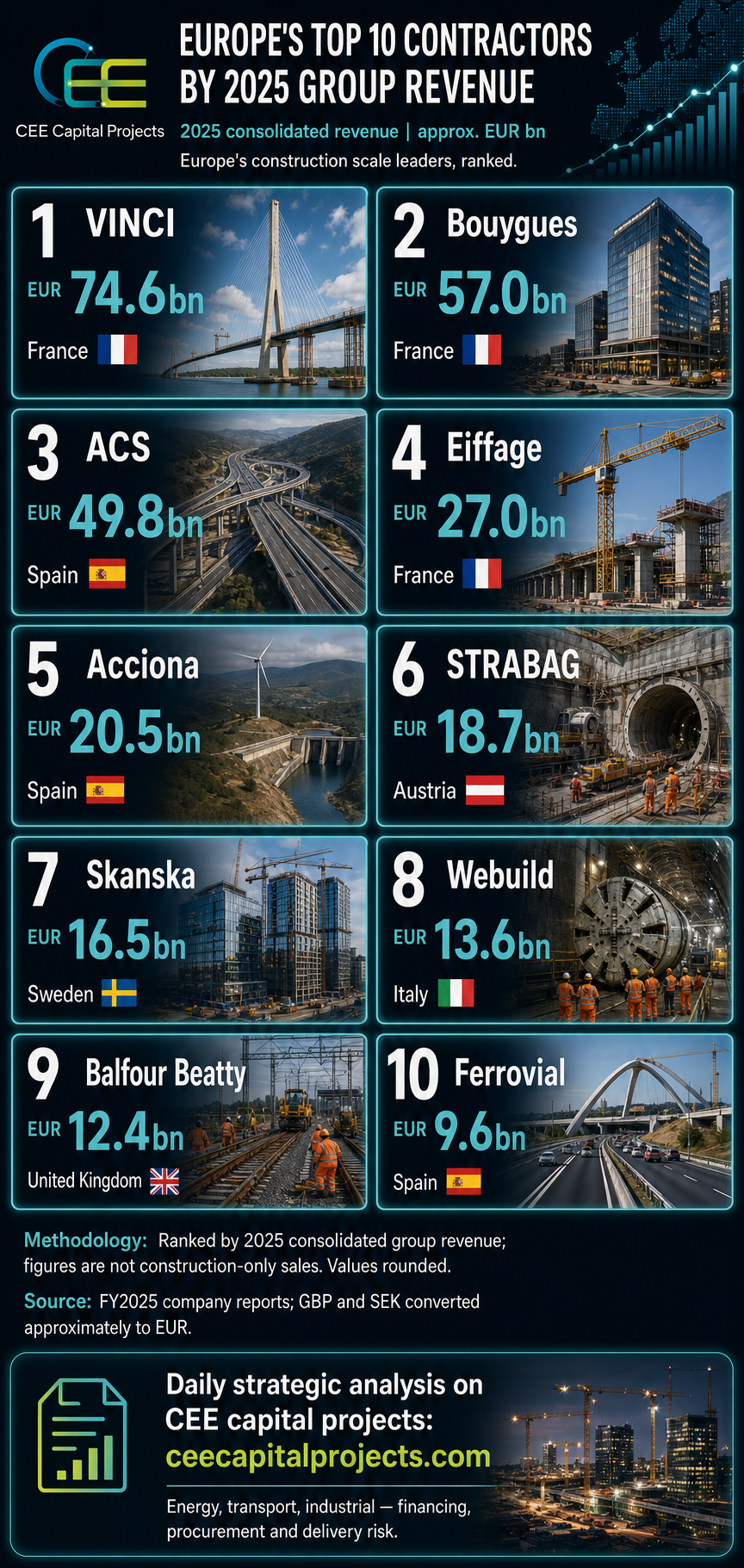
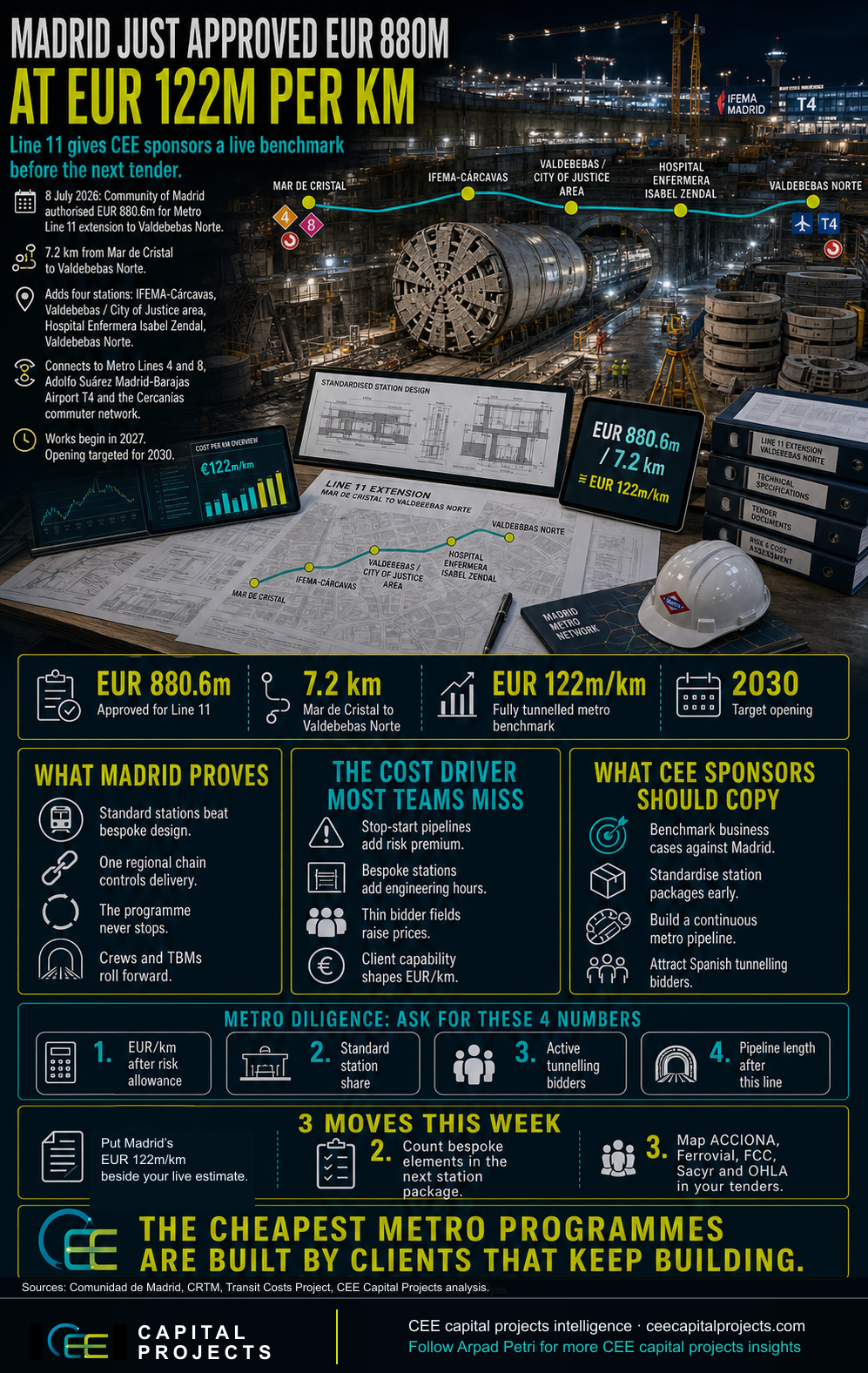
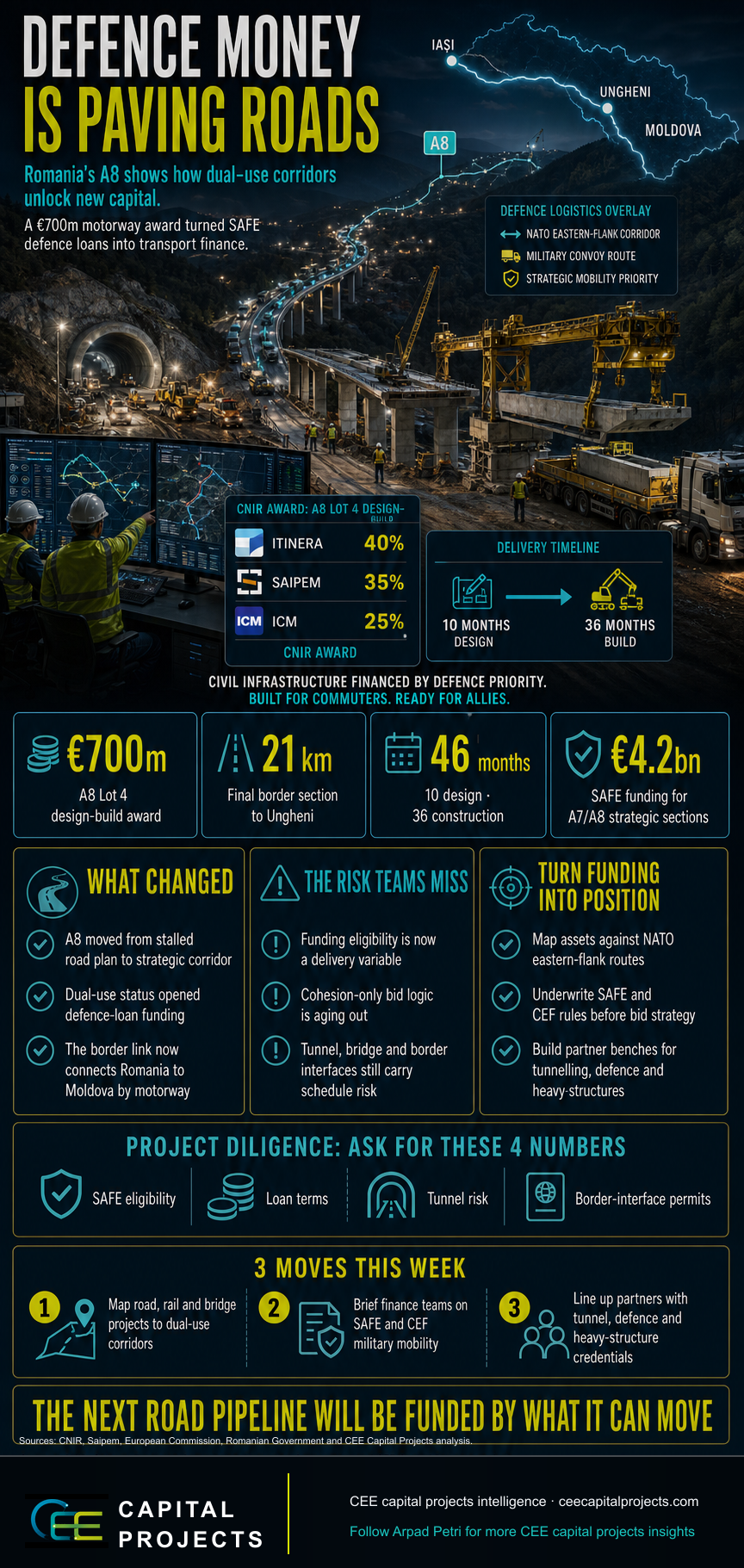

Explore our infograph library — strategic visuals for CEE capital projects leaders.
Project benchmarks, financing structures, tender dynamics and delivery risk — at a glance. Free access for investors, owners, contractors and strategy teams tracking CEE capital projects.
Browse the libraryStrategic Insights
📊 Analytics & Strategic Insight
The plant was fine. The river moved.
The decision most in this industry are avoiding:
👉 Nobody prices the river. Teams check the grid, the fuel and the permit. Very few check whether the water will still be at the right height in twenty years. That check is cheap. Skipping it is not.
👉 The cheapest fix is often outside the fence. Rock in the river cost about HUF 6bn and took 30 days. Moving the pumps would have taken years and bought less. The best answer was not inside the plant at all.
👉 Emergency jobs run on goodwill, and goodwill runs out. Free stone, free lorries and army engineers got this started. There is no contract behind any of it. Next time somebody has to be paid.
Here's the full context:
→ 1982 to 1987: Four units start up at Paks. Together they make 2,000 MW, close to half of the power Hungary generates. All of it is cooled by water taken straight from the Danube.
→ 2018: The Danube at Paks drops to minus 97 centimetres, a record. Most people treat it as a freak year.
→ 3 August 2026: A new record of minus 140 centimetres. That is 43 centimetres lower. The safety cooling pumps have 10 centimetres to spare.
→ Early August 2026: Output falls to 965 MW, then to one unit at half load. A full stop is on the table for the first time.
→ Most recent: On 13 August 2026 work starts on a rock sill across the Danube. Around HUF 6bn, 30 days, day and night, with two barges ready to be sunk if the water keeps falling.
What this means for infrastructure operators, contractors and investors:
✅ Water level is now a credit question. Ask how low the river can go before the pumps stop, not how much water flows past. Elevation is what breaks first.
✅ The next wave of work goes to water engineers. Rock, dredging, sills, bank protection, new intakes. Different firms, different clients, and the buyer is a water authority rather than a utility.
✅ Free help hides the real cost. This job looks cheap because five companies gave away stone and haulage. Budget the honest number for the next one, including insurance and a warranty.
3 moves you can make this week:
1️⃣ Find the intake level for every riverside asset you own or lend to. Compare it with the lowest reading ever recorded on that gauge, not the average year.
2️⃣ Write down what the asset does at that level. Half load, or full stop? Put a cost per day next to it. That single number changes how the asset is valued.
3️⃣ Read your emergency-works clauses. Check who can order work without a tender, who pays for it, and who carries the risk if the structure moves.
Related analyses
- Energy & Power
Constellation's $4.3bn Nuclear Uprate Deal With Google: 890 MW, No New Site, and a Finite Pool
Constellation will invest more than $4.3bn to lift 890 MW out of 11 existing reactors under a 20-year Google power purchase agreement, at roughly half the per-kilowatt cost of recent American new build. The point for Europe is that the national uprate pool runs to three to five gigawatts, ČEZ banked its Dukovany headroom by 2009, and the only route left to fresh capacity is a CZK 407bn new build.
Read analysis → - Real Estate & Construction
Echo Investment's Owner Bid PLN 5.20 a Share for the Rest of Poland's Biggest Developer. The Market Never Came Down to Meet It
Lisala, the vehicle through which Hungary's WING controls Echo Investment, has notified Poland's regulator of a PLN 5.20 per share offer for the 37.63 per cent it does not own, about 4.4 per cent below the close that preceded it. Echo's shares have stayed above the bid, and two Polish pension funds now decide whether the country's largest developer leaves the Warsaw exchange after three decades.
Read analysis → - Transport & Infrastructure
V-Híd Just Lost Hungary's HUF 338 Billion Déli Körvasút at 42 Per Cent Complete. The Grant Clock Is the Real Story
Hungary halted construction of the Budapest Southern Circle Railway on 9 October 2026 and barred V-Híd from every ongoing rail investment. The HUF 367 billion of EU money behind the job survives only if a lawful re-tender lands inside two years.
Read analysis →
Get a second opinion before it gets expensive.
Contractor selection, tender strategy, a project drifting off track — send us the situation and we'll come back with a clear plan.