We Help International Investors and Project Owners Deliver Major CEE Projects Without Expensive Surprises
Independent project intelligence and advisory across energy, transport, real estate and industrial construction.
Kosovo's First Wind Auction: Three Bids, a EUR 80.2 Ceiling and a State on Both Sides of the Contract
Three bidders have filed for Kosovo's first wind auction, competing for 15-year power purchase agreements and contracts for difference under a ceiling of EUR 80.2 per MWh. The state will also hold up to 49 per cent of the winning project company, which changes how lenders have to price the deal.
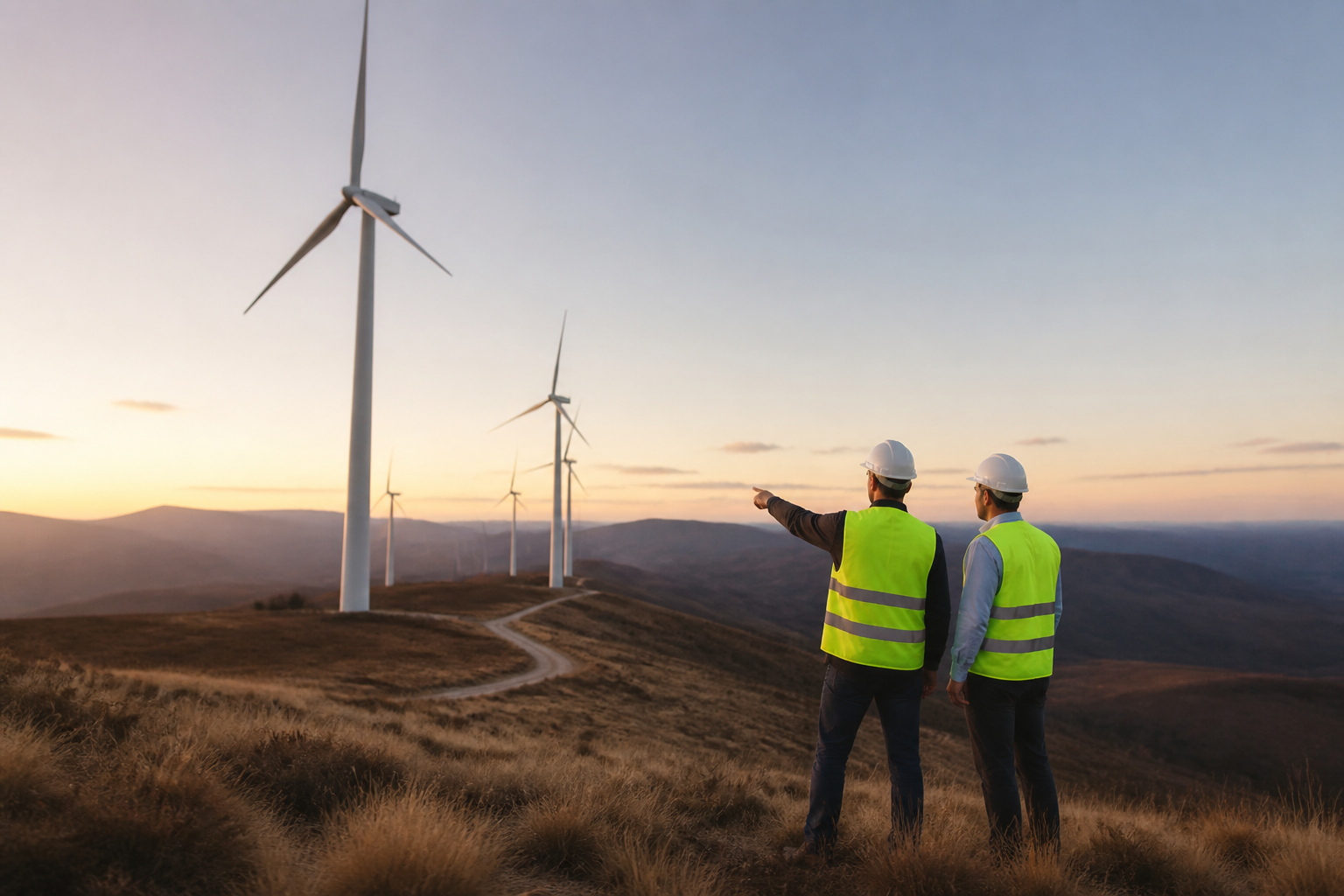
The one question I keep putting to sponsors in small power markets is this. Who sits on the other side of your contract when something goes wrong? In Kosovo's first wind auction the answer is the state, wearing more than one hat.
Balkan Green Energy News reported on 15 September 2026 that all three qualified entities had filed full bids. Akuo Energy of France is bidding. So is the consortium of Germany's Notus Energy and domestic firm Stublla Energy. The third is a consortium led by Guris of Turkiye. The Ministry of Economy will award between 50 MW and 100 MW. A commission checks validity, then the lowest price per megawatt hour wins. The ceiling is EUR 80.2 per MWh. The prize is a 15-year power purchase agreement and a contract for difference.
The ceiling is doing most of the price discovery
Kosovo has run one auction before. Its 2024 solar tender drew 43 offers and closed at EUR 48.88 per MWh. The ministry had raised the ceiling to EUR 75 from EUR 65 after repeated delays. Bidding opened at EUR 57.00 and fell through the rounds to EUR 48.88. A consortium led by Switzerland-based Orllati won the 100 MW.
The wind ceiling of EUR 80.2 sits about 64 per cent above that solar clearing price. That ratio is this article's own arithmetic on the two published figures. Wind and solar carry different load factors, so it is no like-for-like premium. The number that matters more is the bidder count. Forty-three offers produced a price 35 per cent below the cap. Three bidders will not apply the same pressure.
The buyer is also the shareholder
The auction documentation set out that the projects run through special purpose vehicles. The government may hold a stake of up to 49 per cent in each one. The same state awards the contract, licenses the plant and stands behind the contract for difference.
Lenders will price that concentration. Equity partner, offtaker and adjudicator are the same counterparty over a 15-year term. A curtailment dispute or a settlement argument has no independent party to resolve it. Sponsors should expect questions on step-in rights, shareholder deadlock and change-in-law protection.
The system behind the offtake is narrow. Coal-fired plants supplied about 92 per cent of Kosovo's electricity in 2023. Installed capacity is around 1,568 MW, roughly 82 per cent of it lignite. The revenue that pays a wind contract for difference comes from that base.
The bidder list is the incumbent list
Every bidder already holds a position in Kosovo. Guris operates the 32.4 MW Kitka wind farm. Notus built Selac, also called Bajgora, as contractor and minority partner, in a project controlled by Enlight Renewable Energy. Akuo has been developing Cicavica, a 116 MW scheme.
Guris and Akuo also bid in the 2024 solar auction, alongside Calik, Limak and Elsewedy Electric. The same regional pool keeps returning. This is a market with a settled set of developers rather than an opening one.
The operating fleet gives the scale. Zatriq entered regular operation this month at 70 MW effective capacity. Selac holds 104.1 MW, Kitka 32.4 MW and Golesh 1.35 MW. The auction adds 50 MW to 100 MW to roughly 208 MW already running.
What the ceiling buys on a real project
Zatriq gives a local benchmark. It runs twelve GE Vernova turbines of 6.1 MW and is expected to produce about 185 GWh a year. Reported build cost is around EUR 100 million. Calik Renewables and domestic firm Eurokos hold the joint venture.
Price 185 GWh at the EUR 80.2 ceiling and the gross revenue is about EUR 14.8 million a year. That calculation is this article's own, using published figures for a different project. Set against EUR 100 million of capital cost it is close to seven years of gross revenue. Debt service, operations, balancing and tax all sit inside that. The ceiling is workable. It leaves little headroom.
The procurement machine was bought in
Kosovo did not build this auction alone. The International Finance Corporation supported the design with German funding. EBRD, LuxDev and the now defunct USAID also contributed. Money for the wider 150 MW programme was earmarked from the International Monetary Fund's Resilience and Sustainability Facility. A second round is planned to complete that 150 MW.
For sponsors and lenders the read is simple. Small markets can now run a clean auction, because the template and the advisers arrive with donor money. What they cannot import is depth in the bidder pool or an offtaker with a separate balance sheet. Contractors should read the EUR 80.2 ceiling as the revenue envelope for the next round. It will set turbine, civils and grid budgets. Investors should watch the second auction closely. If it draws the same three names, the price in round two will tell you what concentration costs. That number will travel to every other small market in the region.
📊 Analytics & Strategic Insight
In a small power market the bidder count sets the price, and the ceiling does the rest
The decision most in this industry are avoiding:
👉 Three bidders behave like a negotiation. Price discovery needs depth. With a fixed pool the ceiling becomes the anchor and the winner clears just under it.
👉 A minority state shareholder is a credit item. Up to 49 per cent state equity sits alongside a state offtaker and a state adjudicator. Lenders should price all three as one name.
👉 Donor-built procurement has a shelf life. The auction template arrived with IFC, EBRD, LuxDev and USAID support. One of those funders no longer exists, so the capacity has to become domestic.
Here's the full context:
→ 2024: Kosovo ran its first auction. The 100 MW solar tender drew 43 offers and cleared at EUR 48.88 per MWh.
→ Late 2024: The Ministry of Economy opened the competitive process for the first wind auction. The target is 150 MW across two rounds.
→ December 2025: After prequalification, the ministry issued the call for technical proposals and financial bids.
→ September 2026: The Zatriq wind farm entered regular operation at 70 MW. The national wind fleet is now roughly 208 MW.
→ Most recent: All three qualified bidders filed full documentation. They compete for 50 MW to 100 MW under a ceiling of EUR 80.2 per MWh.
What this means for infrastructure operators, contractors and investors:
✅ The ceiling is the revenue envelope. Turbine, civils and grid budgets for the next round have to fit inside EUR 80.2 per MWh.
✅ Counterparty concentration is the pricing question. A 15-year contract for difference with a shareholder-offtaker needs step-in rights, deadlock rules and change-in-law cover.
✅ Regional developers already hold the ground. Guris, Akuo, Notus and Calik appear across both auctions, so partnering beats entering cold.
3 moves you can make this week:
1️⃣ Map the bidder pool in your target market. List every developer that bid in the last two tenders and check what each already owns there.
2️⃣ Stress the offtaker. Model your contract revenue against a counterparty that is also your minority shareholder, then price the dispute path.
3️⃣ Benchmark against a built asset. Take a finished local project, divide capital cost by expected annual output, and test it at the auction ceiling.
Share it with your peers
Help your network stay ahead of CEE capital projects.




Explore our infograph library — strategic visuals for CEE capital projects leaders.
Project benchmarks, financing structures, tender dynamics and delivery risk — at a glance. Free access for investors, owners, contractors and strategy teams tracking CEE capital projects.
Browse the libraryRelated analyses
- Energy & Power
Constellation's $4.3bn Nuclear Uprate Deal With Google: 890 MW, No New Site, and a Finite Pool
Constellation will invest more than $4.3bn to lift 890 MW out of 11 existing reactors under a 20-year Google power purchase agreement, at roughly half the per-kilowatt cost of recent American new build. The point for Europe is that the national uprate pool runs to three to five gigawatts, ČEZ banked its Dukovany headroom by 2009, and the only route left to fresh capacity is a CZK 407bn new build.
Read analysis → - Energy & Power
NEK's EUR 350 Million Yadenitsa Dam Tender Turns Bulgaria's Chaira Storage Fix Into a Civils Job
Bulgaria's NEK has put EUR 350m on the market for the Yadenitsa dam and a six kilometre tunnel at the 864 MW Chaira pumped storage plant, with bids due 4 November 2026 and 60 months to build. The civil works are costed at more than three times the EUR 102m reconstruction of all four of the plant's machines.
Read analysis → - Energy & Power
EIB and BNP Paribas Guarantee EUR 700m of Grid Equipment Bonds: Europe's Network Bottleneck Moves to the Balance Sheet
The EIB and BNP Paribas signed a EUR 700m counter-guarantee portfolio on 29 September 2026, covering advance payment and performance bonds for European manufacturers of electricity grid components. The instrument is small, and it points at the constraint that now sets delivery dates on Europe's grid build: bonding capacity rather than factory floor.
Read analysis →
Building in Central Europe?
Tell us what you're building. We'll tell you what can go wrong — and how to prevent it.