We Help International Investors and Project Owners Deliver Major CEE Projects Without Expensive Surprises
Independent project intelligence and advisory across energy, transport, real estate and industrial construction.
KÉSZ Group Won HUF 4bn to Drain BYD's Szeged Site. Hungary Just Budgeted HUF 51bn for Its Entire Drinking-Water Network
The Hungarian state paid HUF 3.99bn to drain one factory site in Szeged, then budgeted HUF 51bn to cut losses across the country's whole drinking-water network. The gap explains why a fully designed HUF 646bn Balaton overhaul still has no funder.
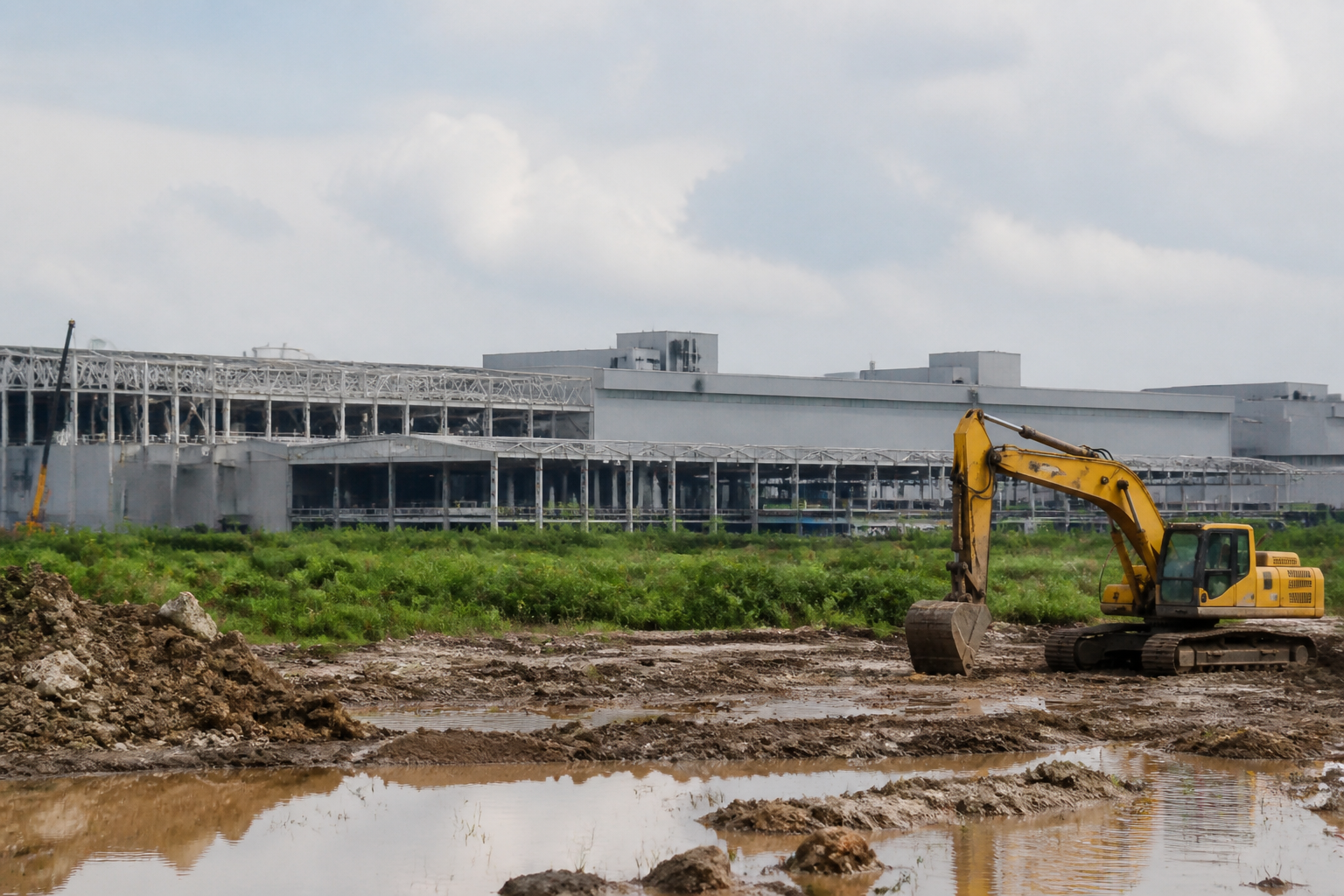
In February, the Hungarian state paid HUF 3.99bn to drain one industrial site in Szeged. On 10 August, it budgeted HUF 51bn to cut water losses across the drinking-water network of an entire country. One factory's drainage cost roughly 8% of the national programme.
Both figures are real. Both were procured by the same state. The distance between them is the most honest description available of how water infrastructure in Hungary actually gets financed.
KÉSZ Group won the easy money
KÉSZ Építő és Szerelő Zrt., the general contracting arm of KÉSZ Group, took the HUF 3.99bn water-engineering package jointly with MA-HARD Hajózási és Vízépítő Kft. in an EU open procedure run by the National Water Directorate (Országos Vízügyi Főigazgatóság). Világgazdaság reported the award on 3 February 2026. The scope covers advance water-engineering structures in Phase II of the Szeged industrial area: a temporary drainage solution for the BYD plant, plus permanent works sized for the heavier industrial load the site will carry for decades.
This is serious hydraulic engineering, and it was funded without argument, because it sits on the critical path of an investment the state has already committed to. KÉSZ Group needs that kind of work. Group revenue was HUF 188.53bn in 2024 against HUF 234.73bn in 2023, with profit after tax of HUF 6.79bn against HUF 7.34bn. A fifth of the top line disappeared in twelve months, and industrial, defence-linked and infrastructure general contracting is where the group has been replacing it.
The network the HUF 51bn is measured against
Gajdos László, the minister responsible for the living environment, announced the HUF 51bn programme on 10 August, as reported by Portfolio.hu. It funds network reconstruction, remote metering, automated operation and pressure management. Municipalities, water utilities and other asset holders can bid, with a stated bias toward the most disadvantaged regions.
Now set that against the asset. Kovács Károly, president of the Hungarian Water and Wastewater Association, told Portfolio Checklist on 19 June 2026 that close to 80% of Hungary's roughly 80,000 km of water and sewer pipe is in critical condition, that pipe bursts are rising exponentially, and that the replacement value of the infrastructure is around HUF 30,000bn. On a 50-year replacement cycle, that arithmetic implies renewal spending near HUF 600bn a year. National average water loss runs about 20% and reaches 60% in some settlements.
HUF 51bn is 0.17% of the replacement value. It is not a renewal budget, and read as designed it was never meant to be one. It is a loss-control budget.
Balaton prices the real curve
Three days before the programme landed, Dunántúli Regionális Vízmű Zrt. (DRV) told MTI that the design work for a complete overhaul of the Balaton region's water and wastewater systems is finished. The design phase closes on 12 August 2026, took four years and cost HUF 3.2bn, paid from the KEHOP and KEHOP Plusz EU programmes. Building it at today's prices would cost HUF 646bn over five to ten years, of which roughly HUF 500bn is drinking water. The Nyirád water base scheme alone is about HUF 300bn.
The package includes capacity expansion and reconstruction at the Balatonújlak and Balatonfüred treatment plants, 20 sewage pumping stations and 104 km of sewer renewal. Average pipe age is 50 to 60 years against an optimal replacement interval of 30 to 50. The estimate excludes easements and expropriation. DRV was explicit that delivery depends primarily on EU funds being available.
So one region's fully permitted plan is 12.7 times the entire national programme announced this week, and its design alone cost 6% of that programme.
Why the money follows the factory
The constraint here is not engineering capacity. KÉSZ, MA-HARD, Duna Aszfalt, A-Híd and the mid-tier water-engineering firms can build this work. Nor is it procurement machinery: the National Water Directorate ran an EU open procedure and got a priced, contracted result for Szeged inside a normal tender cycle.
The constraint is that only one of these projects has a payer. Industrial drainage has a sponsor with a commissioning date, and the state treats it as investment-enabling spend. Household network renewal has to come out of tariffs that have barely moved since the utility price cuts of the mid-2010s, which is exactly Kovács's point: with frozen prices there is practically no source for renewal. Zalavíz said this month that a tariff rise is now unavoidable after sixteen years of underfunding.
What to watch next
For contractors, the near-term Hungarian water pipeline is industrial rather than municipal: site drainage, process water, abstraction works and flood defence attached to factories, data centres and power projects. That is where the payment covenant sits. Build the water-engineering reference trail there, because the municipal wave, when it arrives, will be procured against exactly those references.
For investors and lenders, the gating item is not the HUF 51bn call. It is whether the new government moves household water tariffs. Until a regulated revenue line exists, every Hungarian water asset is grant-dependent, and grant-dependent assets price off the EU programming calendar rather than off demand. The Balaton design pack is now shovel-ready and unfunded, which makes it the cleanest test case in the country. If HUF 646bn of permitted work cannot find money, the sector's bottleneck was never the drawings.
📊 Analytics & Strategic Insight
The money goes where someone has signed to pay. It does not go where the pipes are worst.
The decision most in this industry are avoiding:
👉 Stop calling this a funding gap. It is a missing customer. Hungary can pay for water works. It paid HUF 3.99bn for one factory site. What the household network lacks is a bill that goes up. Frozen prices mean no income to borrow against. A plan with no income line behind it is a wish list.
👉 A finished design can be worse than no design. The Balaton plans cost HUF 3.2bn and took four years. They are done. Nobody has the HUF 646bn to build them. While the drawings sit, prices rise and permits run out. In five years the pack may have to be redone.
👉 At HUF 51bn you cannot buy pipe, so do not try. Spend it on pressure control, meters and remote monitoring. That cuts leaks without digging. Many bidders will still ask for pipe money, because new pipe looks like progress. At this budget it is the wrong buy.
Here's the full context:
→ Mid-2010s: Hungary cut household utility bills and held water prices down. Water companies lost the income they needed to replace pipes.
→ 2022: Design work started on a full fix for the Balaton region. It ran four years and cost HUF 3.2bn of EU money.
→ 2024: KÉSZ Group sales fell to HUF 188.53bn from HUF 234.73bn. The group leaned harder on factory and defence work.
→ February 2026: KÉSZ Építő and MA-HARD won HUF 3.99bn to build drainage for the BYD site in Szeged. The state water directorate ran the tender.
→ Most recent: On 7 August 2026 the Balaton plans were reported finished, with a build cost of HUF 646bn and no funder. On 10 August the government put HUF 51bn on the table for the whole country.
What this means for infrastructure operators, contractors and investors:
✅ Follow the payer, not the need. Hungary's water work over the next two years sits next to factories, data centres and power plants. Those clients have a start date and a budget. Town networks do not have one yet.
✅ Small water budgets buy control, not concrete. Pressure management and smart meters cut losses fast and cost little. Firms that can sell and install that get paid now. Firms that only lay pipe wait.
✅ Watch the water bill, not the tender list. If the government lets household water prices rise, the whole sector reprices, because utilities finally get something to borrow against. Until then every project needs a grant.
3 moves you can make this week:
1️⃣ List your work by who signs the cheque. Split the pipeline into private sponsor, state grant and utility tariff. The tariff column is the risky one. Now you know your real exposure.
2️⃣ Price a leak-control package. Put pressure control, district metering and remote reading together as one product. A small budget can say yes to that. It cannot say yes to a big pipe job.
3️⃣ Check the shelf life of any design you own. Ask when the permits lapse and what the build cost is at today's prices. If nobody has named a funder, put that in writing now.
Share it with your peers
Help your network stay ahead of CEE capital projects.
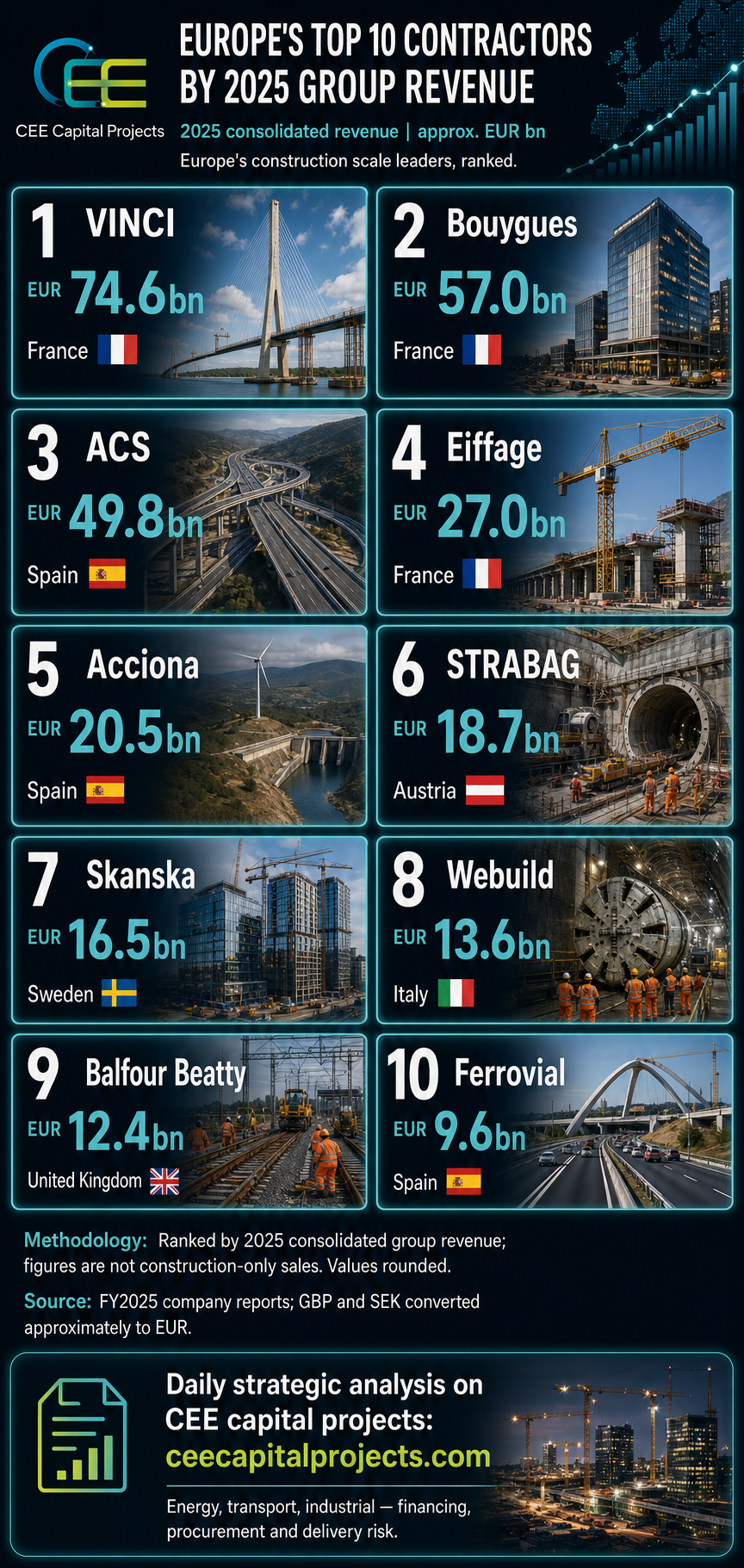
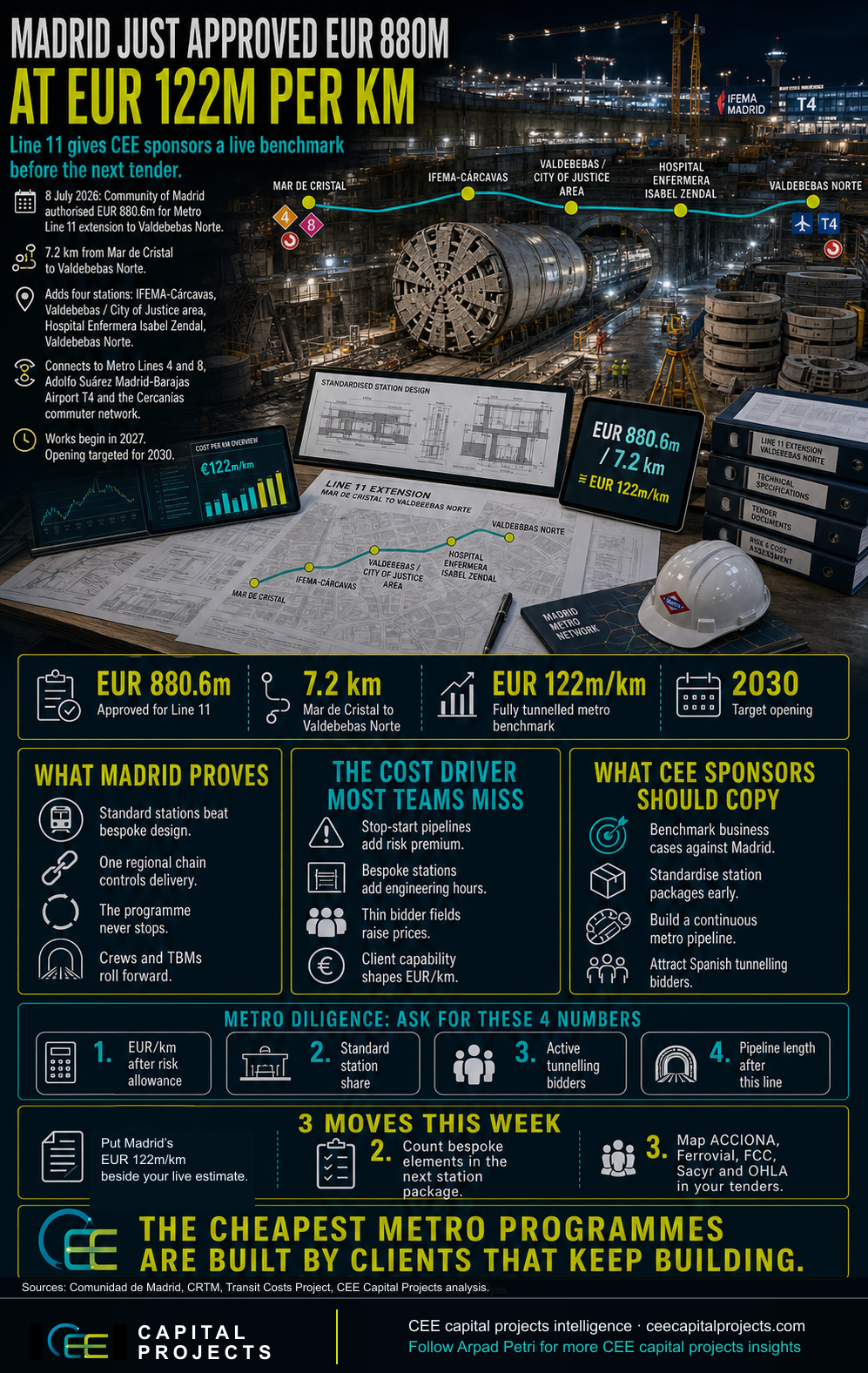
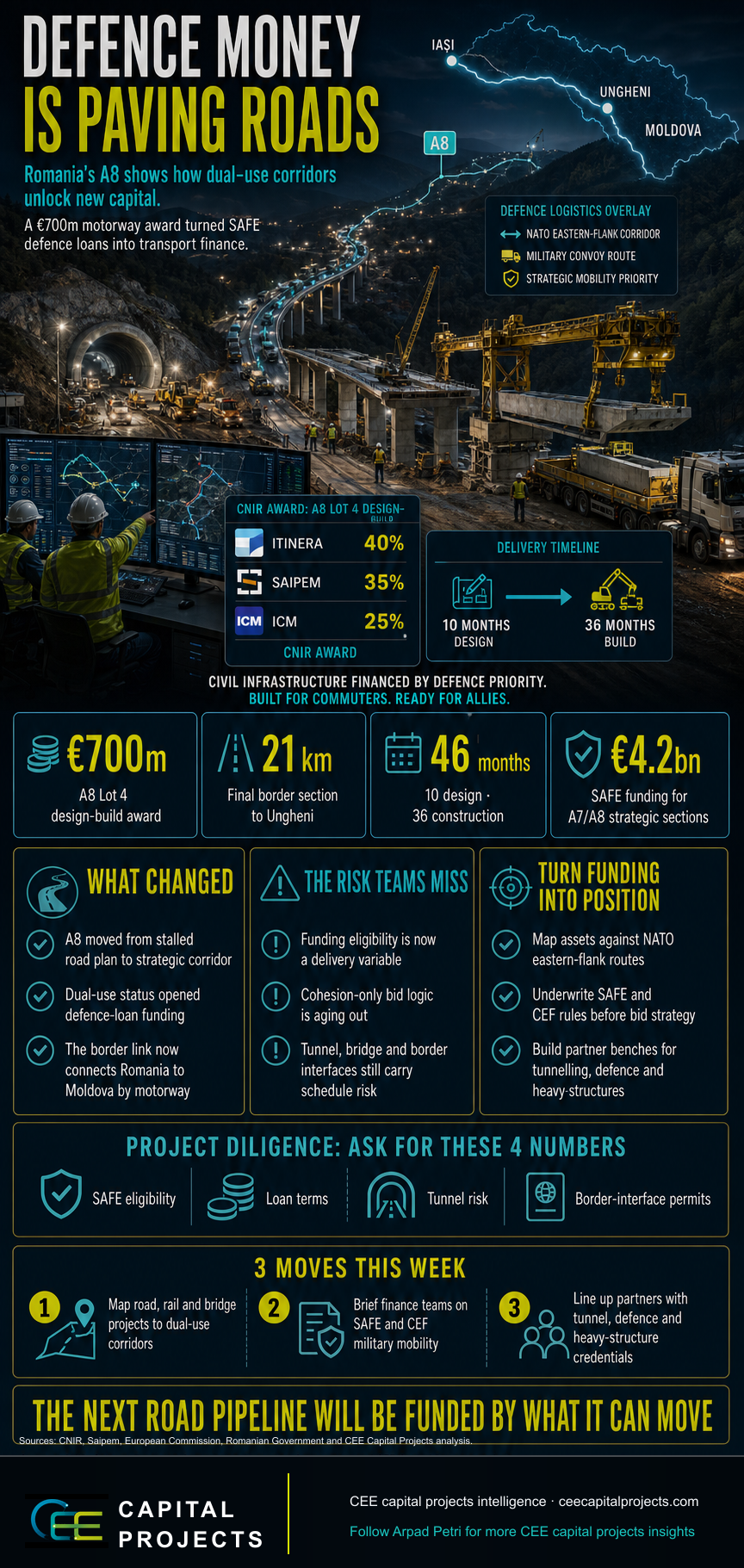

Explore our infograph library — strategic visuals for CEE capital projects leaders.
Project benchmarks, financing structures, tender dynamics and delivery risk — at a glance. Free access for investors, owners, contractors and strategy teams tracking CEE capital projects.
Browse the libraryRelated analyses
- Energy & Power
Constellation's $4.3bn Nuclear Uprate Deal With Google: 890 MW, No New Site, and a Finite Pool
Constellation will invest more than $4.3bn to lift 890 MW out of 11 existing reactors under a 20-year Google power purchase agreement, at roughly half the per-kilowatt cost of recent American new build. The point for Europe is that the national uprate pool runs to three to five gigawatts, ČEZ banked its Dukovany headroom by 2009, and the only route left to fresh capacity is a CZK 407bn new build.
Read analysis → - Real Estate & Construction
Echo Investment's Owner Bid PLN 5.20 a Share for the Rest of Poland's Biggest Developer. The Market Never Came Down to Meet It
Lisala, the vehicle through which Hungary's WING controls Echo Investment, has notified Poland's regulator of a PLN 5.20 per share offer for the 37.63 per cent it does not own, about 4.4 per cent below the close that preceded it. Echo's shares have stayed above the bid, and two Polish pension funds now decide whether the country's largest developer leaves the Warsaw exchange after three decades.
Read analysis → - Transport & Infrastructure
V-Híd Just Lost Hungary's HUF 338 Billion Déli Körvasút at 42 Per Cent Complete. The Grant Clock Is the Real Story
Hungary halted construction of the Budapest Southern Circle Railway on 9 October 2026 and barred V-Híd from every ongoing rail investment. The HUF 367 billion of EU money behind the job survives only if a lawful re-tender lands inside two years.
Read analysis →
Building in Central Europe?
Tell us what you're building. We'll tell you what can go wrong — and how to prevent it.