We Help International Investors and Project Owners Deliver Major CEE Projects Without Expensive Surprises
Independent project intelligence and advisory across energy, transport, real estate and industrial construction.
Hellenic Cables Wins the Entire €1.5bn Corinth–Kos HVDC Job. On Europe's Biggest Capex Wave, the Cable Maker Is Now the Main Contractor
Cenergy Holdings' Hellenic Cables was awarded a turnkey €1.5 billion EPCI contract by Greek grid operator IPTO on 13 August 2026 for the 1 GW Corinth–Kos HVDC interconnection, taking the whole job from converter station to converter station. With Europe's three big cable makers holding €38.4 billion of confirmed backlog and high-voltage factory slots effectively sold out to 2029, the scarce asset is the plant, and the party that owns the plant now writes the contract.
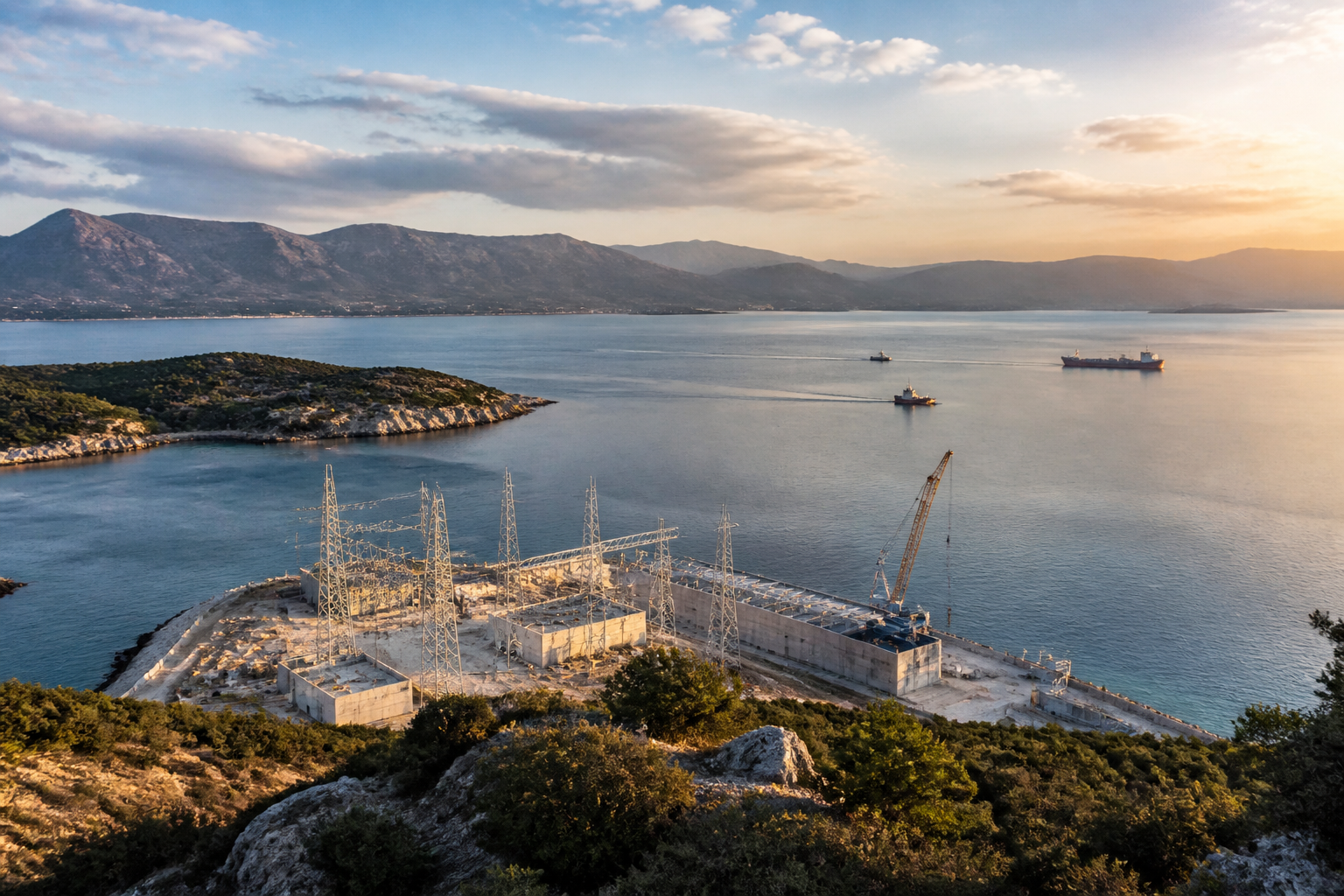
On 13 August a cable factory won a €1.5 billion construction contract. That sentence would have read oddly five years ago. It is now the clearest signal of where bargaining power sits in Europe's grid build-out.
Cenergy Holdings told the market that Hellenic Cables, through its wholly owned subsidiary Fulgor S.A., had been awarded a turnkey contract by Greece's transmission system operator IPTO for the 320kV HVDC electrical interconnection between Corinth and the island of Kos, at a total value of approximately €1.5 billion. The scope runs converter station to converter station: engineering, procurement, construction and installation, roughly 1,260 km of submarine cable and 30 km of underground cable, 1 GW of transfer capacity, works starting in Q4 2026 and completion scheduled for 2030. Fulgor will manufacture the HVDC cable at its own plants in Corinth and Thiva. Signing remains subject to customary statutory conditions and approvals.
The figure to notice is not the €1.5 billion. It is the word turnkey.
The manufacturer took the delivery risk, and the margin came with it
On a project of this shape the conventional split gives the cable maker a supply contract and hands installation, marine works, civils and interface management to a marine contractor or an EPC group. IPTO collapsed that structure into a single counterparty. Fulgor now carries end-to-end delivery on a link that runs 1,260 km of cable through open water.
Vertical integration of this kind happens when the buyer decides the factory is the scarce asset. It is. Prysmian, NKT and Nexans between them hold roughly €38.4 billion of confirmed backlog, and Prysmian alone reported about €17 billion of transmission orders at Q2 2026. High-voltage subsea production slots are booked out through the end of the decade. When the plant is the bottleneck, the owner of the plant writes the contract.
Greece is running the experiment first
IPTO has moved faster than most European transmission operators because its island problem forced the pace. The European Investment Bank signed a €1.9 billion facility with the operator on 5 February 2026 for the Dodecanese interconnection, against a total project cost of about €2.5 billion. The operator then completed a €1 billion share capital increase that attracted roughly €3.5 billion of demand, with the Greek State's participation part-funded from the Recovery and Resilience Facility (RRF), the EU's post-pandemic investment fund. That equity underpins a 2026–2029 plan of about €6 billion covering the Dodecanese and North Aegean island links, mainland reinforcement and a second interconnection with Italy.
The commercial case on the islands is unusually clean. Kos, Rhodes and Karpathos still run on oil and diesel plant. Every kilowatt-hour delivered by cable instead of fuel oil is a cost the tariff base stops paying, which is why both lenders and equity investors were willing to fund a cable route longer than most national grids.
The buyer is spreading its bets across two factories
IPTO has not handed everything to one supplier. Prysmian holds a €910 million framework covering Lot B of the Dodecanese and North Aegean programme, seven projects and more than 900 km of high-voltage alternating current cable running to 2033. Hellenic Cables separately signed a €1.15 billion frame agreement for North and East Aegean connections, close to 700 km of submarine and 230 km of land cable, which lifted the group's cables backlog to a record €3.4 billion. Cenergy reported H1 2026 revenue of €1.15 billion, up 13%, operational profitability of €216 million, up 26%, and raised full-year adjusted EBITDA guidance to €390–420 million.
Two suppliers, several lots, one operator. IPTO is buying factory capacity the way an airline buys delivery slots.
What European contractors just lost
Grid capital expenditure is the fastest-growing pool in European infrastructure. TenneT Germany put €4.1 billion into transmission in the first half of 2026 alone, up 14% year on year. Iberdrola lifted networks investment 42% to nearly €4.4 billion over the same period, close to two thirds of group capex, with its UK regulated asset base up 11%. Construction groups have spent three years repositioning for that wave. On Corinth–Kos the wave went straight past them.
The reason is qualification rather than price. A contractor can charter cable-lay tonnage and hire marine crews. It cannot qualify a 320kV insulation system, and it cannot conjure a factory slot in 2027. Where the scarce input sits inside a manufacturer, that manufacturer can bid the whole job and price the interface risk it already controls.
What to watch next
Three things. First, whether IPTO's peers copy the structure. A second Italy link, the German and Baltic programmes and Ofgem-approved UK spend all face the same slot scarcity. Second, whether manufacturers can carry construction risk to programme. Fulgor now owns weather windows, seabed conditions and marine spread availability out to 2030, and a cable maker's balance sheet absorbs liquidated damages differently from a contractor's. Third, pricing. If turnkey awards become routine, EPC margin migrates permanently into the cable P&L, and the listed cable names will be valued as infrastructure contractors instead of industrial suppliers.
For contractors the practical response is to stop bidding against the factory and start selling to it. Marine spreads, converter-station civils, trenching, landfall works and horizontal directional drilling all still need doing, and Fulgor will subcontract them. The margin is thinner in that seat. It is also the part of the job that is still open.
Share it with your peers
Help your network stay ahead of CEE capital projects.
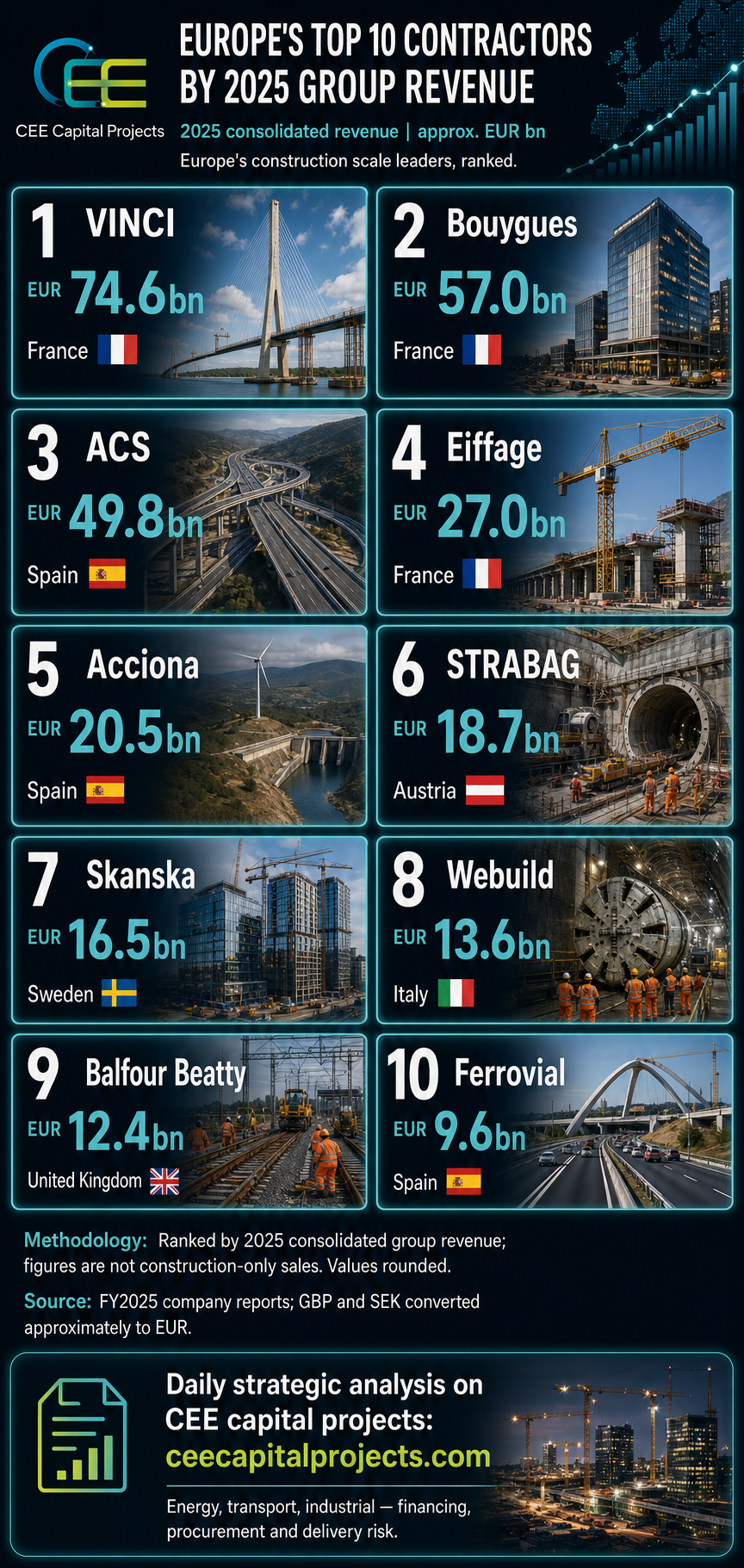
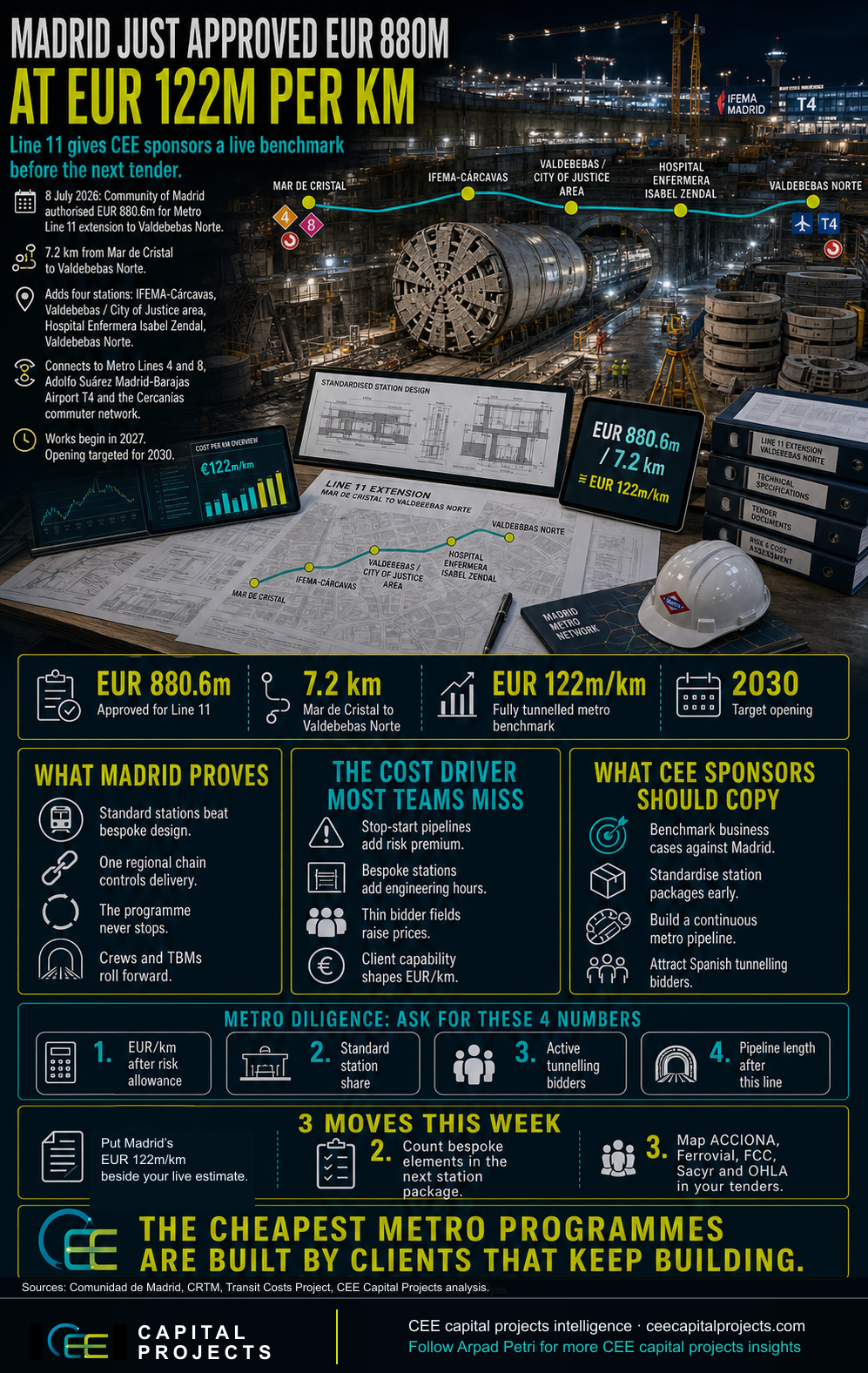
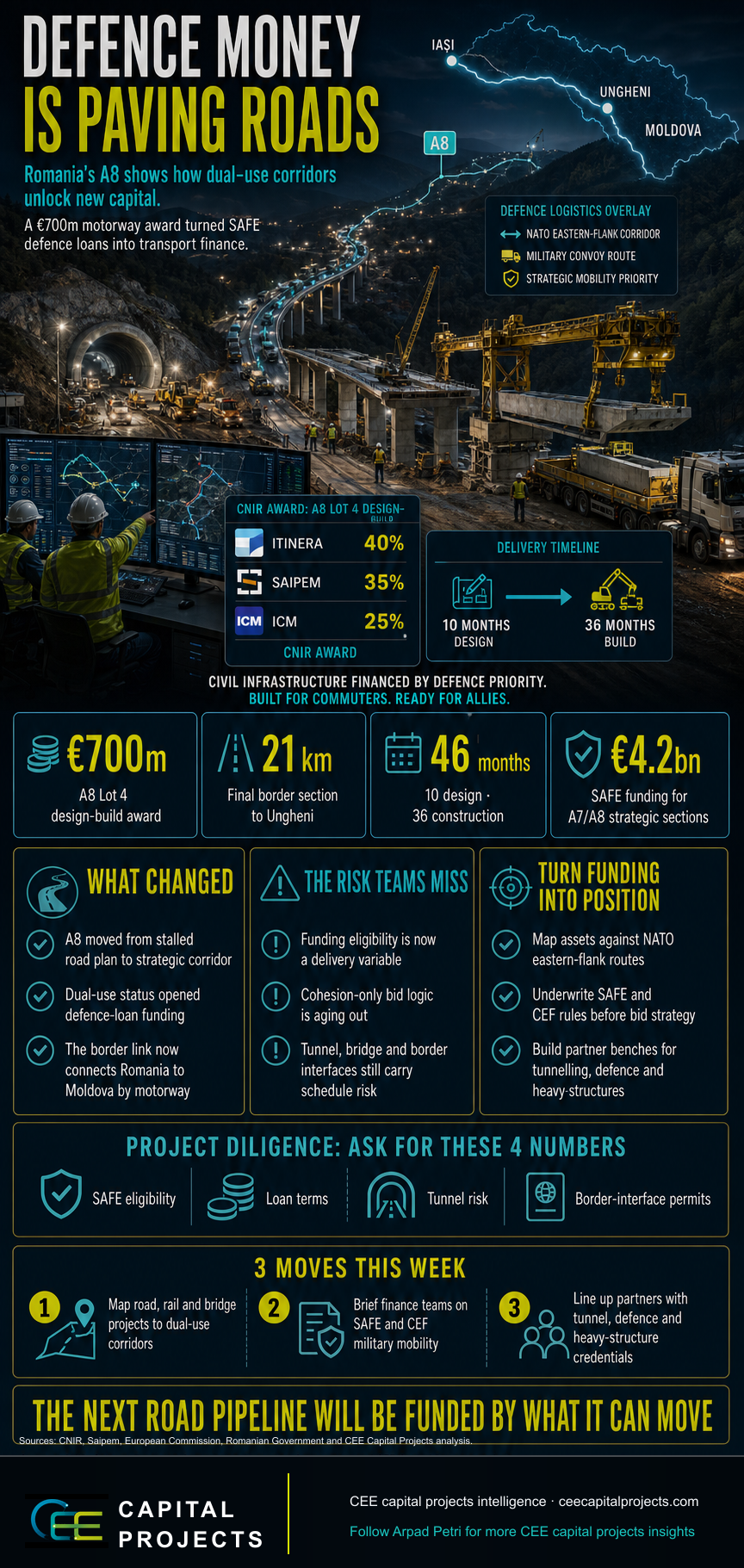
Explore our infograph library — strategic visuals for CEE capital projects leaders.
Project benchmarks, financing structures, tender dynamics and delivery risk — at a glance. Free access for investors, owners, contractors and strategy teams tracking CEE capital projects.
Browse the libraryStrategic Insights
📊 Analytics & Strategic Insight
Europe is buying its grid factory-first, and contract structure is reorganising around the constraint
The decision most in this industry are avoiding:
👉 Cable supply stopped being procurement and became capacity booking. Buyers still run these packages through a tender process built for competitive supply, while the underlying market has €38.4 billion of committed backlog and no free slots before 2029. A tender cannot create a production line. Operators who keep tendering as though it can will keep discovering their schedule was set in a factory they do not control.
👉 EPC margin on grid work is migrating to whoever owns the qualification. The scarce input on an HVDC link is a qualified insulation system and a booked manufacturing window, and neither can be bought in by a contractor. That single fact lets the manufacturer bid the full scope, absorb the interface risk it was already carrying, and keep the construction margin that used to sit with an EPC group.
👉 A turnkey award to a manufacturer relocates counterparty risk rather than removing it. IPTO now has one throat to choke and one balance sheet behind a €1.5 billion programme. Cable makers price liquidated damages against industrial earnings, not against a contractor's claim-and-recovery machine, so a delay on Corinth–Kos will be resolved through a very different commercial conversation than the same delay under a split contract.
Here's the full context:
→ 2023: The EIB closes its first Recovery and Resilience Facility transaction, a €524 million loan to IPTO to connect the Western and Southern Cyclades to the mainland grid. Greek island interconnection becomes an EU-backed template.
→ 5 February 2026: The EIB signs a €1.9 billion facility with IPTO for the Dodecanese interconnection, against a total project cost of about €2.5 billion, covering converter stations at Corinth and Kos plus the submarine cable systems on to Rhodes and Karpathos.
→ 2026: IPTO completes a €1 billion share capital increase that draws roughly €3.5 billion of demand, with the Greek State's share part-funded through the RRF, underwriting a 2026–2029 investment plan of about €6 billion.
→ Q2 2026: Prysmian takes a €910 million framework for Lot B of the island programme while Hellenic Cables signs a €1.15 billion frame agreement for the North and East Aegean, pushing Cenergy's cables backlog to a record €3.4 billion and its group backlog to €3.9 billion.
→ Most recent: On 13 August 2026 Cenergy Holdings announces that Fulgor S.A. has been awarded the approximately €1.5 billion turnkey EPCI contract for the 320kV, 1 GW Corinth–Kos interconnection, converter station to converter station, with works starting in Q4 2026 and completion in 2030.
What this means for infrastructure operators, contractors and investors:
✅ Transmission operators should be underwriting factory access before they underwrite a route. The programme date on any HVDC link is now set by an insulation-system qualification and a booked slot. Reserving capacity ahead of consent, or through frame agreements as IPTO did, is what turns a plan into a schedule.
✅ Contractors need a supply-chain position, not just a delivery position. On grid work the winning seat is either inside the manufacturer, in a joint venture with one, or in the marine and civils scope the manufacturer must subcontract. Bidding a full EPC against a vertically integrated supplier is a losing structure on price and on risk.
✅ Investors should reprice the listed cable names on contract mix, not volume. Turnkey scope carries construction risk and construction margin. The relevant disclosure is no longer backlog value alone; it is how much of that backlog is supply-only versus full EPCI, and what the liquidated-damages exposure looks like on the EPCI share.
3 moves you can make this week:
1️⃣ Audit every HVDC or high-voltage package in your pipeline for slot exposure. For each one, write down the manufacturing window it depends on, whether it is contractually reserved, and what the fallback supplier and delay cost are. Anything unreserved past 2028 is a schedule assumption, not a schedule.
2️⃣ Open a subcontract conversation with the cable makers now, before the turnkey awards land. Marine spreads, landfall works, converter-station civils and trenching all sit outside a cable plant. Being on the qualified subcontractor list before the EPCI contract is signed is worth more than a competitive bid after it.
3️⃣ Rerun your grid-capex thesis with the margin sitting in the factory. If you model contractors capturing EPC margin from the European grid wave, test the opposite case: manufacturers take the scope, contractors take thin subcontract work, and the valuation multiple shifts accordingly. Decide which side of that trade you are actually on.
Related analyses
- Energy & Power
Constellation's $4.3bn Nuclear Uprate Deal With Google: 890 MW, No New Site, and a Finite Pool
Constellation will invest more than $4.3bn to lift 890 MW out of 11 existing reactors under a 20-year Google power purchase agreement, at roughly half the per-kilowatt cost of recent American new build. The point for Europe is that the national uprate pool runs to three to five gigawatts, ČEZ banked its Dukovany headroom by 2009, and the only route left to fresh capacity is a CZK 407bn new build.
Read analysis → - Real Estate & Construction
Echo Investment's Owner Bid PLN 5.20 a Share for the Rest of Poland's Biggest Developer. The Market Never Came Down to Meet It
Lisala, the vehicle through which Hungary's WING controls Echo Investment, has notified Poland's regulator of a PLN 5.20 per share offer for the 37.63 per cent it does not own, about 4.4 per cent below the close that preceded it. Echo's shares have stayed above the bid, and two Polish pension funds now decide whether the country's largest developer leaves the Warsaw exchange after three decades.
Read analysis → - Transport & Infrastructure
V-Híd Just Lost Hungary's HUF 338 Billion Déli Körvasút at 42 Per Cent Complete. The Grant Clock Is the Real Story
Hungary halted construction of the Budapest Southern Circle Railway on 9 October 2026 and barred V-Híd from every ongoing rail investment. The HUF 367 billion of EU money behind the job survives only if a lawful re-tender lands inside two years.
Read analysis →
Building in Central Europe?
Tell us what you're building. We'll tell you what can go wrong — and how to prevent it.