We Help International Investors and Project Owners Deliver Major CEE Projects Without Expensive Surprises
Independent project intelligence and advisory across energy, transport, real estate and industrial construction.
Germany's Bau-Turbo Approves 7,892 Homes, but Build Cost Still Decides What Gets Built
Germany's federal building ministry says municipalities using the Bau-Turbo approved 7,892 homes in the first half of 2026, more than a quarter of them in Munich. The planning shortcut removes the slowest consent, but build cost and finance now decide which approved homes get started.
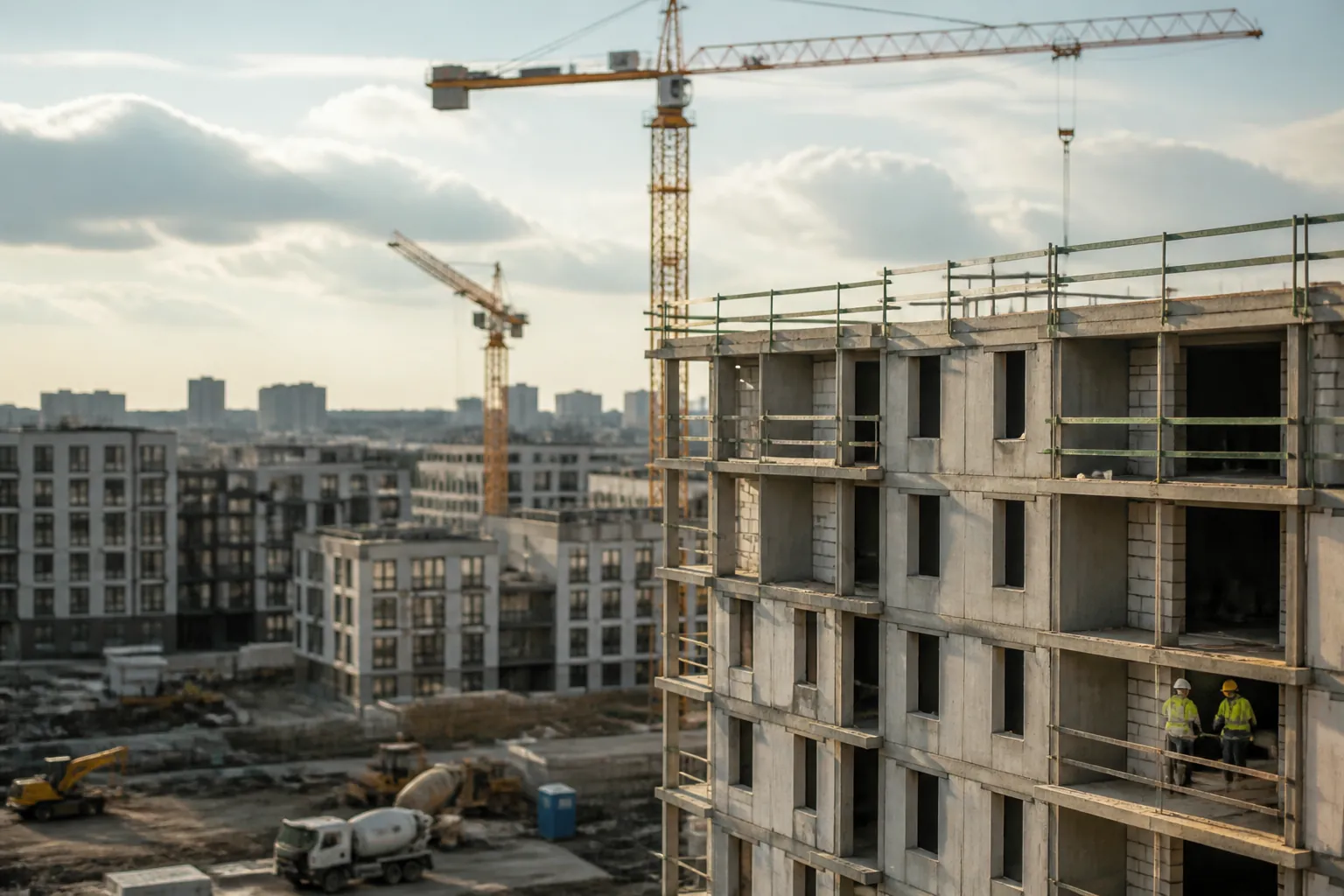
I think the Bau-Turbo is working best where it was needed least. It clears planning fastest in cities where the sums already worked. Munich alone accounts for more than a quarter of the homes approved under it so far.
Germany's federal building ministry published the first monitoring results in late October. Municipalities using the new route approved 7,892 homes in the first half of 2026. Munich contributed 2,107 of them. The data covers 393 municipalities that answered a voluntary survey, out of almost 11,000 in Germany. The ministry says the sample is not representative.
What the law changed
The Bau-Turbo took effect on 30 October 2025. Its core is section 246e of the federal building code. The clause lets a municipality approve housing that departs from the local land-use plan. The developer no longer needs a new or amended development plan first. The clause runs until the end of 2030.
That matters because the development plan was the slowest consent in the German chain. A new plan needs surveys, public consultation and a council vote. It can be challenged in court afterwards. Each step adds months, and each month adds interest on land the developer already holds. The Bau-Turbo removes that step and hands the decision to the town hall.
What the first half-year shows
The monitored municipalities logged 1,624 cases. Of those cases, 57 per cent were approved and 28 per cent refused. About 84 per cent of approved homes sit in multi-family buildings. Most of them, 88 per cent, are on land already in use, such as brownfield or commercial sites.
Here is why the land figure matters. Building on used land avoids the fight over green fields that stalls many new plans. Town halls find these approvals easy to defend. In practice the reform has become a densification tool.
The concentration is the striking part. Munich's share is more than a quarter of all approved homes. Large cities as a group filed only about 18 per cent of applications. A handful of high-price cities therefore produced most of the volume.
Approval is only the first gate
A Bau-Turbo approval opens the first of three gates. The ministry's own footnote says municipal consent does not equal a final building permit. By the end of June, only 36 per cent of approved projects held a building permit.
The mechanism is a sequence. The town hall consents to the departure from the plan. The building authority then checks the design against the building rules. Only after that does the developer raise finance and sign a contractor. The reform shortens the first gate and leaves the other two as they were.
There are no figures yet on starts or completions under the scheme. The ministry expects the first finished homes to become visible next year.
Permits are rising faster than homes are built
The national statistics show the same split. Destatis, the federal statistics office, counted 169,400 approved homes from January to August. That is 12.1 per cent more than a year earlier. Approvals for multi-family buildings rose fastest.
Completions are moving the other way. Germany finished 206,600 homes in 2025, the fewest in more than a decade. The ifo Institute expects about 185,000 this year.
That happens because a permit costs a developer little to hold. It works like an option on a future start. Developers file while the window is open and wait for the sums to work. The permit count measures intent, and the completion count measures what was financed.
Build cost now decides what starts
Once planning is fast, the cost of building decides what starts. Destatis put new-build prices for residential buildings 5.5 per cent above a year earlier in August. Finishing trades rose 5.7 per cent, slightly faster than shell work.
That is what the index does to a housing scheme. A developer works backwards from the expected sale price or rent. Build cost and finance cost come off the top. What remains is what the land can be worth. When build cost rises faster than prices, that residual shrinks.
This explains Munich. Sale prices there are high enough to absorb the cost rise. In Munich the binding constraint really was the plan. In a mid-sized town, sale prices sit much closer to build cost. Removing the plan there removes a constraint that was rarely binding.
Who keeps the time saved
A faster consent creates value, and someone captures it. The first claimant is the landowner. The reason is simple. Land with a likely fast approval is worth more than land waiting years for a plan. Sellers know this and price it in. If the land price absorbs the saving, the developer's margin stays the same and so does the start rate.
The second claimant is the contractor. Approved schemes are mostly multi-family, on used land, inside existing towns. That favours general contractors used to tight urban sites. Upward extensions and conversions made up about a sixth of cases, which means smaller tickets. For groups with German building arms, such as STRABAG and PORR, this pipeline arrives slowly and in small pieces.
The read: consent is fixed and cost still decides
The likelier path is that approvals keep rising into 2027 while completions fall again this year. The Bau-Turbo has fixed consent in the cities where consent was the problem. Elsewhere, cost and finance still decide.
That matters because the next monitoring round will show whether approvals turn into permits. The figure to watch is the share of approved projects holding a full building permit. If it rises well above a third, the pipeline is real. If it stalls, the reform will mostly have produced options on land.
Share it with your peers
Help your network stay ahead of CEE capital projects.
Strategic Insights
📊 Analytics & Strategic Insight
Germany Fixed Its Slowest Consent. The Land Market Will Decide Who Keeps the Saving.
The decision most in this industry are avoiding:
👉 Landowners are capturing the reform before builders do. A site with a likely fast approval reprices as soon as the town hall signals it will use the clause. Developers buying land now are paying for time they have not yet saved.
👉 A clear refusal is now worth almost as much as an approval. Under the plan route a weak scheme died slowly inside procedure. An early municipal no tells a developer which towns will not densify, and that map is worth building before the next land purchase.
👉 Consent by deviation may prove less durable than consent by plan. A development plan sets the rules for a whole area and every later applicant. A one-off deviation covers only the scheme it approves, so lenders will ask how exposed it is to challenge.
Here's the full context:
→ 2025: Germany completes 206,600 homes, down 18 per cent and the fewest since 2012.
→ 30 October 2025: The Bau-Turbo takes effect, with section 246e of the building code valid until the end of 2030.
→ First half of 2026: 393 municipalities log 1,624 cases in the ministry's voluntary monitoring.
→ 16 October 2026: Destatis reports 169,400 homes approved from January to August, up 12.1 per cent.
→ Most recent: The ministry's first monitoring report counts 7,892 approved homes, 2,107 of them in Munich.
What this means for infrastructure operators, contractors and investors:
✅ Land acquisition teams should price the approval route into every bid. A site that qualifies for a deviation is a different asset from one that needs a new plan. Ask the town hall early whether it uses the clause at all, because participation is voluntary.
✅ Development lenders should separate consent risk from cost risk. The reform lowers the first and leaves the second untouched. A credit paper that treats a municipal approval as de-risking the whole scheme overstates it.
✅ Contractor bid teams should build an offer for small urban sites. The approved pipeline is dense, multi-storey and on land already in use. Firms that can run tight inner-city sites at modest contract sizes will see this work first.
3 moves you can make this week:
1️⃣ Re-run your residual land values with the latest build-cost index. Update the cost line on every German site in your pipeline. Any scheme whose residual has turned negative will not start, whatever its approval status.
2️⃣ Ask the ministry's model municipalities how their cases are moving. Towns such as Duisburg, Kiel and Trier sit in the federal support programme. Their case lists show which project types clear the permit stage after approval.
3️⃣ Write an approval-route adjustment into land option agreements. Tie part of the land price to the consent route actually achieved. If the town hall refuses a deviation, the price should fall back to plan-route value.
The analyst's read:
This proves the Bau-Turbo can move consent quickly where land values are high. It does not prove it can lift completions where build cost sits close to what buyers will pay. The figure that settles it is the share of approved projects holding a full building permit in the ministry's next monitoring round.
Related analyses
- Real Estate & Construction
Adventum and Habaita want a EUR 2 billion mall platform. Its only mall just borrowed to pay shareholders
Adventum and Habaita are building a regional shopping-centre platform on Urban Plaza Plus, owner of Budapest's KÖKI. A EUR 95 million refinancing funds the first dividend, and a share price below book value decides how the platform can grow.
Read analysis → - Real Estate & Construction
Poland's Construction Output Fell 8.9%: Why Record CEE Order Books Are Not Turning Into Work
Eurostat's September data puts Hungary, Romania and Poland at the bottom of the EU construction table, while Polish builders report record order books. The gap between signed work and built work is now the main test of contractor health in the region.
Read analysis → - Energy & Power
Latvia's Grid Operator Now Borrows at 4.8%, and Its Build Plan Has to Carry It
Latvia's transmission operator AST is repaying its 0.5% green bond early, after raising replacement money at 4.768%. With most of its ten-year grid plan funded from its own balance sheet, the price of that money now shapes which lines and substations move first.
Read analysis →
Get a second opinion before it gets expensive.
Contractor selection, tender strategy, a project drifting off track — send us the situation and we'll come back with a clear plan.