We Help International Investors and Project Owners Deliver Major CEE Projects Without Expensive Surprises
Independent project intelligence and advisory across energy, transport, real estate and industrial construction.
Europe's Data Centre Race Is Now a Grid Race: Interconnection Queues Reprice the Market as Poland Plays Power-First
Grid-connection queues of seven to ten years, not chips or capital, now decide which European data centres get built, and power-secured sites command a scarcity premium. Poland's 3.2 GW Baltic Data Center Campus, which locked in its grid conditions upfront, shows how the smart money is underwriting megawatts before land.
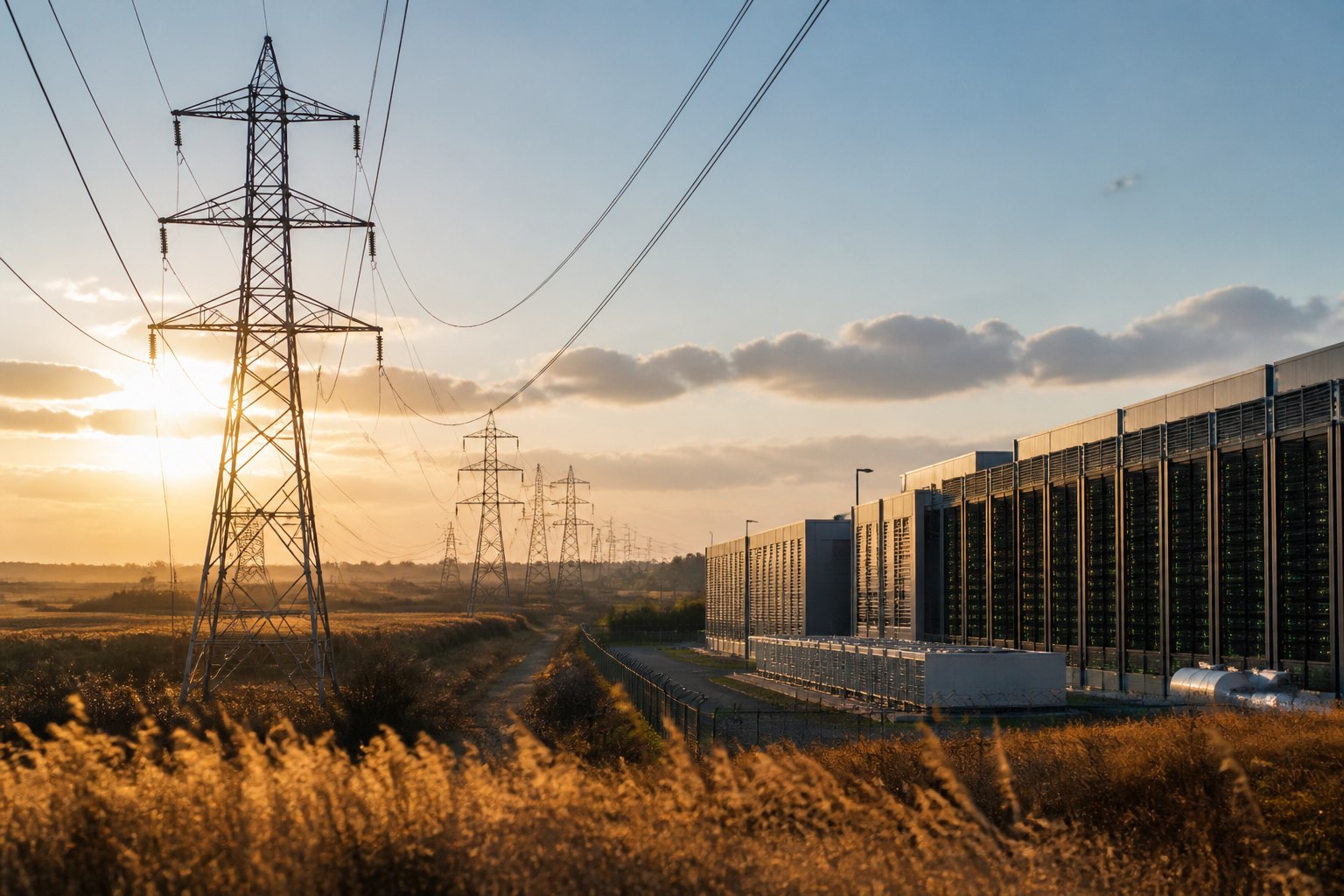
The binding constraint on Europe's artificial-intelligence buildout is not silicon and it is not money. It is a socket. In the region's largest digital hubs, a new data centre now waits seven to ten years for a grid connection, and up to thirteen years in the most congested markets, while the building itself takes roughly two years to construct. That gap has quietly become the most important number in European infrastructure, and it is repricing an entire asset class.
The figure comes from Ember, the energy think-tank, in its June 2025 report "Grids for data centres". It has since hardened into the working assumption behind every serious underwriting model in the sector. When the queue for power runs five times longer than construction, capital arrives, land is bought, tenants are signed, and then the asset sits dark, earning nothing.
The market is pricing megawatts, not square metres
For a decade, a data centre was a real-estate play dressed up as technology: connectivity, proximity to users, and cheap capital decided the winners. That model is breaking. AI clusters land on the grid as continuous, high-density loads, often more than 100 MW at a single site, and they cannot be staggered the way older enterprise workloads could. They need firm power, at scale, on day one.
The cost of getting it wrong is now visible in the numbers. EU grid-congestion costs reached EUR 4.3 billion in 2024, according to ACER, the EU energy regulators' agency, as operators paid to manage power the network could not physically move. Ireland has spent close to EUR 1 billion on emergency generation to keep Dublin's data-centre cluster supplied. On 30 April 2026, ENTSO-E, the body that coordinates Europe's transmission operators, warned that data-centre demand could swallow so much of the continent's spare generation that grid operators would be forced to curtail renewables to keep systems stable.
Capital is already moving to where the power is
The response from investors is a straightforward flight to certainty. Frankfurt, London, Amsterdam, Paris and Dublin, the legacy "FLAP-D" hubs, were built for connectivity, not for absorbing multiple gigawatts inside a development cycle. Money is now flowing to markets where the grid can actually deliver. In parts of the Nordics and in Italy, connection timelines fall to roughly three years, and that single fact is enough to redraw the European data-centre map. A site with credible, near-term power now trades at a premium; a site without it is treated as speculative, wherever it sits.
The scale of what is at stake is large. The European Data Centre Association puts cumulative Western European data-centre investment at around EUR 176 billion between 2026 and 2031, and EU data-centre capacity is expected to more than double, from about 12 GW in 2025 to 28 GW by 2030. How much of that capital lands in the core markets, and how much migrates east and north, will be decided by transmission planners, not chip designers.
Poland's power-first play
This is where Central Europe enters the story. In Choczewo, on Poland's Baltic coast, WBS Power is developing the Baltic Data Center Campus, a 3.2 GW hyperscale project it says is one of the largest in Europe. The detail that matters is not the size but the sequencing: WBS Power announced in March 2026 that it had already secured grid-connection conditions for the full 3.2 GW before breaking ground, phasing the build in 800 MW stages with a first phase costed at EUR 6.9-8.6 billion. The campus sits beside one of Poland's largest substations and near the landfall of the 1.2 GW Baltic Power offshore wind farm, which began feeding the grid this month.
Poland is deliberately building the headroom others lack. Grid operator PSE has a roughly EUR 15 billion investment plan running to 2034, sized to absorb tens of gigawatts of new wind and solar. The country is not immune to the speculative overbooking plaguing the rest of Europe: connection applications from data centres alone total around 13 GW, far more than can be real, and in January 2026 the government approved a draft energy-law overhaul to curb phantom reservations and speed genuine ones. But by treating grid capacity as the product to be secured first, Polish developers are selling exactly what the market has decided is scarce.
What comes next
For contractors, EPC firms and investors, the lesson is that the value chain has inverted. The scarce, bankable asset is no longer the finished shell but the interconnection agreement, the substation slot, and the megawatts behind them. Projects that lock in firm power early will command a scarcity premium and cleaner financing; those that assume the grid will catch up will find equity trapped in dark buildings and debt structures straining under delayed cash flows. Europe's AI ambitions will be delivered, or not, by its transmission networks, and the smart money has already stopped pricing space and started pricing power.
Share it with your peers
Help your network stay ahead of CEE capital projects.
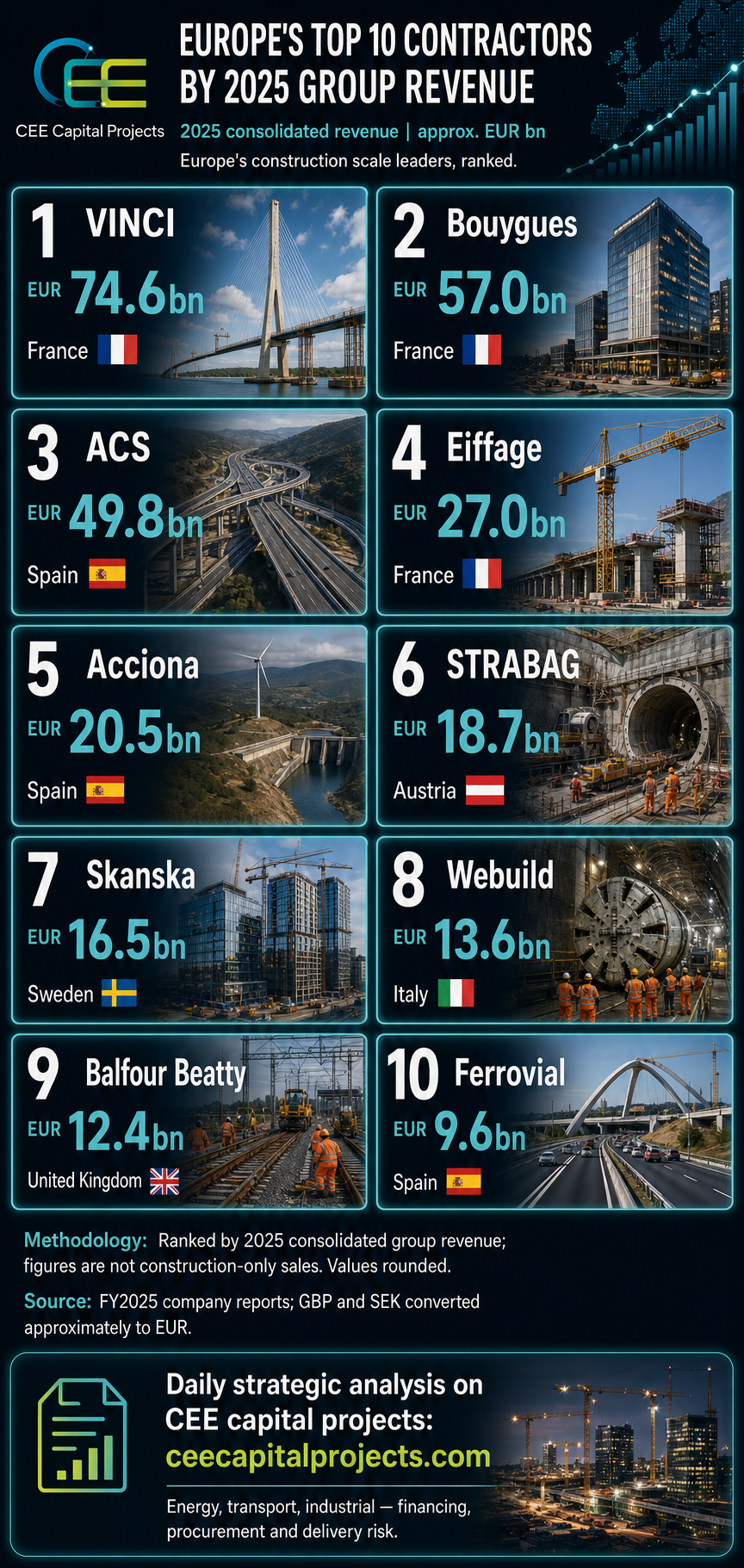
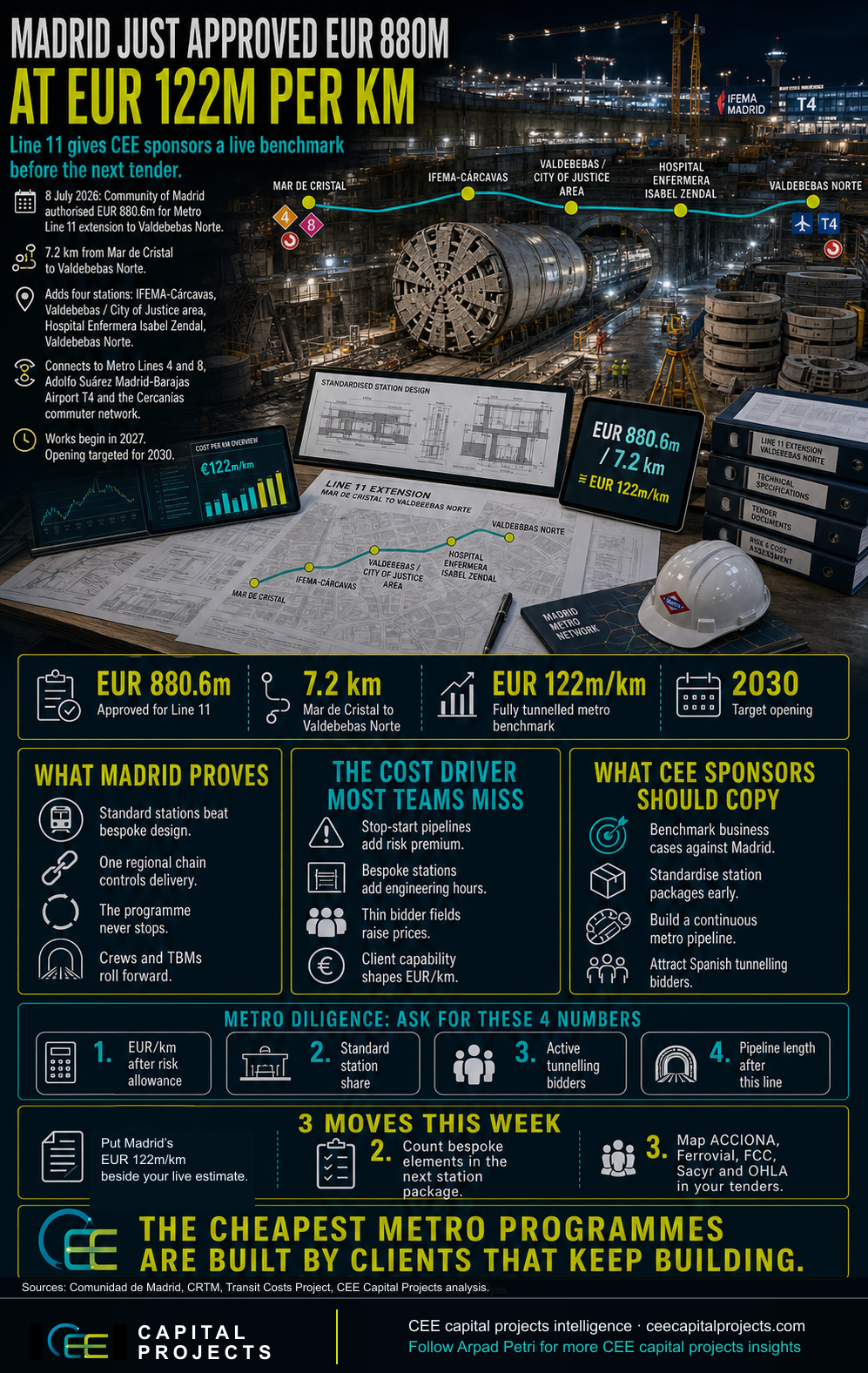
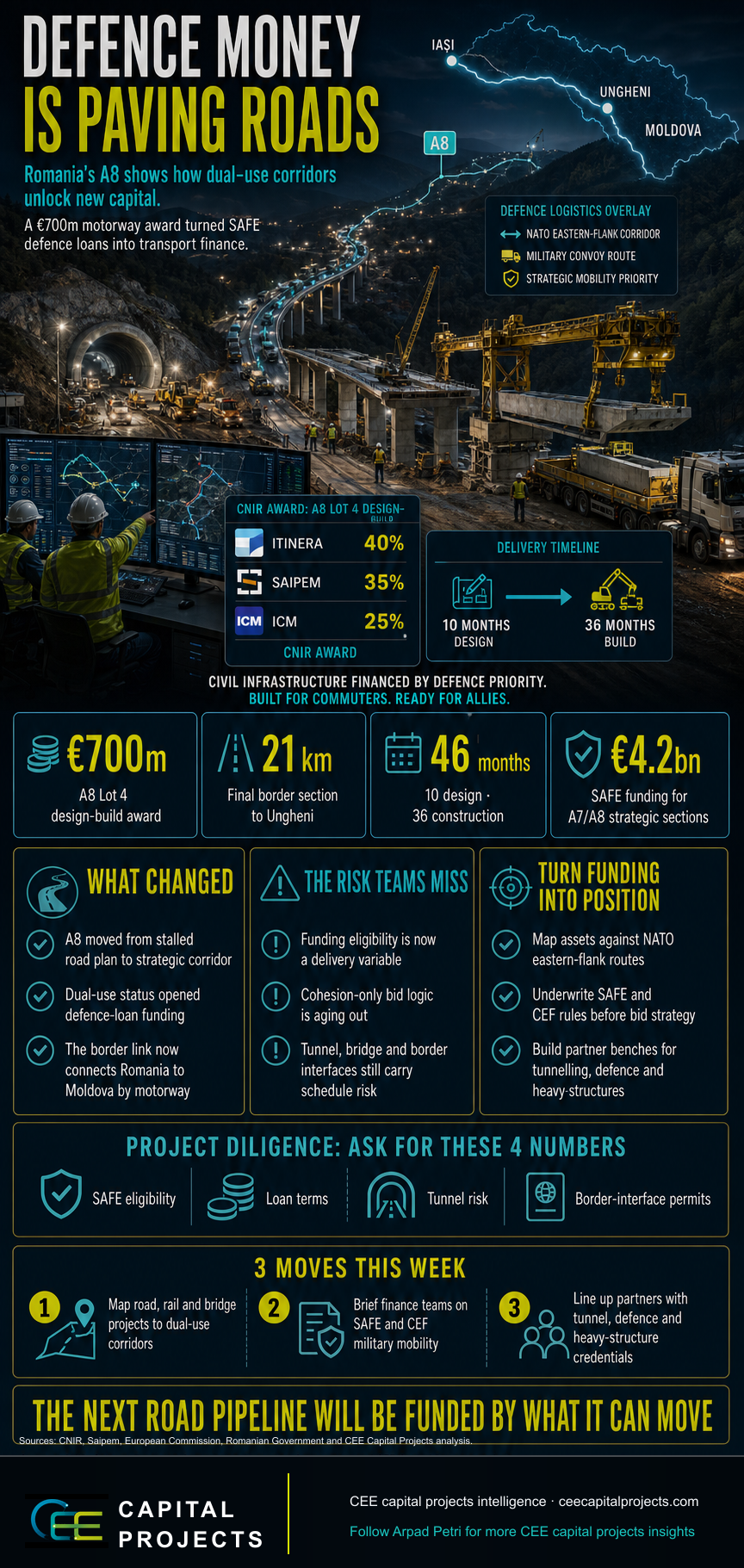
Explore our infograph library — strategic visuals for CEE capital projects leaders.
Project benchmarks, financing structures, tender dynamics and delivery risk — at a glance. Free access for investors, owners, contractors and strategy teams tracking CEE capital projects.
Browse the libraryStrategic Insights
📊 Analytics & Strategic Insight
In Europe's AI buildout, the grid connection is the asset, and power-secured sites are the new scarcity trade
The decision most in this industry are avoiding:
👉 Stop underwriting data centres as real estate. The discipline that wins now is energy project finance, not property development. A site's value is set by its interconnection queue position, not its postcode, and treating power as a procurement afterthought is how equity ends up trapped in a completed, revenue-free building.
👉 The FLAP-D hubs are a melting ice cube. Frankfurt, London, Amsterdam, Paris and Dublin still carry brand prestige, but seven-to-ten-year queues mean the incremental gigawatts will not land there. Refusing to reprice legacy-hub land against three-year-connection markets like the Nordics, Italy and Poland is a slow write-down few are booking honestly.
👉 Speculative grid applications are hiding the real pipeline. When 13 GW of data-centre requests sit in Poland's queue and 74 GW was rejected system-wide in a single year, headline demand is fiction. The operators quietly holding firm, non-speculative connection agreements are the only credible counterparties, and most capital has not learned to tell them apart.
Here's the full context:
→ 2024: European data centres consumed about 96 TWh, roughly 3% of demand at continental level but a third to over 40% locally in the main hubs; EU grid-congestion costs hit EUR 4.3 billion (ACER).
→ June 2025: Ember's "Grids for data centres" quantified the bottleneck: seven-to-ten-year connection queues in FLAP-D hubs, up to thirteen years in the most congested markets, against roughly two-year construction.
→ March 2026: WBS Power unveiled the 3.2 GW Baltic Data Center Campus in Choczewo, Poland, having already secured grid-connection conditions for the full capacity, phased in 800 MW stages, Phase I at EUR 6.9-8.6 billion.
→ 30 April 2026: ENTSO-E warned that data-centre demand could consume so much spare generation that operators would have to curtail renewables to keep systems stable.
→ Most recent: With Western European data-centre investment estimated at EUR 176 billion for 2026-2031 (European Data Centre Association) and capacity set to more than double to 28 GW by 2030, capital is visibly reallocating from legacy hubs to power-secured sites, and Poland is positioning as a winner.
What this means for infrastructure operators, contractors and investors:
✅ Power certainty is now the core underwriting variable. Queue position, substation capacity and planned reinforcements belong in the investment memo before land and tenant covenants; a firm connection is worth more than a prime address.
✅ Secondary and CEE markets capture the overflow. The Nordics, Italy and Poland gain share precisely because they can connect load in about three years, turning grid planning into a regional competitiveness weapon.
✅ The power stack is being redesigned, not just contracted. PPAs alone no longer clear the risk; on-site generation, storage, phased energisation and behind-the-meter links are becoming standard, opening a real pipeline for EPC firms, gas and grid contractors, and BESS developers.
3 moves you can make this week:
1️⃣ Map your portfolio by connection date, not completion date. Re-rank every site and pipeline asset on realistic energisation timing, and flag anything relying on the grid "catching up" as at-risk equity.
2️⃣ Get upstream with the TSO. Open direct dialogue with the transmission operator on queue reform, anticipatory reinforcement and non-firm or phased connections; the developers moving first on this are locking in the scarce slots.
3️⃣ Price the power-secured premium into your bids. Where you hold firm capacity, underwrite and market it as the differentiator; where you do not, pivot sourcing toward three-year-connection markets before the repricing is fully in the numbers.
Related analyses
- Energy & Power
Constellation's $4.3bn Nuclear Uprate Deal With Google: 890 MW, No New Site, and a Finite Pool
Constellation will invest more than $4.3bn to lift 890 MW out of 11 existing reactors under a 20-year Google power purchase agreement, at roughly half the per-kilowatt cost of recent American new build. The point for Europe is that the national uprate pool runs to three to five gigawatts, ČEZ banked its Dukovany headroom by 2009, and the only route left to fresh capacity is a CZK 407bn new build.
Read analysis → - Energy & Power
NEK's EUR 350 Million Yadenitsa Dam Tender Turns Bulgaria's Chaira Storage Fix Into a Civils Job
Bulgaria's NEK has put EUR 350m on the market for the Yadenitsa dam and a six kilometre tunnel at the 864 MW Chaira pumped storage plant, with bids due 4 November 2026 and 60 months to build. The civil works are costed at more than three times the EUR 102m reconstruction of all four of the plant's machines.
Read analysis → - Energy & Power
EIB and BNP Paribas Guarantee EUR 700m of Grid Equipment Bonds: Europe's Network Bottleneck Moves to the Balance Sheet
The EIB and BNP Paribas signed a EUR 700m counter-guarantee portfolio on 29 September 2026, covering advance payment and performance bonds for European manufacturers of electricity grid components. The instrument is small, and it points at the constraint that now sets delivery dates on Europe's grid build: bonding capacity rather than factory floor.
Read analysis →
Building in Central Europe?
Tell us what you're building. We'll tell you what can go wrong — and how to prevent it.