We Help International Investors and Project Owners Deliver Major CEE Projects Without Expensive Surprises
Independent project intelligence and advisory across energy, transport, real estate and industrial construction.
The EU Network Charges Regulation Hit a Tax Wall: What It Means for Europe's 100 Billion Euro Grid Build
EU energy ministers spent their first political debate on the network charges regulation arguing about one excise-duty article. The tariff articles underneath it are the ones that decide who funds Europe's grid build and what a connection costs.
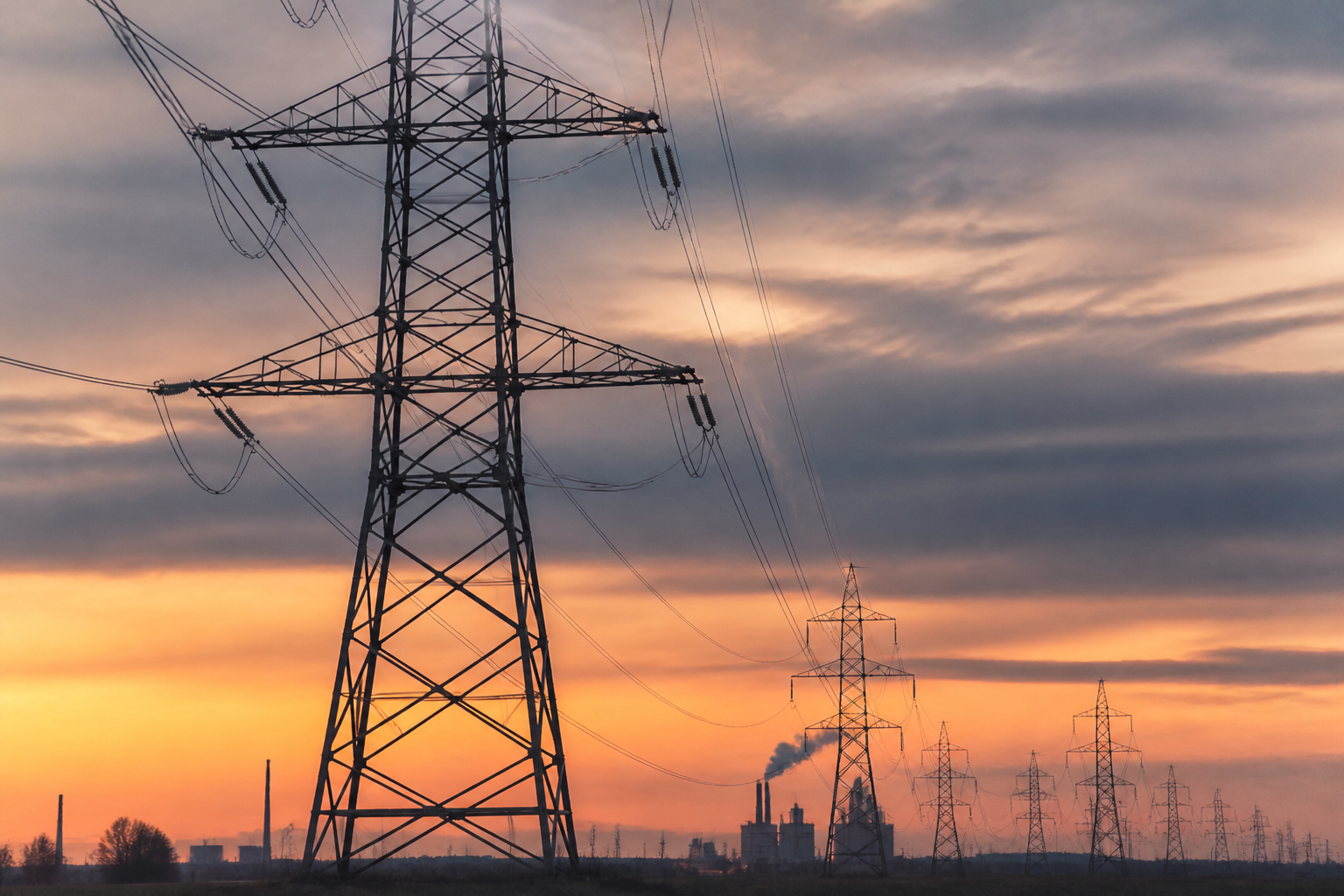
My view is simple. The taxation article should be cut out and the tariff articles should go through. The tariff articles are where Europe's grid capital spending actually gets funded.
On 29 October 2026 EU energy ministers held their first political debate on the Commission's network charges regulation in Luxembourg. Almost all of it went on the legal basis of one provision about excise duty. Network charges already account for 24 to 29 per cent of a household electricity bill. That figure is the Commission's own, in the explanatory memorandum to COM(2026) 600 of 17 July 2026.
What the Council actually argued about
The Council Legal Service gave an unfavourable opinion on the taxation provisions, and on Article 18c in particular. That article would require electricity to be taxed more favourably than natural gas. The opinion went orally to the Working Party on Energy and is unpublished.
A majority of member states want Article 18c removed. Many want the taxation element to sit on Article 113 instead. That is the tax base of the Treaty on the Functioning of the European Union (TFEU). That matters because Article 113 requires unanimity. Unanimity on energy tax has already failed once. The Danish presidency abandoned the Energy Taxation Directive revision in November 2025. A file that carries a tax article inherits that record.
Greece proposed a joint meeting with finance ministers, and Bulgaria, Slovakia and Romania backed it. Luxembourg offered a narrower route. It would replace the contested provisions with a general duty. That duty would be to promote electrification and improve the gas to electricity price ratio. Energy Commissioner Dan Jørgensen said he had taken careful note of the concerns.
The tariff is the grid's revenue line
Here is why the tariff articles matter more than the tax one. ACER is the EU agency that coordinates national energy regulators. It estimates annual grid investment could double to as much as 100 billion euro by 2050. Total grid costs could rise by up to 60 per cent over the same horizon.
A regulated network operator recovers that spending through allowed revenue. Allowed revenue is collected through network charges. So a charging methodology is a financing instrument before it is a consumer measure. No EU budget line of that size exists. Cohesion funding and the Recovery and Resilience Facility (RRF) cannot carry it either. The tariff is what is left.
Grants were never designed to close a gap of that shape. A grant funds a project once. A tariff funds a rolling asset base for decades. That is why the Commission reached for the charging rules rather than a new fund.
Anticipatory investment gets built only if the regulator can recover it
The proposal puts the cost of anticipatory investment inside the costs that tariffs must reflect. It excludes costs that support unrelated policy objectives.
The mechanism is straightforward. An operator that builds ahead of demand holds an asset with no customer on it. If the regulator will not allow that cost, the rational move is to wait for the connection request. Queues are the result of that incentive. Connection queues now exist in at least 16 member states, and some reached 30 times peak load in 2024.
Grid users feel this as a date rather than a cost. The reinforcement is not refused. It is simply not started until somebody has signed for it.
A flexible connection trades firmness for a date
The tariff article also requires charges to enable flexible connections, without letting that delay reinforcement. A flexible or non-firm connection gives a user an earlier energisation date. In exchange the user carries curtailment risk.
The reason is simple. The wire is sized for the firm case. A user who accepts curtailment does not need the reinforcement finished first. That changes the financing case as well as the programme. A lender now has to size debt against curtailed hours in the base case. Projects underwritten on firm access get repriced rather than refused.
The locational signal is a siting decision
The same article requires tariff methodologies to carry locational investment signals. Charges would differ according to where a user connects. That is a planning instrument dressed as a billing rule.
The mechanism is a price gap. Connecting at a congested node would cost more than connecting at a spare one. The cheapest land stops being the cheapest site. Developers already model land, grid distance and consent. A node-level charge adds a fourth line, and across much of Central and Eastern Europe nobody has priced it yet.
Data centres and heavy industry get a regime with a test attached
Article 18(3) lets a national regulator set a special tariff regime for categories such as energy-intensive industry and data centres. The provision is conditional, and the condition is the interesting part.
That matters because the regulator has to show the category places a proportionally different impact on the network. Cost-reflectivity still has to hold. That moves the argument off lobbying and onto measured load profiles. A flat load profile has a real case. A sharp evening peak does not.
Bid teams should read a second safeguard closely. A special regime cannot push costs onto households and smaller businesses. So a discount granted at one node has to be funded somewhere in the same tariff.
The meter programme is the works package behind the reform
The proposal sets smart metering targets. At least 50 per cent of final customers must be covered by 2030. The target rises to 75 per cent by 2033.
That matters because a time-of-use charge cannot be billed without interval metering. The meter rollout therefore gates the tariff reform. In the member states furthest behind it becomes a procurement and installation programme on a fixed date. The payoff is measurable. Slovenia's tariff reform cut peak load by more than 2.4 per cent.
What I think happens next
I expect Article 18c to be cut and the tariff articles to survive in a narrower form. The reason is simple. It is procedural rather than political. Splitting a file is cheaper than losing it. The presidency has already run two compromise texts through the working party.
Adoption in the first half of 2027 stays reachable only if the taxation element goes before trilogue. One thing settles whether any of this changes project economics. Watch whether the delegated power to set a common tariff structure survives. If it does, tariff methodology becomes an EU-level variable and national regulatory risk falls for cross-border grid investors. If it is stripped out, the file is a transparency exercise and nothing in a connection budget moves.
📊 Analytics & Strategic Insight
A billing rule is Europe's last grid funding instrument, and an excise clause is holding it hostage
The decision most in this industry are avoiding:
👉 Treating this as a household bills file is the mistake. The Commission wants electrification to reach 46 per cent of final energy use by 2040. Nobody has written a cheque for the wires that carries. The charging rules are the cheque. So the detail belongs in a capital plan rather than a public affairs note.
👉 The delegated power is the prize, and almost nobody is lobbying on it. Attention has gone to the tax clause, which affects a bill. The power to set a common tariff structure affects a regulated asset base in twenty-seven jurisdictions. One is a price. The other is a valuation input.
👉 Non-firm access is being sold as a win and priced as a gift. In the consultation behind the proposal, 82 per cent of respondents saw congestion-relieving measures as potentially helpful. Very few sponsors have put a number on the curtailed hours they would accept. A concession you have not priced is a liability you have not disclosed.
Here's the full context:
→ 2019: Regulation (EU) 2019/943 sets the current principles for network charging. Cost-reflectivity is the anchor and national regulators decide almost everything else.
→ November 2025: The Danish presidency abandons the Energy Taxation Directive revision after years of deadlock. Energy tax stays unreformed and unanimity is discredited as a route.
→ March 2026: The European Council of 19 March asks the Commission for urgent targeted measures on electricity prices. That request becomes the mandate for the file.
→ 17 July 2026: The Commission presents COM(2026) 600 alongside the Electrification Action Plan. One instrument bundles tariff design, smart metering, grid data and two taxation provisions.
→ Most recent: On 29 October 2026 in Luxembourg, the legal basis of Article 18c dominates the first political debate. The tariff articles are barely discussed.
What this means for infrastructure operators, contractors and investors:
✅ The regulatory team inside a network operator now owns a capital question. Build-ahead capacity only clears an investment committee if the cost sits in the allowed revenue. The drafting on anticipatory cost is therefore a financing term. It should be read by the people who size the asset base. The regulatory affairs desk should not own it alone.
✅ The lender's technical adviser has a new base-case input. Where a project accepts a non-firm connection, the adviser has to model lost hours rather than assume firm access. A study commissioned by SmartEN found peak load could fall by more than 20 per cent. That assumes high electric-vehicle uptake. It tells you how much of this flexibility the system intends to use.
✅ The site-selection team for a large load has to carry a node-level price. Grid charges have been treated as a fixed national input for a decade. In the same consultation, 56 per cent of respondents said capacity is locked up by requests that never mature. Queue position and node choice are now commercial variables rather than engineering ones.
3 moves you can make this week:
1️⃣ Pull the network charge out of your opex line and model it separately. Split it into the one-off connection payment and the recurring charge. Run both against a time-of-use and a capacity-based structure. If the two structures give different answers, you have found a siting decision.
2️⃣ Put a price on the curtailed hours you would accept. Ask your adviser for the number of hours at which a non-firm connection stops being cheaper than waiting. That single figure turns a negotiating position into a decision rule.
3️⃣ Read your regulator's next tariff consultation as a procurement document. The metering and tariff timetable sets when national methodologies change. In the consultation behind the proposal, 66 per cent of respondents said immature connection requests are a problem. Expect maturity tests to arrive before the charging reform does.
The analyst's read:
This proves the Council can agree that grid funding needs a charging answer. It does not prove it can pass one, because the taxation clause gives every reluctant capital a procedural exit. The figure that settles it is whether the delegated power on a common tariff structure survives the first compromise text. That lands before trilogue opens.
Share it with your peers
Help your network stay ahead of CEE capital projects.
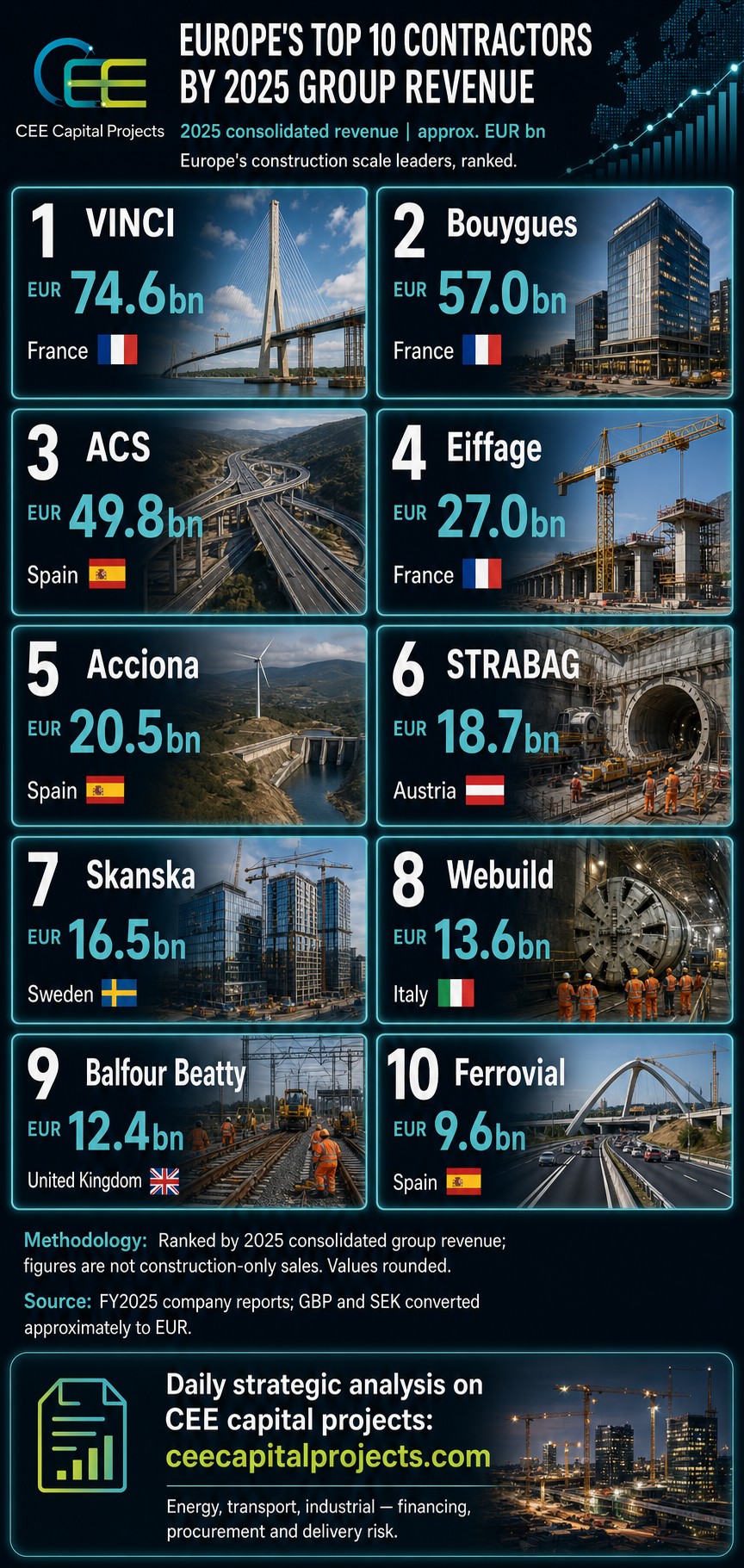
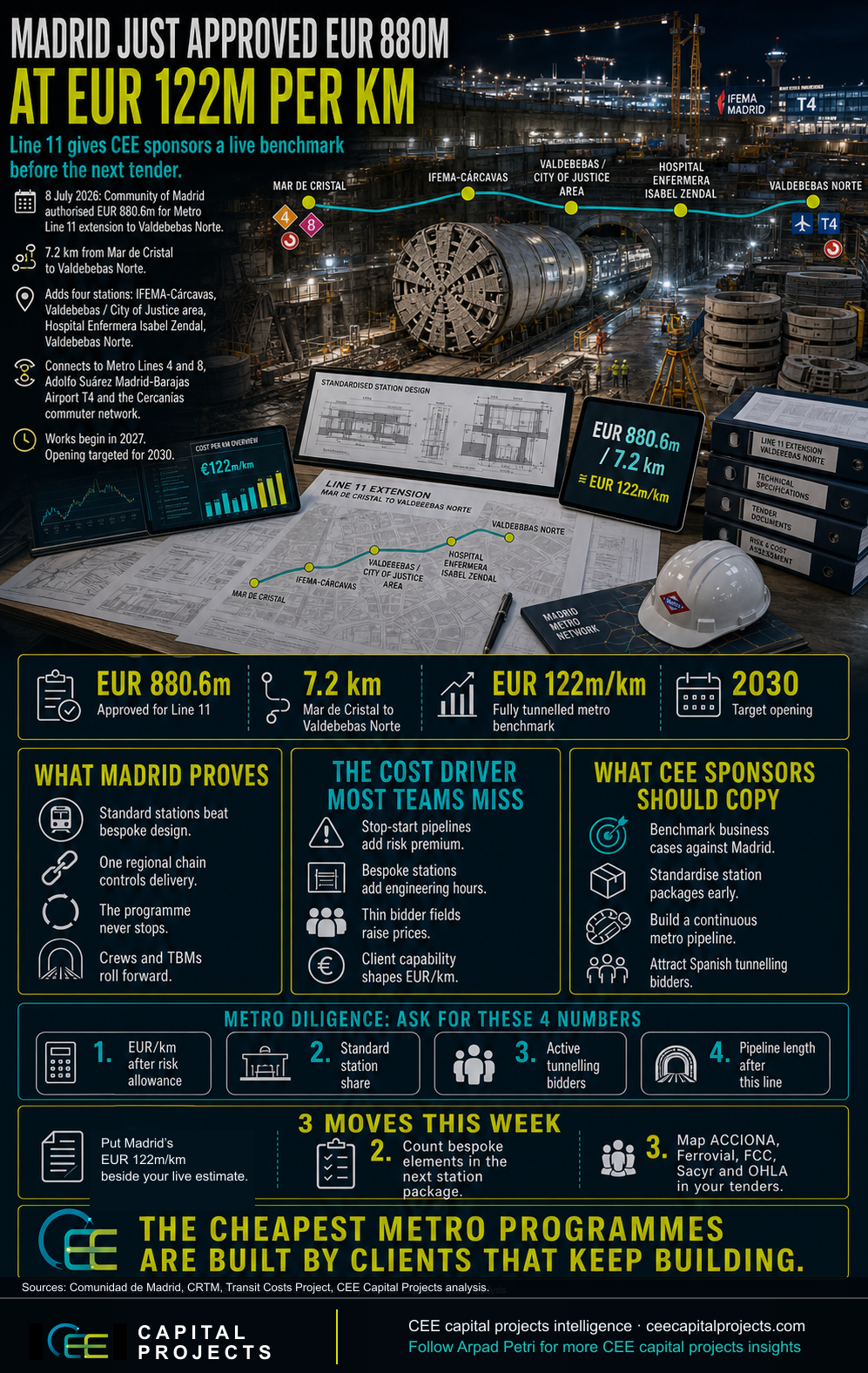
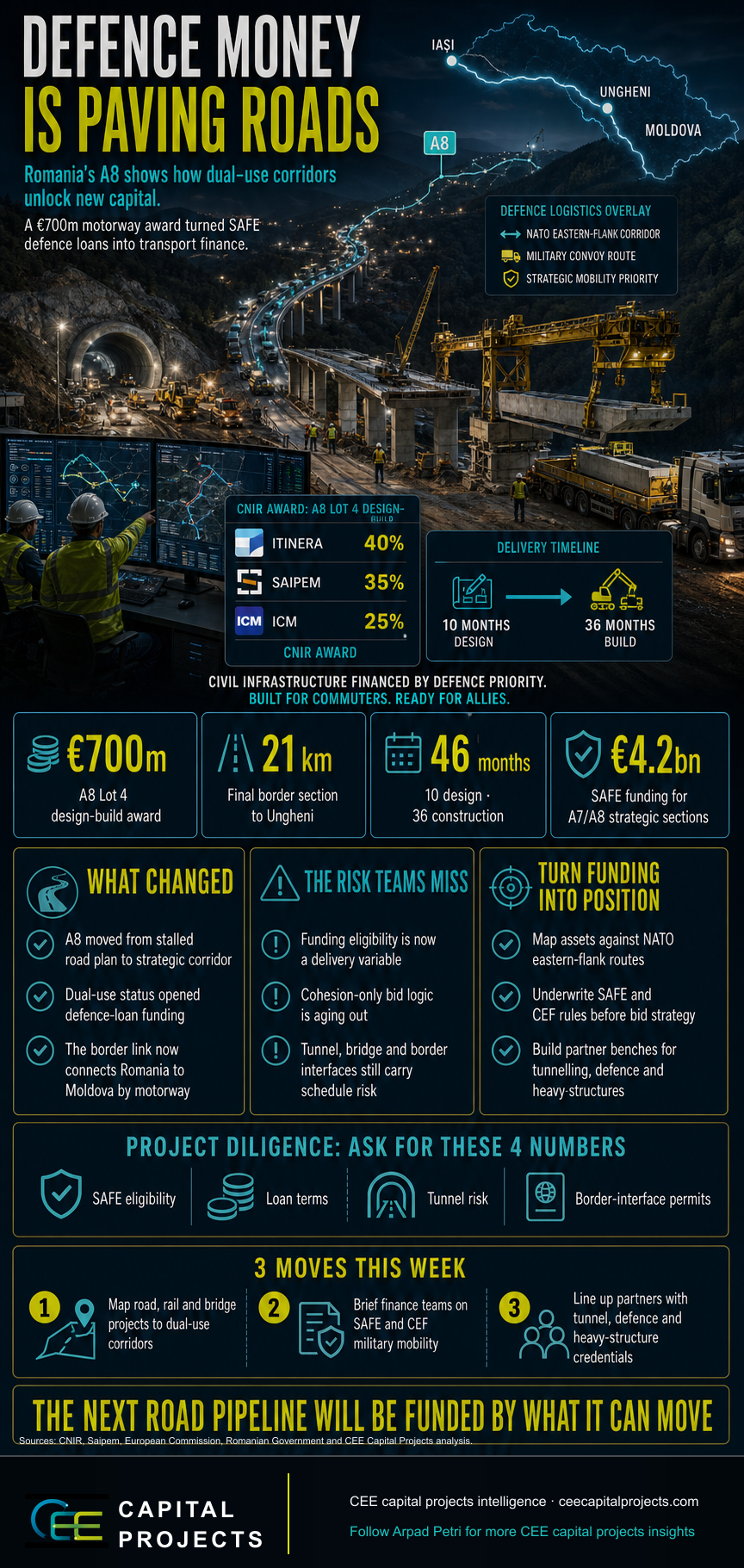
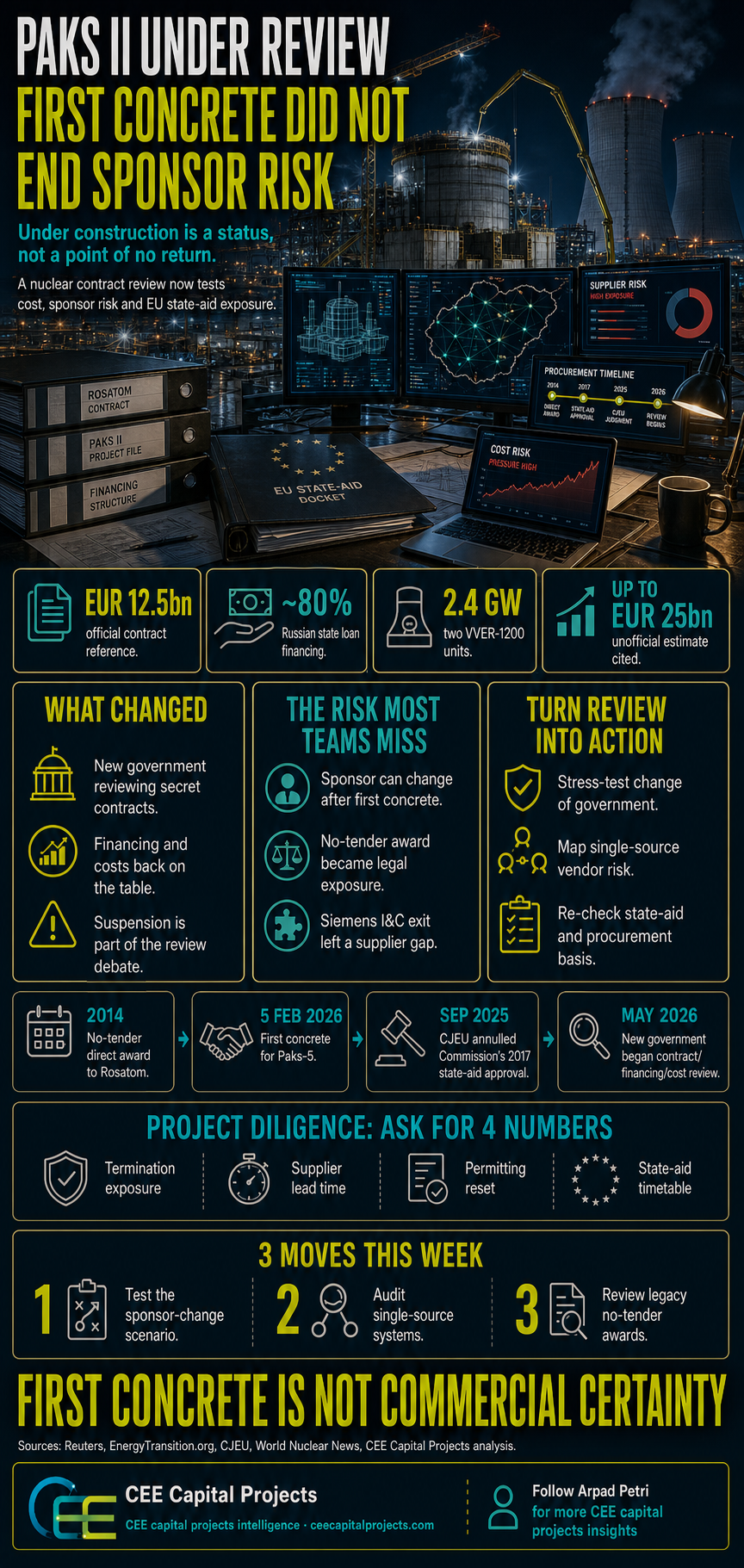
Explore our infograph library — strategic visuals for CEE capital projects leaders.
Project benchmarks, financing structures, tender dynamics and delivery risk — at a glance. Free access for investors, owners, contractors and strategy teams tracking CEE capital projects.
Browse the libraryRelated analyses
- Energy & Power
Dukovany: KHNP drops Daewoo over a 663 million euro civils gap on a fixed-price nuclear deal
KHNP has ended construction talks with Daewoo E&C and Doosan Enerbility on the two new Dukovany units after a gap of over 1 trillion won. The fixed price to ČEZ holds at the top, but the quantity risk below it now decides the schedule.
Read analysis → - Energy & Power
Nuclearelectrica Cernavoda Restart: One Reactor Back, a 43% Profit Cut Built on Two
Nuclearelectrica's revised budget cut 2026 profit by 43% and assumed both Cernavoda reactors back on 1 November. Only one is returning, and a forward-sold nuclear plant on a low river becomes a forced buyer of power.
Read analysis → - Energy & Power
METLEN and Karatzis Built Greece's Largest Battery for EUR 170m in Six Months. Only EUR 33m of It Was Sponsor Money
Alpha Bank lent EUR 56m to Greece's largest battery, beside EUR 81m of EU recovery money. Sponsor cash was EUR 33m of the EUR 170m total, and that funding window closes this year.
Read analysis →
Building in Central Europe?
Tell us what you're building. We'll tell you what can go wrong — and how to prevent it.