We Help International Investors and Project Owners Deliver Major CEE Projects Without Expensive Surprises
Independent project intelligence and advisory across energy, transport, real estate and industrial construction.
Enea Idled Units at Poland's Second-Biggest Power Plant Because a River Ran Low. It Is Building €1.53 Billion of New Gas Capacity on the Same Riverbank
On 6 August 2026 Enea cut output at Kozienice and Połaniec when the Vistula fell too low to cool them, while Tauron's closed-loop plants ran untouched. The same riverbank now carries the largest project financing in the history of Polish conventional power.
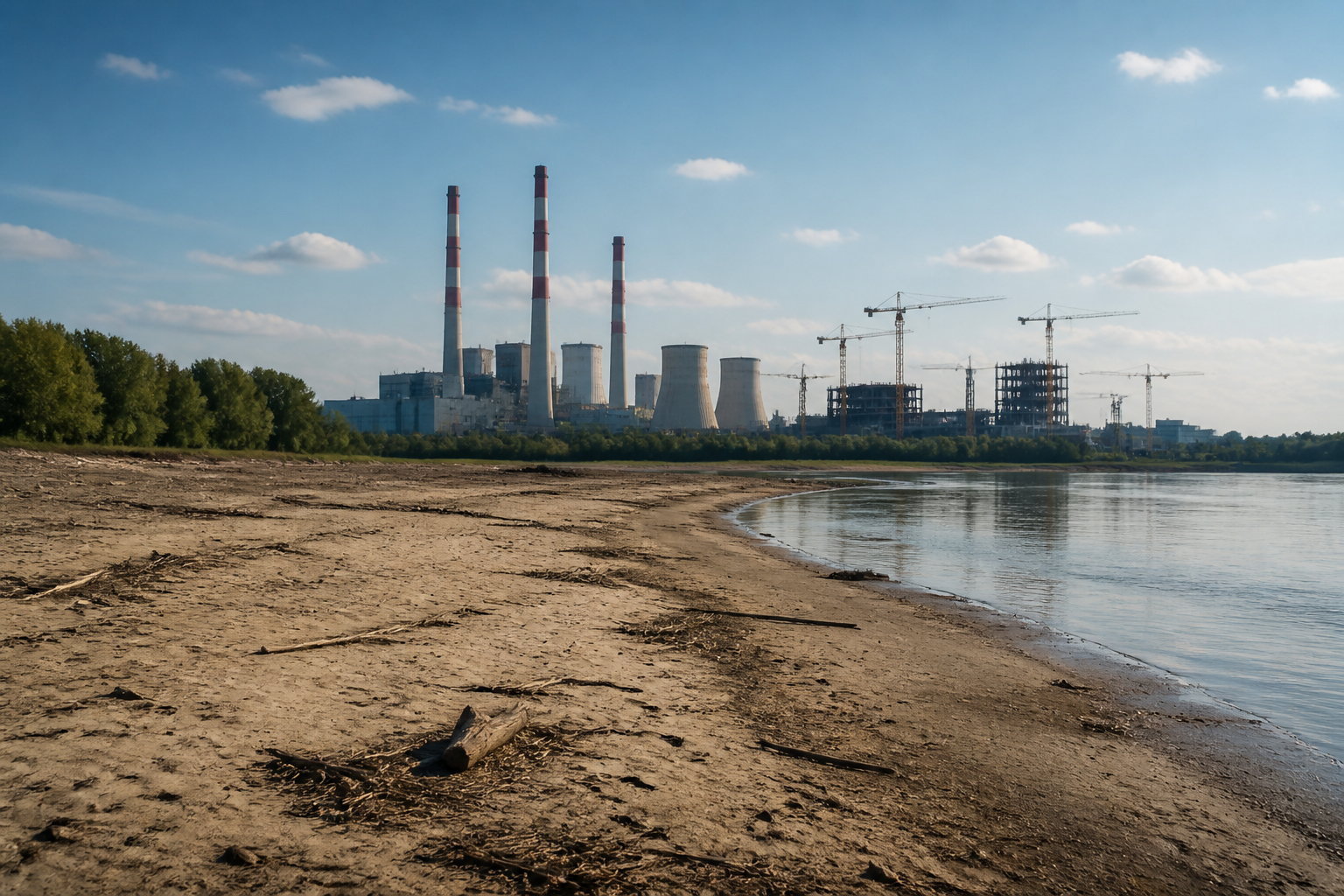
On 6 August 2026, Enea idled generation units at two of Poland's largest coal-fired stations, Kozienice and Połaniec, because the Vistula had dropped too low to cool them. Tauron and Energa, running in the same heat, on the same grid, reported no interruption at all. Tauron's explanation was one sentence long: its plants use closed-loop cooling.
That sentence is the story. Two fleets, one weather event, opposite outcomes, and the difference is a capital decision taken decades ago that no lender, no rating agency and no capacity auction has ever scored.
One river, two cooling architectures
Kozienice is Poland's second-largest power station at roughly 4,016 MW of installed capacity, behind only Bełchatów. It and Połaniec draw cooling water straight from the river and return it warmer. This is once-through cooling, also called open-loop, and it is the cheapest way to reject heat ever built: no towers, no fan load, best-in-class heat rate. It works about 350 days a year.
Closed-loop plants recirculate water through cooling towers and give up efficiency every hour of their lives to do it. On an ordinary day that reads as a permanent tax. On 6 August, according to Polska Agencja Prasowa reporting carried by CEEnergyNews, it was the difference between selling into an emergency capacity window and watching one. Poland's transmission operator PSE declared exactly that window to hold the system together, and the energy ministry asked households and companies to cut consumption between 19:00 and 23:00 until 31 August.
The €1.53 billion sitting on the same bank
Here is the part that should make lenders sit up. In December 2025 Enea Elkogaz closed approximately PLN 6.45 billion (€1.53 billion) of project finance from a consortium led by Bank Gospodarstwa Krajowego, with PKO Bank Polski and Bank Pekao alongside and a KUKE guarantee. Enea called it the largest project finance deal in the history of conventional Polish power generation. The money builds two GE Vernova H-class combined-cycle units of 668 MWe each, 1,336 MWe in total, at Kozienice, with commissioning scheduled for 31 March and 30 June 2029.
Those units will sit on the riverbank that just failed. A combined-cycle unit rejects less heat per MWh than a coal unit, so the exposure is smaller. It is not zero, and it is not visible in anybody's base case.
Romania ran the same test on nuclear
Five days later, on 11 August, Romania's Ministry of Energy confirmed that Cernavodă was preparing Unit 2 for a controlled shutdown because Danube levels had fallen near the cooling pump suction area. The replacement plan tells you what cover costs: regional imports, the Rovinari 4 coal unit pulled out of reserve at the Oltenia Energy Complex, and Hidroelectrica topping up "within the limits of available water resources", which is a hydro producer being asked to cover a water shortage. Romania had already declared a 30-day state of alert on 6 August. Hungary's Paks plant hit the same Danube constraint in late July.
A European panel reviewed grid resilience on 12 August and found no short-term adequacy risk. That finding is correct and beside the point. The system held. The individual asset owners did not all get paid.
The cooling spread
Merchant thermal generation is underwritten on fuel spreads, carbon and capacity payments. Availability enters the model as a percentage, 92 or 94, with outages assumed random. Cooling-constrained outages are not random. They cluster on the hottest, lowest-flow, highest-price days of the year, which means they arrive exactly when the plant's option value peaks and when its correlation with the rest of the portfolio is at its worst.
Run that through a real price curve and the closed-loop efficiency penalty starts to look like an insurance premium rather than a design mistake. Tauron pays it every hour and collected on 6 August. Enea does not pay it and did not collect. Nobody publishes that spread, because nobody discloses cooling architecture as a financial variable.
What to fix before the next heatwave
The engineering answer is known and unpriced. Converting a once-through plant to hybrid or closed-loop cooling means towers, pumps, a permanent heat-rate penalty and a long outage. That is capex boards approve after a bad summer, which means the queue for tower suppliers, air-cooled condenser vendors and mechanical contractors starts forming now, across a thin European supply chain.
For sponsors the more urgent task is documentation. Every thermal asset inside a project finance structure should answer four questions on one page: what is the cooling architecture, which river or abstraction licence does it depend on, what flow or temperature threshold triggers derating, and how many hours has it lost to that threshold in each of the last ten summers. Most cannot answer the fourth. For system operators and regulators the same data settles a bigger question: whether a capacity market is buying megawatts, or buying megawatts that leave on the hottest evening of the year. Poland, Romania and Hungary paid for that answer in real time this month. The next round of thermal financing should charge for it up front.
Share it with your peers
Help your network stay ahead of CEE capital projects.
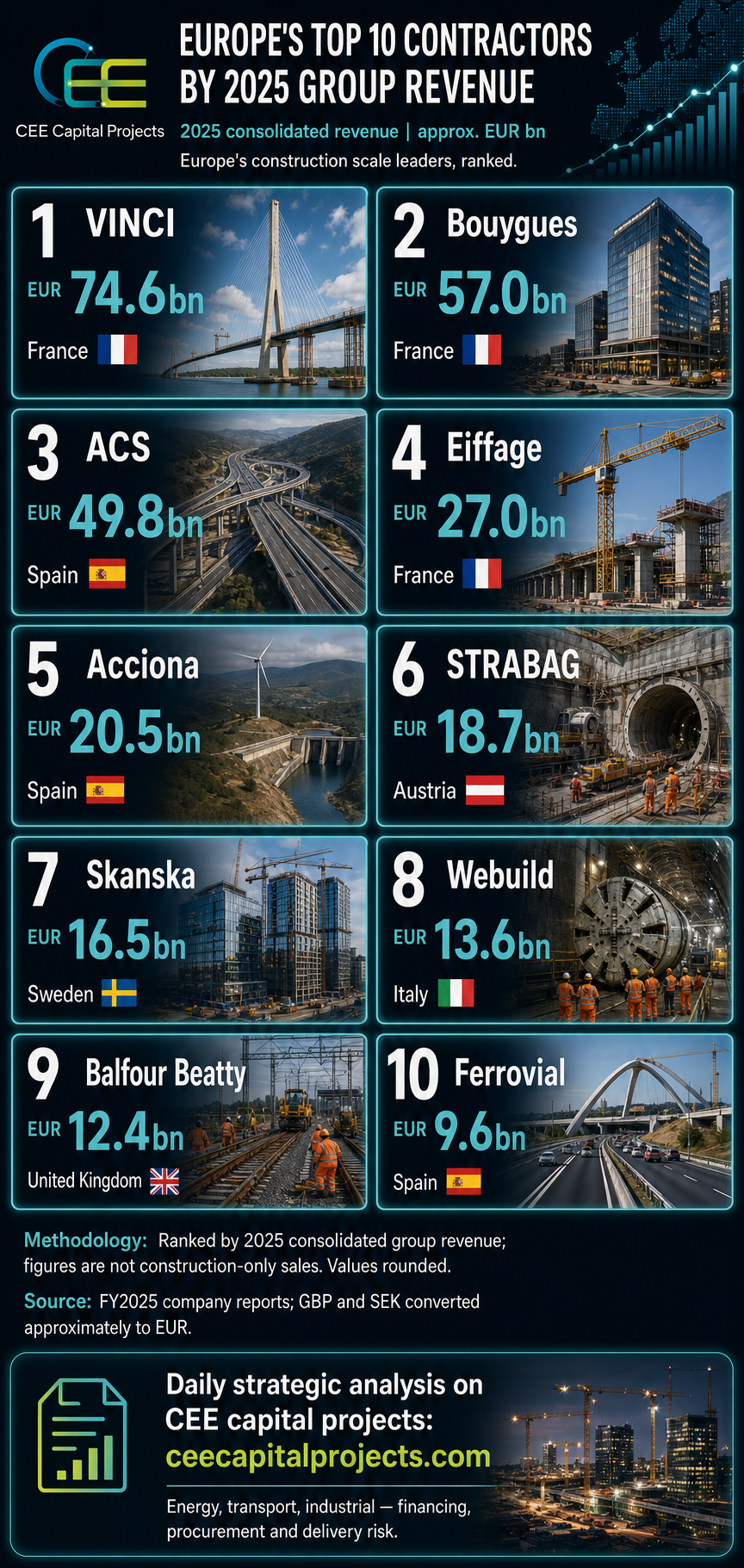
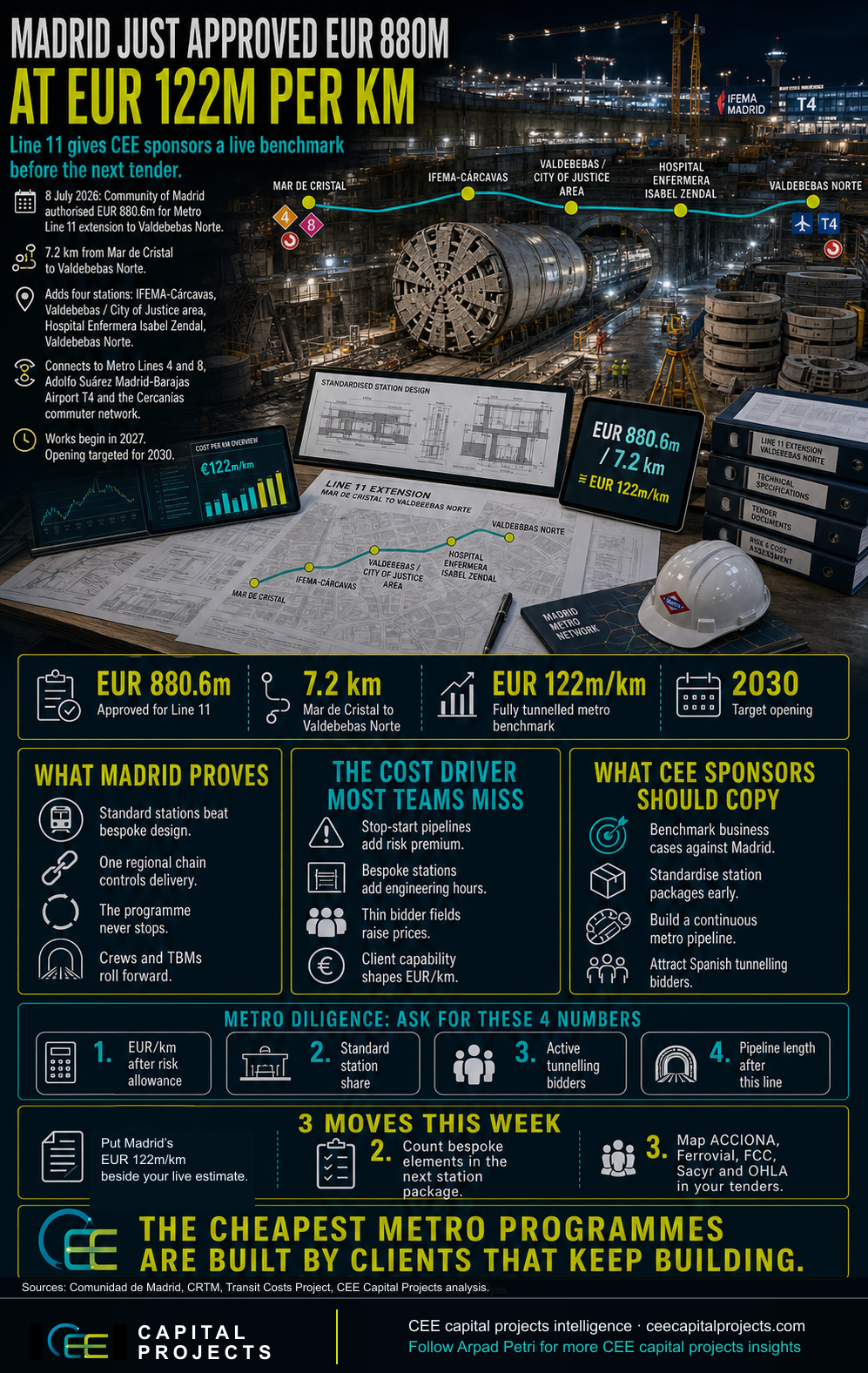
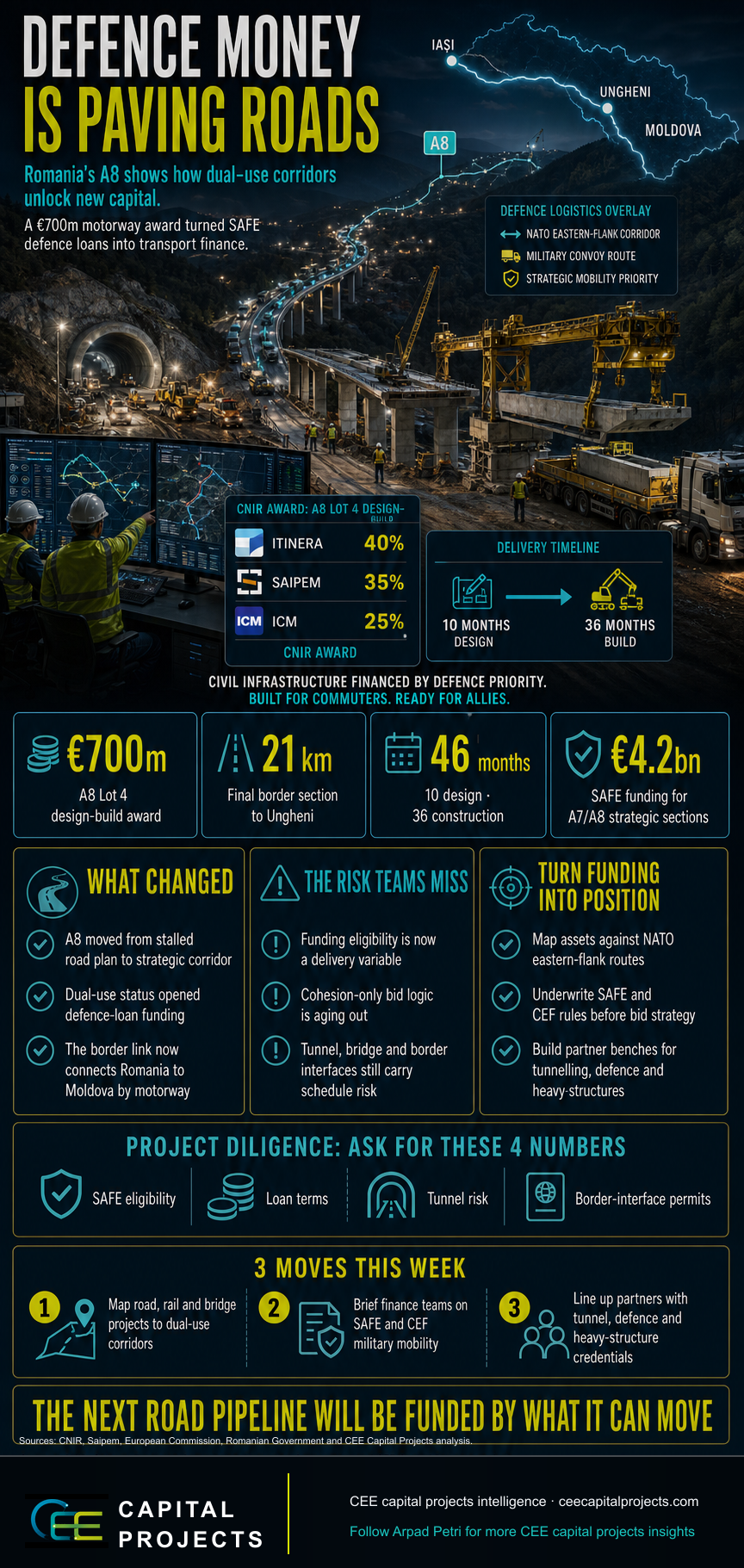
Explore our infograph library — strategic visuals for CEE capital projects leaders.
Project benchmarks, financing structures, tender dynamics and delivery risk — at a glance. Free access for investors, owners, contractors and strategy teams tracking CEE capital projects.
Browse the libraryStrategic Insights
📊 Analytics & Strategic Insight
The cheapest cooling system ever built stops working on the days that matter most
The decision most in this industry are avoiding:
👉 Nobody scores how a plant is cooled. Banks check the fuel, the carbon cost and the grid link. They rarely ask where the cooling water comes from. Two plants can look the same on paper and behave very differently in a heatwave.
👉 The waste on a cooling tower is really insurance. A plant with towers burns a little more fuel every hour. That looks like bad design. It is the price of still running on the ten days a year when power is dearest.
👉 Lost hours are not spread evenly. Most outage maths assumes faults happen at random. Water-driven cuts all land on the same hot, dry, high-price days. That makes them far more costly than the average suggests.
Here's the full context:
→ 1973: Kozienice starts up. It takes water straight from the Vistula and puts it back warmer. That was the cheapest and most normal way to build.
→ 2017: Enea adds a 1,075 MW unit. Kozienice reaches about 4,016 MW and is Poland's second-biggest plant, after Bełchatów.
→ December 2025: Enea Elkogaz borrows about PLN 6.45 billion (€1.53 billion) from banks led by BGK to build two gas units at the same site. It is the biggest deal of its kind in Polish power. The units start in 2029.
→ 6 August 2026: The Vistula drops. Enea cuts output at Kozienice and Połaniec. Tauron and Energa keep running, and Tauron says its plants use closed cooling loops. Grid operator PSE calls an emergency capacity window (source: Polska Agencja Prasowa, via CEEnergyNews).
→ Most recent: On 11 August Romania starts shutting Cernavodă Unit 2 because the Danube is too low near the cooling pumps. It fills the gap with imports, an old coal unit and hydro.
What this means for infrastructure operators, contractors and investors:
✅ Ask about water before you lend. Any thermal plant in a loan book should state on one page where its cooling water comes from and what level stops it. Most files do not say.
✅ Capacity payments may be buying the wrong thing. A plant that drops out on the hottest evening is not firm capacity. Auctions that ignore cooling type pay full price for part-time cover.
✅ Cooling-tower work is about to get busy. After a summer like this, boards approve retrofits. Europe has few suppliers of towers, pumps and air-cooled condensers. Prices and lead times move first.
3 moves you can make this week:
1️⃣ List your water-cooled plants. For each one write down the cooling type, the river, and the water level or temperature that forces a cut. One page per asset.
2️⃣ Count the lost hours. Pull the last ten summers. How many hours did each plant lose to heat or low water, and what was the power price in those hours? That number is your real risk.
3️⃣ Get a retrofit price now. Ask two suppliers what a hybrid or closed-loop conversion costs and how long the outage runs. Do it before every other operator in Europe calls them.
Related analyses
- Energy & Power
Constellation's $4.3bn Nuclear Uprate Deal With Google: 890 MW, No New Site, and a Finite Pool
Constellation will invest more than $4.3bn to lift 890 MW out of 11 existing reactors under a 20-year Google power purchase agreement, at roughly half the per-kilowatt cost of recent American new build. The point for Europe is that the national uprate pool runs to three to five gigawatts, ČEZ banked its Dukovany headroom by 2009, and the only route left to fresh capacity is a CZK 407bn new build.
Read analysis → - Energy & Power
NEK's EUR 350 Million Yadenitsa Dam Tender Turns Bulgaria's Chaira Storage Fix Into a Civils Job
Bulgaria's NEK has put EUR 350m on the market for the Yadenitsa dam and a six kilometre tunnel at the 864 MW Chaira pumped storage plant, with bids due 4 November 2026 and 60 months to build. The civil works are costed at more than three times the EUR 102m reconstruction of all four of the plant's machines.
Read analysis → - Energy & Power
EIB and BNP Paribas Guarantee EUR 700m of Grid Equipment Bonds: Europe's Network Bottleneck Moves to the Balance Sheet
The EIB and BNP Paribas signed a EUR 700m counter-guarantee portfolio on 29 September 2026, covering advance payment and performance bonds for European manufacturers of electricity grid components. The instrument is small, and it points at the constraint that now sets delivery dates on Europe's grid build: bonding capacity rather than factory floor.
Read analysis →
Get a second opinion before it gets expensive.
Contractor selection, tender strategy, a project drifting off track — send us the situation and we'll come back with a clear plan.