We Help International Investors and Project Owners Deliver Major CEE Projects Without Expensive Surprises
Independent project intelligence and advisory across energy, transport, real estate and industrial construction.
Dukovany One Year On: Czechia's $18.6 Billion KHNP Nuclear Build Stays on Schedule While Western Europe Slips
One year after signing the CZK 407 billion contract with KHNP, the Czech trade ministry reports the two-unit Dukovany nuclear build on schedule, with more than 13 kilometres of exploratory drilling complete and a cooling-tower tender due in H2 2026. The preparatory playbook holds lessons for every European megaproject sponsor.
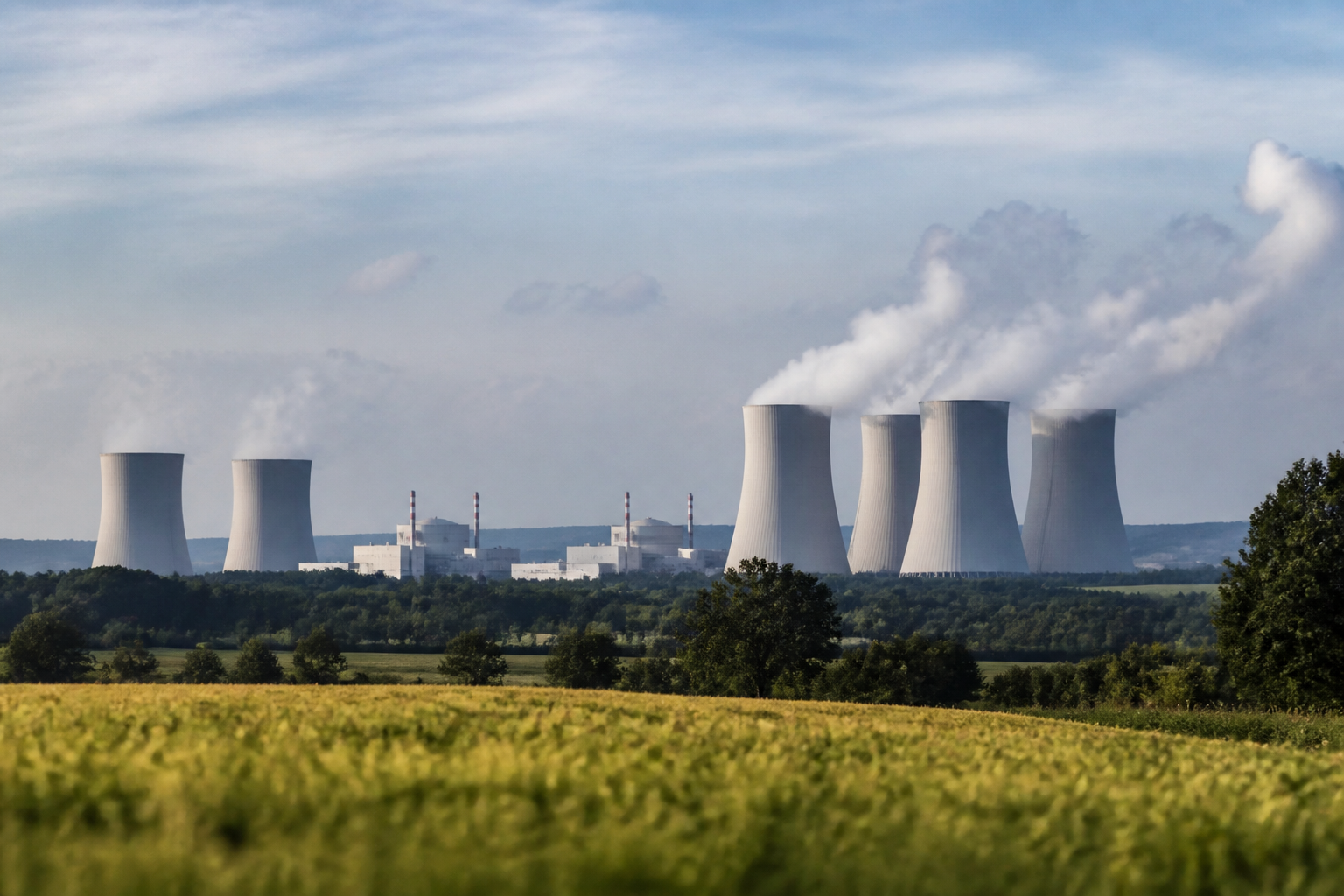
In European nuclear construction, 'on schedule' is a phrase with a short life expectancy. Olkiluoto 3 connected to the grid roughly 14 years late. Flamanville 3 took 17 years from first concrete to grid connection. Hinkley Point C's estimated bill has climbed towards £46 billion. Against that record, the first annual progress report on Czechia's Dukovany expansion reads almost like a provocation: one year after the CZK 407 billion (US$18.6 billion) contract with Korea Hydro & Nuclear Power (KHNP) was signed, the Czech Ministry of Trade and Industry reports that the two-unit project 'is proceeding according to the set schedule' (Czech Ministry of Trade and Industry progress report, via World Nuclear News, 8 July 2026).
The report lands one year after a signing that was itself delayed by an eleventh-hour court injunction. It describes a project that is deliberately front-loading the unglamorous work: the current first phase will run roughly four years and, in the ministry's words, is 'primarily focused on developing project and licensing documentation, obtaining all necessary permits and ensuring the necessary infrastructure for the start of construction'. First concrete is expected in 2029.
Thirteen kilometres of drilling before a single pour
The headline achievement of year one is geological. Site crews drilled hundreds of exploratory wells totalling more than 13 kilometres, sent the samples through laboratory testing, and condensed the results into a final report of more than 6,000 pages that will also feed a full 3D model of the site. For a sector whose worst overruns have often started with ground conditions and late design changes, this is exactly the sequence lenders and EPC risk managers want to see.
Petr Závodský, director general of project company Elektrárna Dukovany II, put it plainly: 'The preparatory phase is always a bit thankless, because it is not much visible from the outside, but it is absolutely crucial for the subsequent construction to proceed smoothly.'
The Czech supply chain is already winning work
Three domestic awards stand out. ČEZ Energetické projekty carried out the geological survey campaign. Doosan Škoda Power, the Plzeň-based turbine maker, won the contract for turbogenerators, the most prestigious localisation prize on the project so far. Energoprojekt Praha will provide consulting services, including licensing and project documentation support.
The pipeline behind those awards is being institutionalised. A registration system for prospective Czech and South Korean suppliers is live, and four training days on the APR1000 technology have already been held. In the second half of 2026 the project company intends to tender the supply of cooling towers, while an archaeological survey, a six-floor administrative building and preparatory works, including road bypasses and accommodation for a peak workforce of around 10,000, move ahead in parallel.
An ownership structure built for bankability
The project owner, Elektrárna Dukovany II, is 80% held by the Czech state and 20% by ČEZ, which operates the country's existing reactors. That structure does two jobs at once. It shields ČEZ's balance sheet and credit metrics from an US$18.6 billion construction programme, and it gives every supplier and future lender a sovereign-grade counterparty. The legal overhangs that shadowed the award have also cleared: EDF's challenge failed in June 2025, and KHNP has said the European Commission dropped its foreign-subsidies review of the deal.
KHNP submitted the conceptual design for the plant in April 2026, covering all changes against the standard APR1000 needed for Czech legislation, site conditions and the investor's contractual requirements. The design is now open for comments before the next, more detailed documentation stage. The schedule thesis rests on keeping those changes minimal: KHNP's reference record, including four APR1400 units delivered at Barakah in the UAE, is built on replication discipline rather than bespoke engineering.
For operators, contractors and investors, the near-term signals to watch are concrete: the cooling-tower tender in H2 2026, the pace of licensing documentation through 2027, and how the region absorbs the logistics of a 10,000-worker site. Civil packages, worker accommodation, transport upgrades and grid works will be procured years before the nuclear island, and they are financeable today against a state-backed counterparty. If Dukovany holds its schedule through the permitting years, it becomes the reference case that Poland's AP1000 programme, Paks II and every future CEE nuclear tender will be measured against, and the strongest argument yet that Europe can buy nuclear delivery discipline off the shelf.
Share it with your peers
Help your network stay ahead of CEE capital projects.
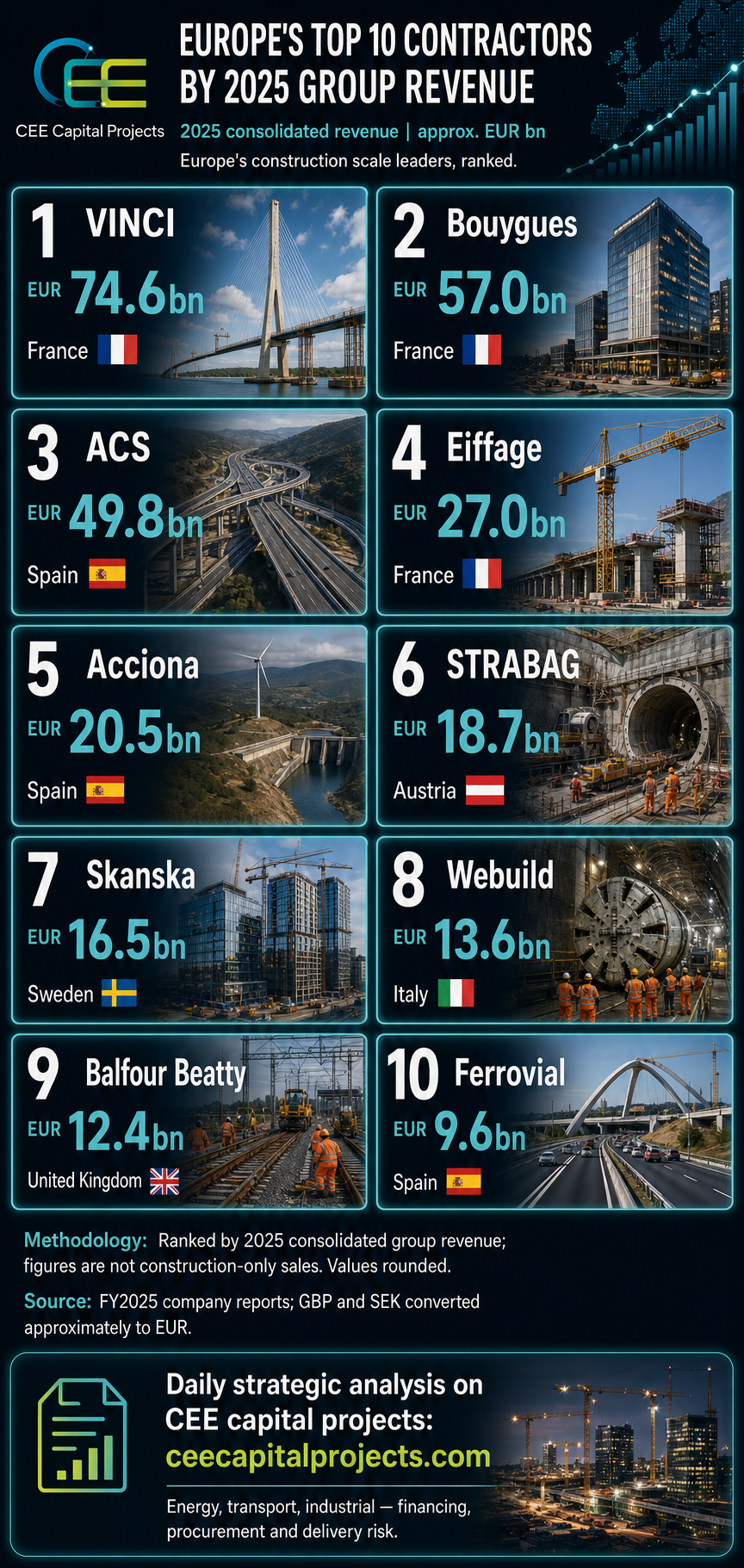
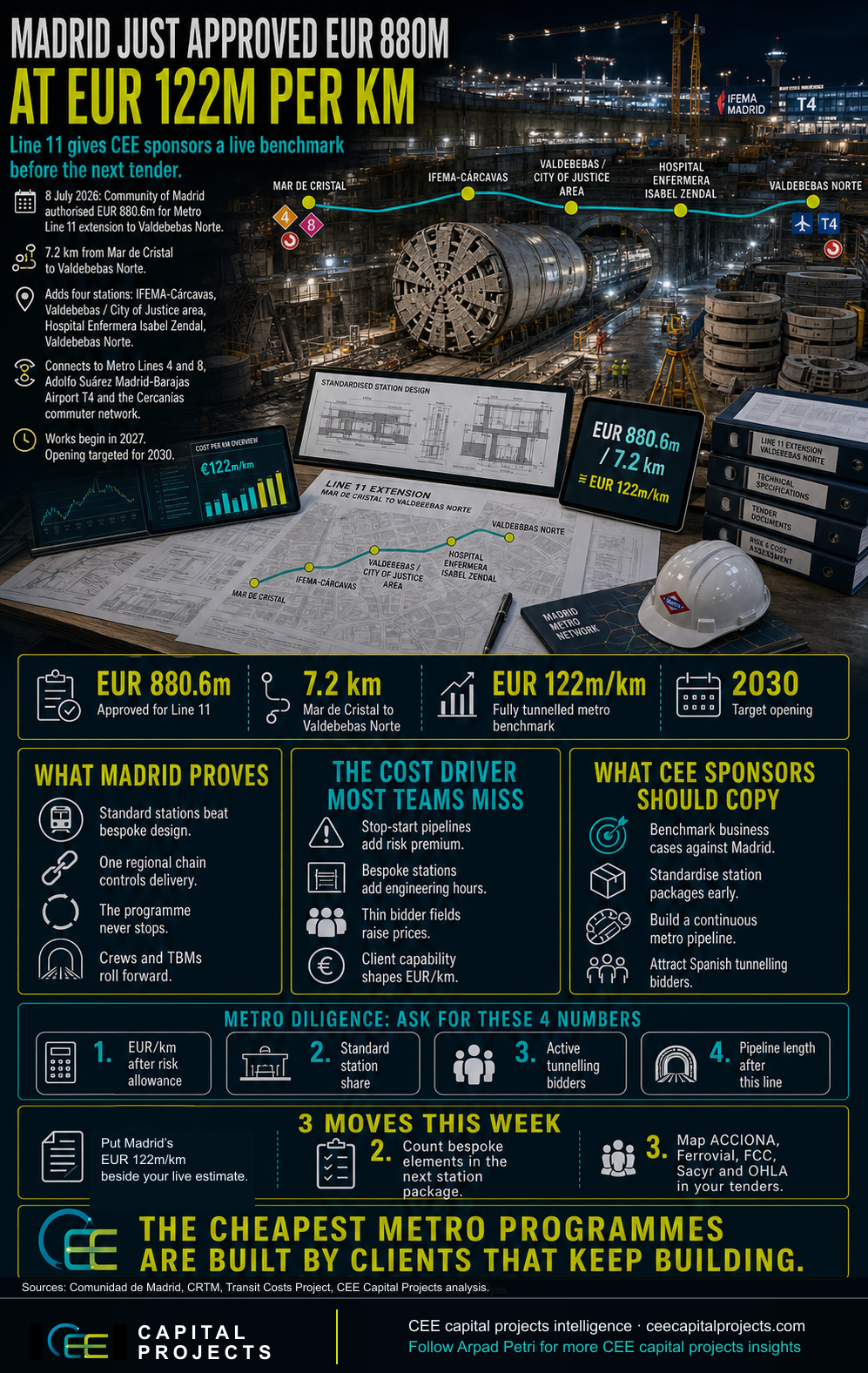
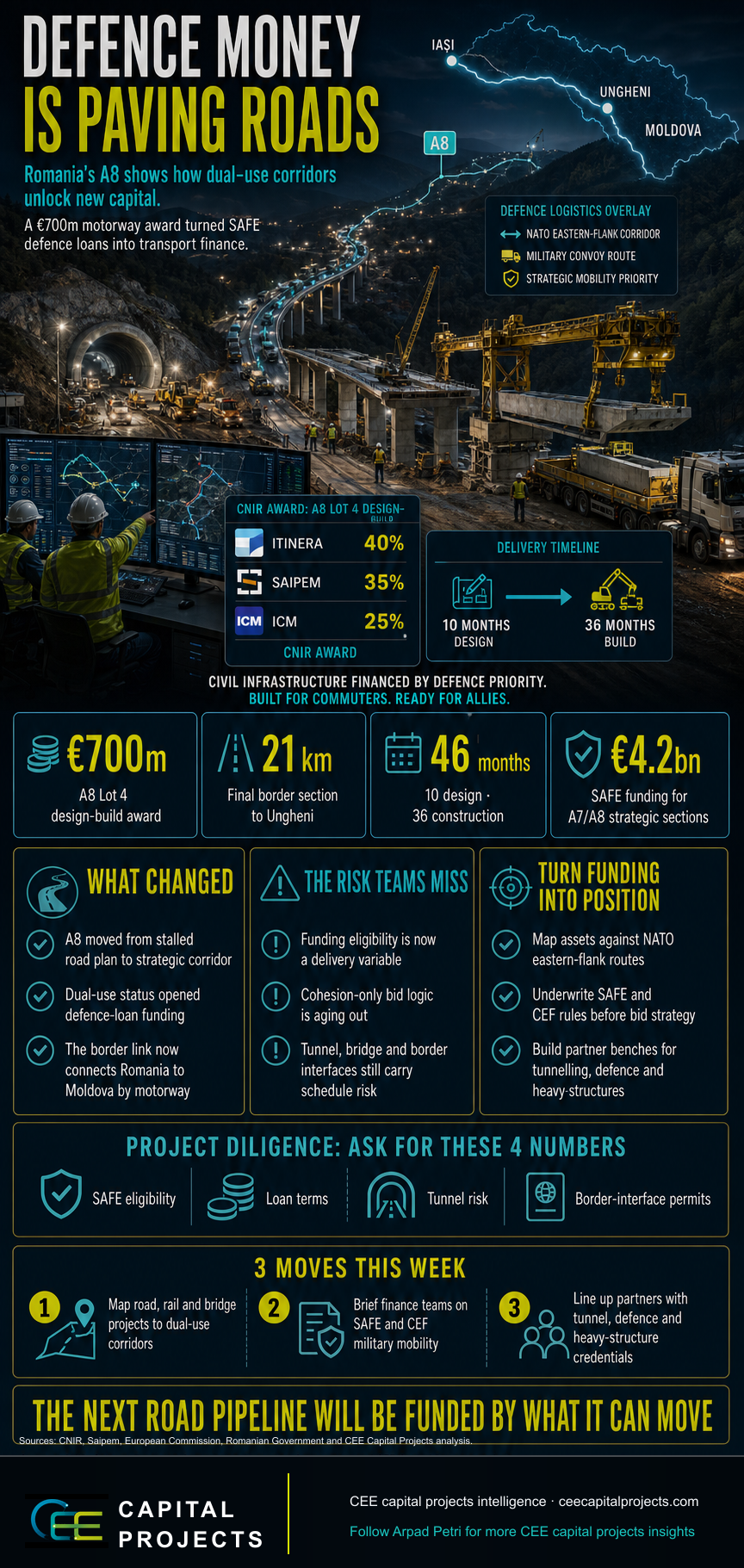
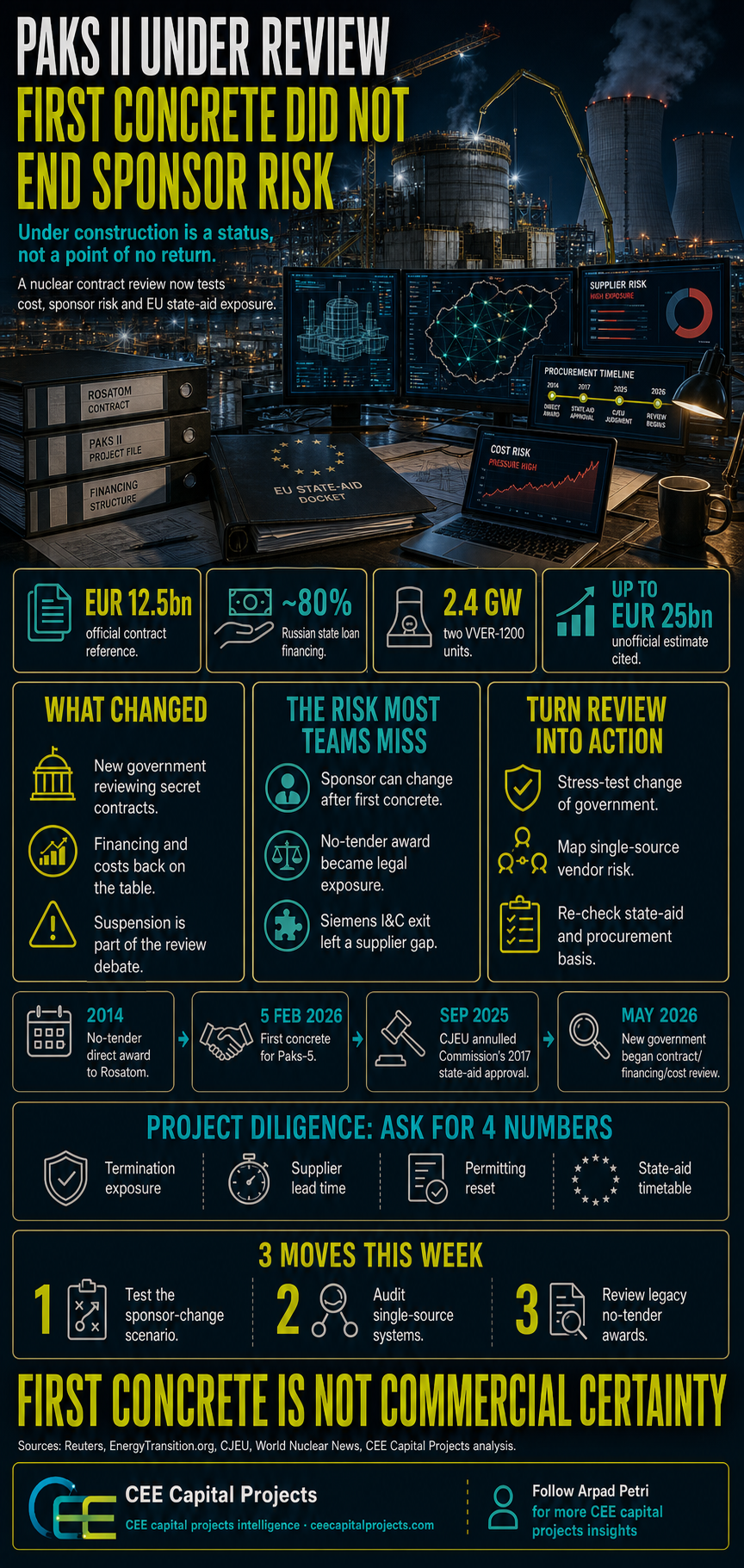
Explore our infograph library — strategic visuals for CEE capital projects leaders.
Project benchmarks, financing structures, tender dynamics and delivery risk — at a glance. Free access for investors, owners, contractors and strategy teams tracking CEE capital projects.
Browse the libraryStrategic Insights
📊 Analytics & Strategic Insight
Nuclear megaprojects are won or lost before the first pour of concrete
The decision most in this industry are avoiding:
👉 Treating the preparatory phase as the profit phase. Most contractors watch nuclear projects from a distance until construction tenders appear. By then, prequalification lists, training pipelines and framework relationships are set. The firms that will earn the best margins at Dukovany are registering, training and partnering now, four years before first concrete.
👉 Betting on replication over bespoke design. Europe's EPR record shows what first-of-a-kind engineering costs. The Czech wager is that a Korean reference design with minimal adaptation beats a European design with maximal customisation. Sponsors elsewhere keep avoiding this choice and paying for it in overruns.
👉 Using state ownership as a financing tool rather than a political liability. The 80/20 state-ČEZ split is unfashionable among privatisation purists, but it converts supplier counterparty risk into sovereign risk and keeps the utility investable. More CEE sponsors will copy it than admit it.
Here's the full context:
→ July 2024: The Czech government selects KHNP as preferred bidder for two APR1000 units at Dukovany, beating EDF.
→ June 2025: The Supreme Administrative Court lifts the injunction won by EDF; the CZK 407 billion (US$18.6 billion) EPC contract is signed, with the state taking 80% of project company Elektrárna Dukovany II and ČEZ holding 20%.
→ 2025–2026: Legal and regulatory overhangs clear: EDF's challenge fails and KHNP says the European Commission has dropped its Foreign Subsidies Regulation probe into the deal.
→ April 2026: KHNP submits the conceptual design adapting the APR1000 to Czech legislation, site conditions and the investor's contract requirements.
→ Most recent: On 8 July 2026 the Czech Ministry of Trade and Industry reports year-one progress: geological surveys complete after more than 13 kilometres of exploratory drilling, a 6,000-page site report delivered, construction start held at 2029 and a cooling-tower tender due in H2 2026.
What this means for infrastructure operators, contractors and investors:
✅ The bankable work starts years before the nuclear island. Bypass roads, a six-floor administrative building, accommodation for some 10,000 peak workers and grid reinforcement are all procured in the preparatory phase against a state-backed counterparty. This is conventional civil and building work with sovereign-grade payment risk.
✅ Localisation is a competition you can enter from outside Czechia. The supplier registration system is open to Czech and Korean firms, and consortium structures will pull in wider CEE capacity as packages scale. Doosan Škoda Power's turbogenerator award shows the owner is serious about placing major scope locally.
✅ Transparent annual reporting is itself a de-risking instrument. A published progress report keeps political consensus, supplier confidence and future lender appetite aligned. Investors should read reporting discipline as a leading indicator of schedule discipline.
3 moves you can make this week:
1️⃣ Get onto the Dukovany supplier registration system. Map which packages fit your capability and start the prequalification paperwork before the cooling-tower tender crowds the queue.
2️⃣ Price the nuclear-adjacent packages now. Worker accommodation, transport bypasses and site utilities will move first. Build your cost base and local partnerships around those, and treat the nuclear island as a later phase.
3️⃣ Open a conversation with Korean tier-one suppliers. KHNP's delivery model relies on established partners. A CEE contractor with local labour, permitting knowledge and references is a natural consortium piece for the 2027–2029 tenders.
Related analyses
- Energy & Power
Constellation's $4.3bn Nuclear Uprate Deal With Google: 890 MW, No New Site, and a Finite Pool
Constellation will invest more than $4.3bn to lift 890 MW out of 11 existing reactors under a 20-year Google power purchase agreement, at roughly half the per-kilowatt cost of recent American new build. The point for Europe is that the national uprate pool runs to three to five gigawatts, ČEZ banked its Dukovany headroom by 2009, and the only route left to fresh capacity is a CZK 407bn new build.
Read analysis → - Energy & Power
NEK's EUR 350 Million Yadenitsa Dam Tender Turns Bulgaria's Chaira Storage Fix Into a Civils Job
Bulgaria's NEK has put EUR 350m on the market for the Yadenitsa dam and a six kilometre tunnel at the 864 MW Chaira pumped storage plant, with bids due 4 November 2026 and 60 months to build. The civil works are costed at more than three times the EUR 102m reconstruction of all four of the plant's machines.
Read analysis → - Energy & Power
EIB and BNP Paribas Guarantee EUR 700m of Grid Equipment Bonds: Europe's Network Bottleneck Moves to the Balance Sheet
The EIB and BNP Paribas signed a EUR 700m counter-guarantee portfolio on 29 September 2026, covering advance payment and performance bonds for European manufacturers of electricity grid components. The instrument is small, and it points at the constraint that now sets delivery dates on Europe's grid build: bonding capacity rather than factory floor.
Read analysis →
Get a second opinion before it gets expensive.
Contractor selection, tender strategy, a project drifting off track — send us the situation and we'll come back with a clear plan.