We Help International Investors and Project Owners Deliver Major CEE Projects Without Expensive Surprises
Independent project intelligence and advisory across energy, transport, real estate and industrial construction.
Poland's CPK High-Speed Rail Tender Draws Eight Bidders for Warsaw–Łódź Section
Eight consortia and firms have lined up for a single 14.3km section of Poland's Warsaw–Łódź high-speed line, a sign of strong contractor appetite for Central Europe's largest greenfield rail build. CPK's choice to run a competitive dialogue rather than an open tender shows how the client is de-risking a first-of-its-kind 350 km/h programme.
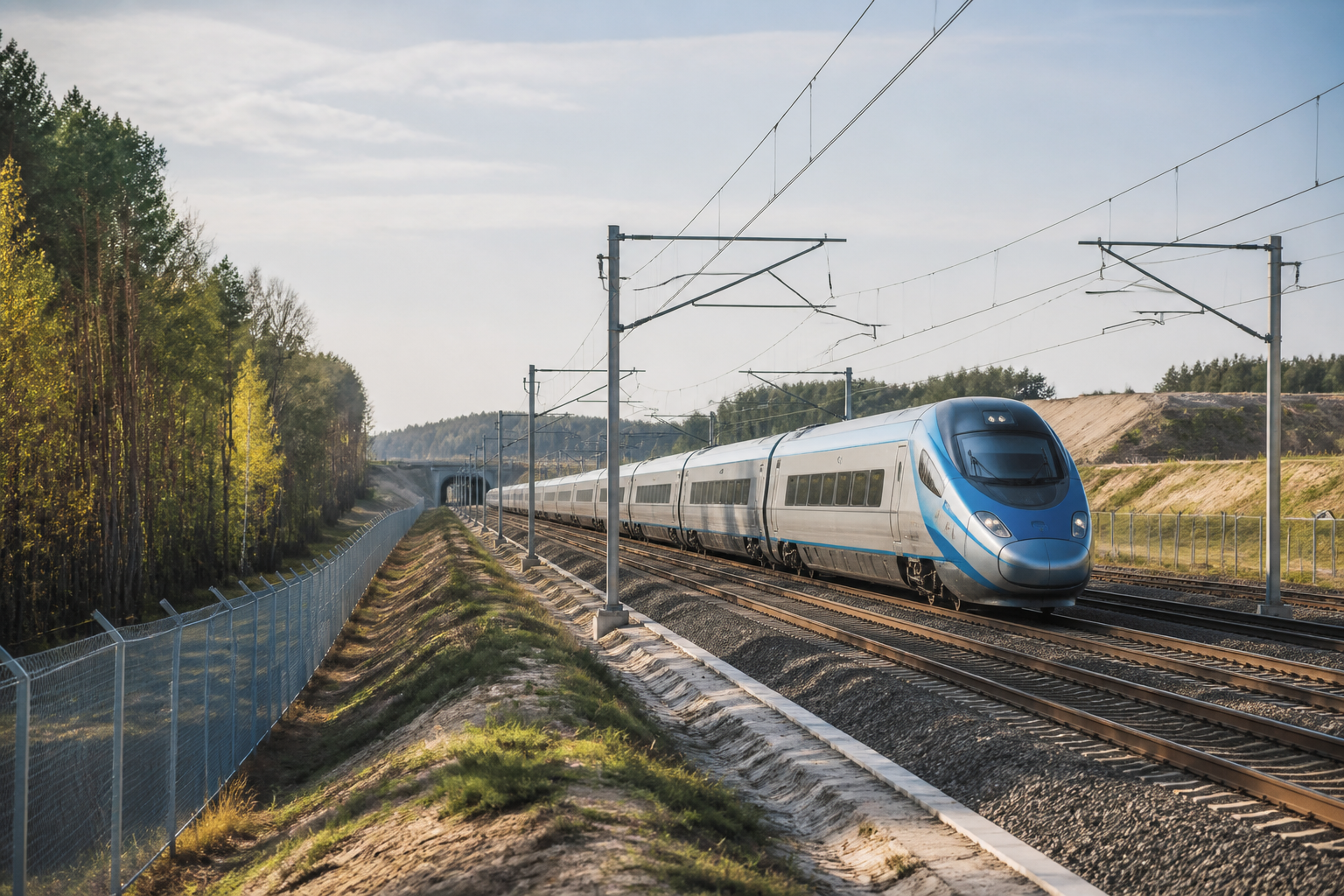
Eight bidders lined up for a single 14.3-kilometre stretch of track. That is the appetite Poland's Central Communication Port (CPK) just confirmed for the backbone of what will be Central Europe's largest greenfield high-speed railway, and it says more about the health of the European construction market than any contractor's order-book statement.
A short section, a long queue of suitors
On 6 July 2026, CPK confirmed it had received eight requests to participate in the tender for the Airport Junction – Bolimów Junction section of the Warsaw–Łódź high-speed line, according to the International Railway Journal. The line-up reads like a roll-call of the contractors that matter across Central and Eastern Europe: Strabag with Tym-Bud, Porr with Trakcja, Budimex bidding alone, a Torpol–Mirbud–Kobylarnia trio, Zue alongside Duna Polska and Polaqua, a four-way consortium led by Gülermak, Mostostal Warsaw, and an Ntercor–NDI grouping. CPK will invite up to five of them into a competitive dialogue.
The scope is anything but token. The winner designs and builds a 350 km/h alignment carrying 55 road and railway bridges and viaducts, plus drainage culverts and wildlife crossings, and delivers the full detailed design. This is the second of six construction packages on the Warsaw–Łódź route, the first inter-city leg of a network that will later reach Poznań and Wrocław.
The Warsaw–Łódź line is being carved into six construction packages, and CPK now has two of them running at once. A procurement launched in December 2025 for the 12.9km Kotowice – Airport Junction section is in the final stage of shortlisting, while preparations continue on the remaining stretches, including an 18km tunnel between Warsaw West and Kotowice and the longer Bolimów Junction – Brzeziny leg. Splitting the route this way spreads risk across contractors and keeps any single failure from stalling the whole line.
Why competitive dialogue, not a straight open tender
Poland has no true high-speed track today. Building the first 350 km/h line in a country without the reference base is exactly the situation where a client benefits from talking to the market before freezing the specification. Competitive dialogue lets CPK refine scope, risk allocation and buildability with shortlisted bidders before final bids land. "The competitive dialogue process has provided us with valuable market feedback that will enable us to launch the remaining procurements as open tenders," CPK rail board member Piotr Rachwalski said. In other words, the early packages are buying market intelligence that de-risks the larger ones behind them.
The Rail Baltica warning hanging over every mega-tender
The caution is well founded. In March 2026, a Polish appeals panel struck down PKP PLK's award of the roughly €1.2bn Białystok–Ełk section of Rail Baltica to a Budimex-led consortium that included Porr, throwing the contract back into play. One annulled award can cost a year. A dialogue-first process, with criteria hammered out in the open with bidders, is partly an answer to that litigation risk, and a reason the CPK field is so deep.
What the depth of the field signals
Eight bidders for one section is a vote of confidence at a moment when Western European rail budgets are wobbling. Germany's latest budget sent what the trade press called "mixed messages" for rail on 8 July 2026, and Deutsche Bahn has just confirmed the Stuttgart 21 project will slip to 2031 and cost another €3bn. Against that backdrop, contractors are hunting for clean, well-funded, greenfield work with a defined pipeline, and CPK offers exactly that. The port operator has set out a tender pipeline worth around $10bn for 2026, according to Aviation Week, spanning rail, the hub airport and the road links that feed it. Poland is also one of the largest recipients of EU cohesion and recovery funding, giving the CPK programme a financing base that many Western European schemes now envy as national budgets tighten.
Implications for contractors, sponsors and lenders
For contractors, the logic is to position now. The firm that wins an early Warsaw–Łódź package builds the reference credentials that shape the remaining four sections and the Poznań and Wrocław extensions expected around 2035. For public sponsors elsewhere in the region, CPK is becoming a live case study in how to procure a first-of-its-kind programme without inviting the appeals that have stalled rivals. For lenders and infrastructure investors, a competitive, litigation-resistant procurement is what separates a bankable pipeline from a stalled one. The Warsaw–Łódź section is due to open in 2032. The field forming around it this summer will decide who gets to build Central Europe's high-speed future.
Share it with your peers
Help your network stay ahead of CEE capital projects.
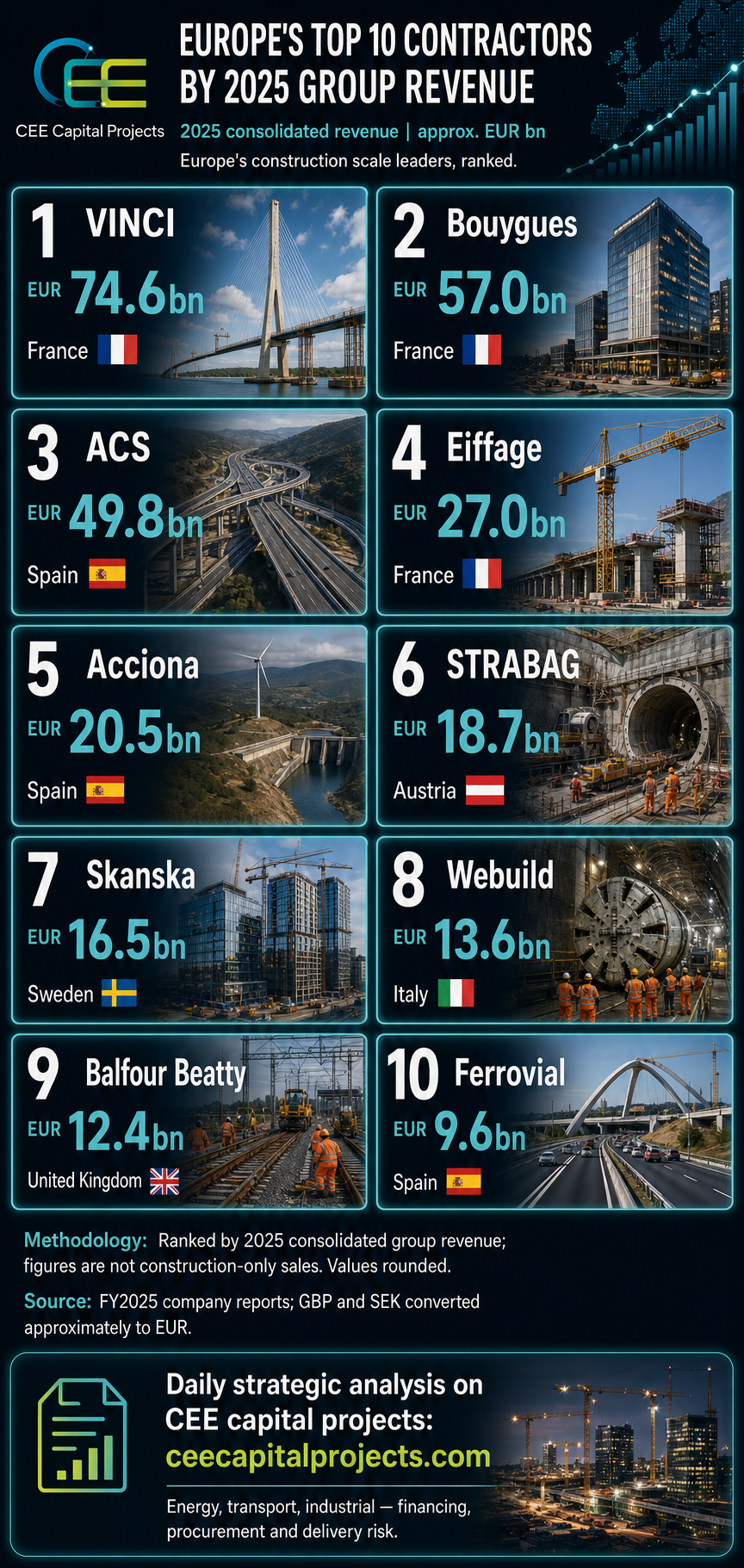
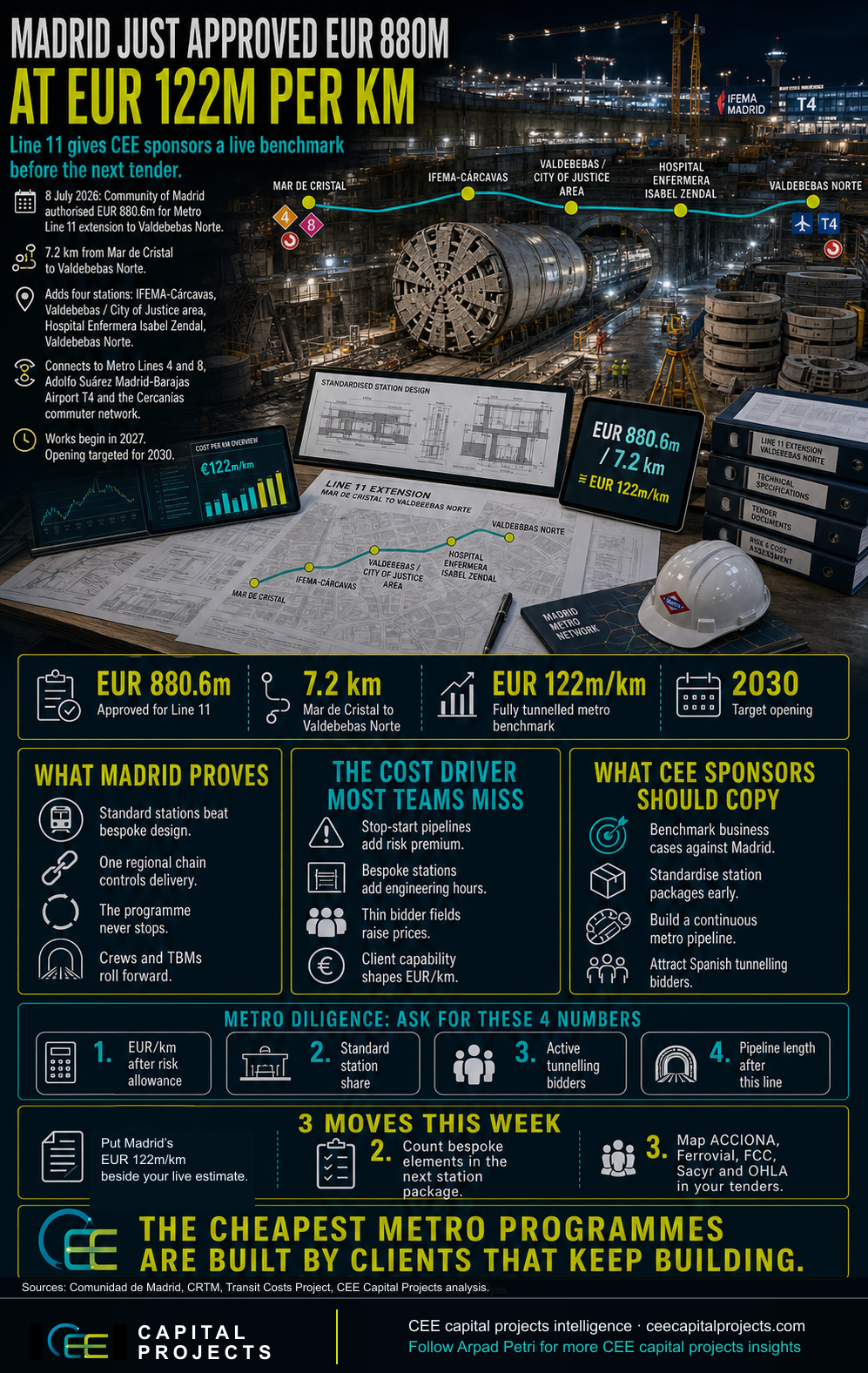
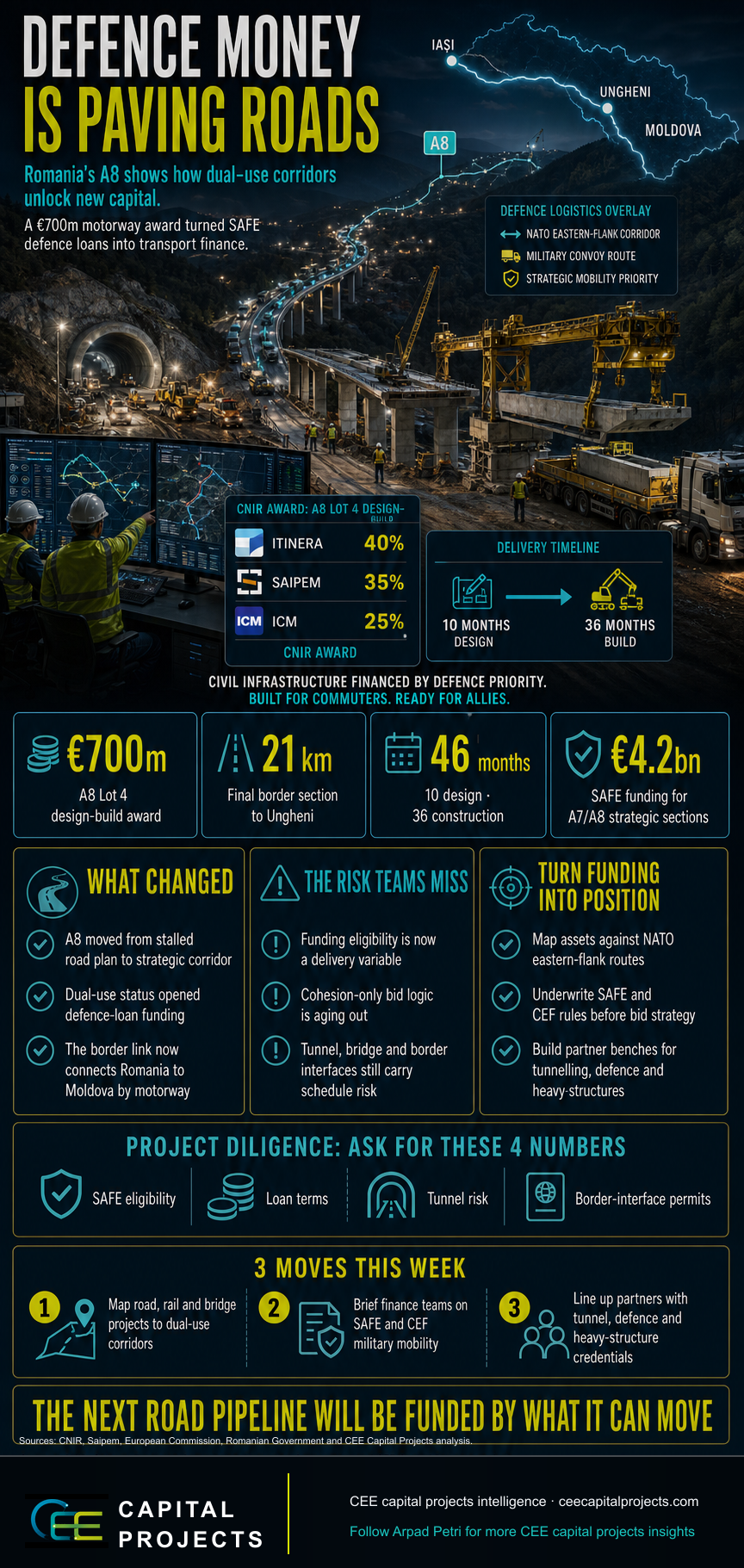
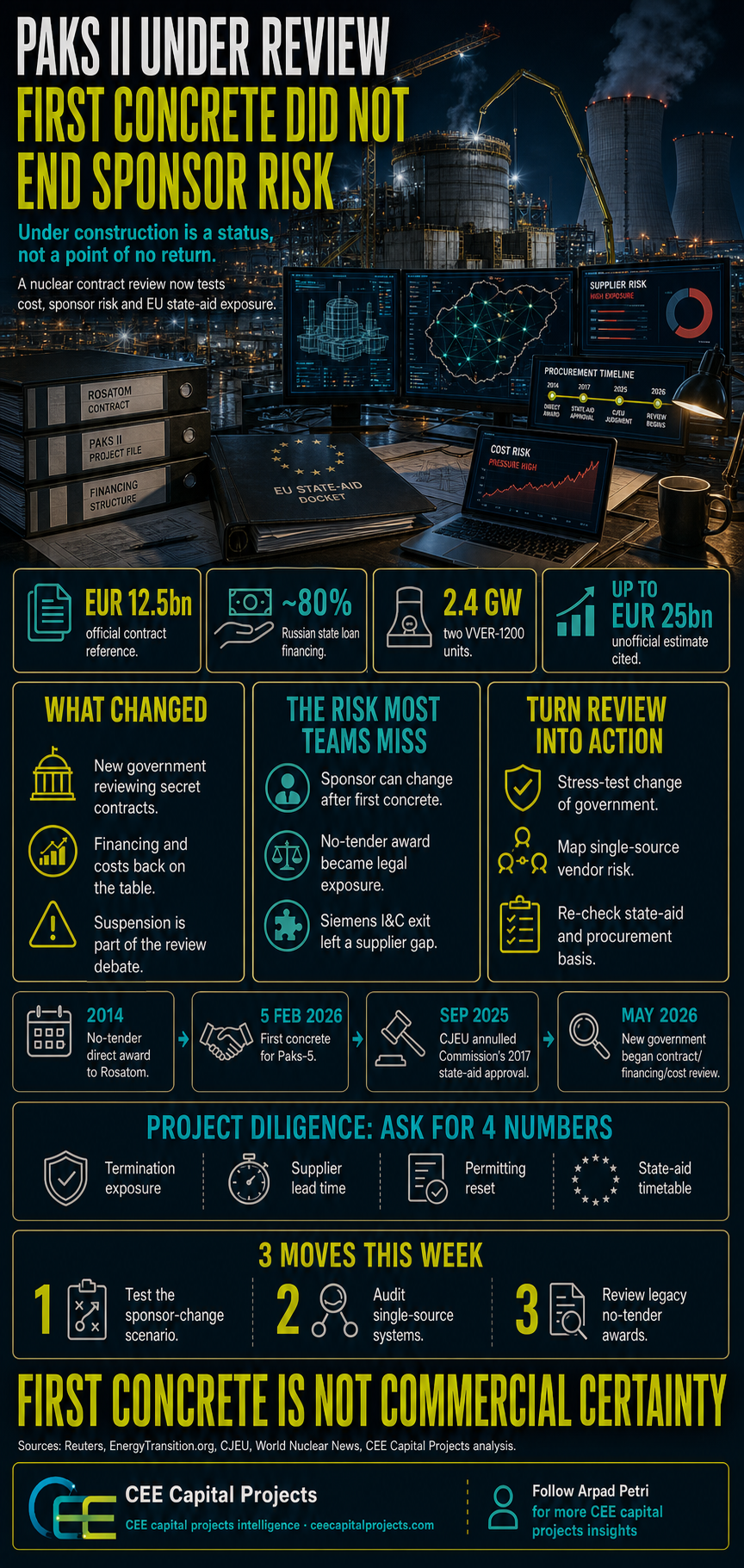
Explore our infograph library — strategic visuals for CEE capital projects leaders.
Project benchmarks, financing structures, tender dynamics and delivery risk — at a glance. Free access for investors, owners, contractors and strategy teams tracking CEE capital projects.
Browse the libraryStrategic Insights
📊 Analytics & Strategic Insight
Poland is turning procurement design into a competitive weapon on the biggest greenfield rail build in Central Europe
The decision most in this industry are avoiding:
👉 Slowing down before you tender. Most owners equate progress with issuing a tender fast. CPK is spending weeks in structured dialogue with bidders first, betting that a sharper specification saves years of claims and rework later.
👉 Treating procurement method as a strategic choice, not admin. Open tender versus competitive dialogue gets ticked off as a formality. It is the single biggest lever over price, risk transfer and the odds of a legal challenge on a mega-scheme.
👉 Breaking the prize into pieces rivals can each win. Splitting a 130km-plus line into six packages caps the damage from any one failed contractor and keeps real competition alive across the whole programme.
Here's the full context:
→ 2020: Poland confirms CPK as a combined hub airport and high-speed rail programme centred southwest of Warsaw.
→ December 2025: CPK launches the first Warsaw–Łódź construction procurement (Kotowice – Airport Junction, 12.9km) using competitive dialogue.
→ March 2026: A Polish appeals panel strikes down the roughly €1.2bn Rail Baltica Białystok–Ełk award to a Budimex–Porr consortium, a reminder of tender-litigation risk.
→ 2026: CPK sets out a tender pipeline worth around $10bn for the year across rail, the hub airport and feeder roads (Aviation Week).
→ Most recent: On 6 July 2026 CPK confirms eight bidders for the 14.3km Airport Junction – Bolimów Junction section and will shortlist up to five for competitive dialogue (International Railway Journal).
What this means for infrastructure operators, contractors and investors:
✅ Contractors should build local consortia now. Almost every serious bidder here is paired with regional partners; going it alone, as Budimex did, is the exception rather than the rule in this market.
✅ Sponsors can copy the dialogue-first playbook. Refining scope with bidders before final bids reduces both cost surprises and appeal risk on first-of-a-kind schemes with no domestic reference base.
✅ Investors should read bidder depth as a demand signal. Eight bidders for one short section says the CEE greenfield pipeline is pricing better than Western European schemes now facing budget cuts and delays.
3 moves you can make this week:
1️⃣ Map the CPK package pipeline. Line up the six Warsaw–Łódź sections plus the airport and road tenders against your capacity, and decide which one or two you can credibly win.
2️⃣ Line up a consortium partner. If you lack Polish delivery references, start conversations now with a local civils or track firm before shortlisting closes on the next package.
3️⃣ Stress-test your bid criteria for appeal risk. If you are a sponsor, have counsel pressure-test your scoring wording; if you are a bidder, model the timeline hit from a possible challenge before you commit.
Related analyses
- Transport & Infrastructure
V-Híd Just Lost Hungary's HUF 338 Billion Déli Körvasút at 42 Per Cent Complete. The Grant Clock Is the Real Story
Hungary halted construction of the Budapest Southern Circle Railway on 9 October 2026 and barred V-Híd from every ongoing rail investment. The HUF 367 billion of EU money behind the job survives only if a lawful re-tender lands inside two years.
Read analysis → - Transport & Infrastructure
Afcons Wins Croatia's EUR 899m Dugo Selo-Novska Rail Contract: Four Bids, No European Prime
Croatia signed its largest ever railway contract on 1 October 2026, handing 83 km of double-tracking to India's Afcons Infrastructure at EUR 677.06m excluding VAT. Four bids were priced for the work and not one of them came from a European prime contractor.
Read analysis → - Transport & Infrastructure
STRABAG Closes BAWI Construction Buy in Romania as Rail Qualification Becomes the Scarce Asset
STRABAG has closed its purchase of BAWI Construction, a Bucharest rail specialist with 240 employees and about EUR 60 million of 2025 output. The number that matters is the qualification it buys, as Romania opens a EUR 5.99 billion rail programme with the EU recovery window shut.
Read analysis →
Facing a decision on a CEE capital project?
Describe the situation in a few sentences. Within 72 hours you get an experienced read: the risks we see, what we'd check, and whether we can help — no calls, no obligation.