We Help International Investors and Project Owners Deliver Major CEE Projects Without Expensive Surprises
Independent project intelligence and advisory across energy, transport, real estate and industrial construction.
ČEZ Just Lined Up Two Dead Coal Plants for 3 GW of Nuclear. The Reactor Was Never the Scarce Part.
On 21 July 2026 ČEZ, Rolls-Royce SMR and the Czech industry ministry signed a memorandum covering small modular reactor preparation at the Tušimice and Dětmarovice coal stations. The deal is a lesson in what actually limits new nuclear build: not reactors, but connected, permitted, staffed ground.
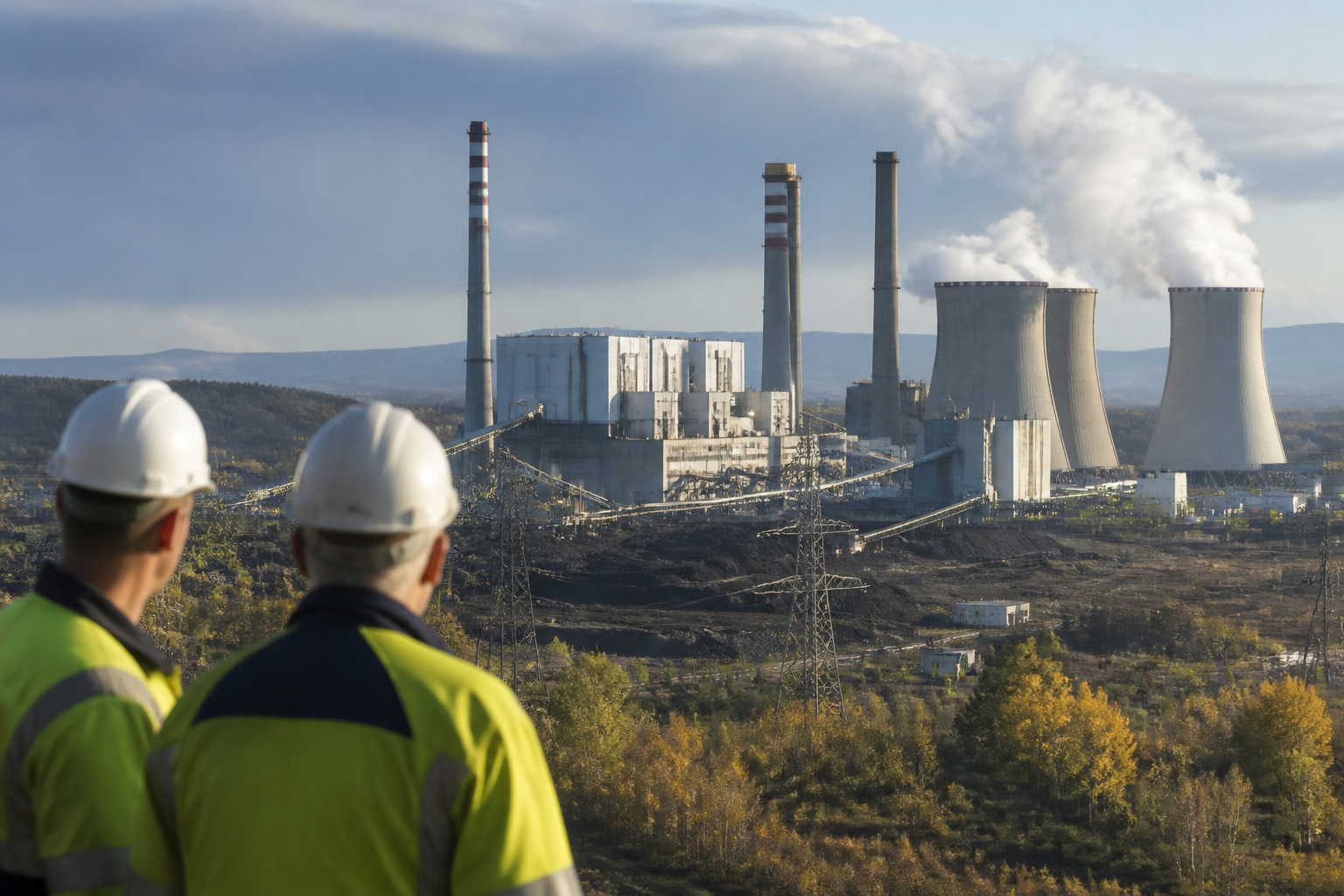
Czechia has just chosen the next two homes for its small modular reactor fleet, and neither of them is a nuclear site. On 21 July 2026 the Czech Ministry of Industry and Trade, ČEZ and Rolls-Royce SMR signed a memorandum of understanding to begin preparatory work at Tušimice in the Ústí nad Labem region and Dětmarovice in Moravian-Silesia. Both are coal power stations. Together with the first unit planned beside the existing Temelín plant, the three locations give Rolls-Royce SMR what its chief executive Chris Cholerton described as a route to "at least six" reactors and the foundations for 3 GW of capacity in Czechia (World Nuclear News, 21 July 2026).
The reactor is the least interesting part of that sentence.
The scarce asset is connected ground, not hardware
The Rolls-Royce SMR is a 470 MWe pressurised water reactor with a 60-year design life. The module measures roughly 16 metres by 4 metres and around 90 per cent of it is built in factory conditions, leaving on-site work largely to the assembly of pre-fabricated, pre-tested modules. That is the entire industrial premise: take the work off the critical path and put it in a shed where it can be repeated.
Factories can be replicated. Sites cannot. What no supply chain can manufacture is a piece of ground that already holds a high-voltage grid connection, cooling water rights, transmission capacity, a district heating network, a licensed industrial history, a trained shift workforce and a town that has lived next to a power station for four decades. The Czech ministry stated the logic plainly: in the long term it considers the sites of current coal-fired power plants especially suitable for SMRs, because they can supply reliable heat to surrounding cities alongside electricity.
That is a procurement insight dressed up as an energy story. In a European market where interconnection queues now run for years and greenfield consenting runs longer, the retiring coal station is the closest thing to pre-permitted, pre-connected nuclear real estate anyone owns.
Heat is the revenue line most investors skip
Electricity gets the headlines; heat pays the mortgage. Both Czech coal sites sit inside established district heating systems, and ČEZ has already committed around CZK 2 billion to a new low-emission heat and power plant at Dětmarovice to secure supplies to Bohumín and Orlová. A reactor dropped onto that footprint inherits a contracted, weather-driven, price-regulated offtake that behaves nothing like a merchant power curve.
For anyone underwriting SMRs, that matters more than the levelised cost slide. A unit with a heat contract has a floor. A unit selling only into a day-ahead market does not.
ČEZ owns a fifth of its own supplier
The other structural feature of this deal is ownership. In October 2024 ČEZ selected Rolls-Royce SMR to deploy up to 3 GW in Czechia and simultaneously took a 20 per cent stake in the company. That converts a technology dependency into an equity position: every Rolls-Royce SMR ordered in Britain, Sweden or anywhere else now feeds value back to a Czech utility balance sheet.
The industrial follow-through is already visible. Tomáš Pleskač of the ČEZ board noted that the Plzeň-based nuclear engineering firm Škoda JS has become one of two suppliers of nuclear-island components for the Rolls-Royce SMR, and that the British company is only beginning to build out its supply chain. Czech industry is being positioned as a fleet supplier, not a host country. That is the same localisation logic Poland is applying to CPK and the Baltics to Rail Baltica, applied to reactors.
Brownfield does not mean de-risked
Contractors should read the site strategy with some care. Coal stations come with ash lagoons, contaminated ground, buried services, obsolete foundations and forty years of undocumented modification. Nuclear licensing demands geotechnical, seismic and hydrological evidence to a standard no coal plant ever had to meet. Demolition, remediation and ground investigation move to the front of the programme, and they are exactly the packages where FIDIC claims breed.
Timing deserves the same discipline. This is a memorandum of understanding covering preparatory activities, not a contract and not a final investment decision. The first Czech SMR is targeted for the Temelín area in the second half of the 2030s. Meanwhile the gigawatt-scale programme runs on its own track: the EPC contract with KHNP for two APR-1000 units at Dukovany was signed in June 2025 at a projected CZK 407 billion (USD 18.6 billion), with construction targeted from 2029. Czechia is running a fleet-scale nuclear programme and an SMR programme at once, from a domestic supply chain that is not twice its former size.
What to watch next
The competition for SMR deployment in Europe will not be won on reactor economics for some years yet. It will be won on sites. Every utility in the region with retiring thermal capacity now holds an option that looks cheap on the balance sheet and expensive to replace: Poland, Romania, Bulgaria and Germany all have coal footprints with grid connections attached. Expect site-control agreements, heat-network due diligence and early-works remediation contracts to move ahead of technology selection, and expect the developers who quietly secured that ground years ago to set the price for everyone else.
Share it with your peers
Help your network stay ahead of CEE capital projects.
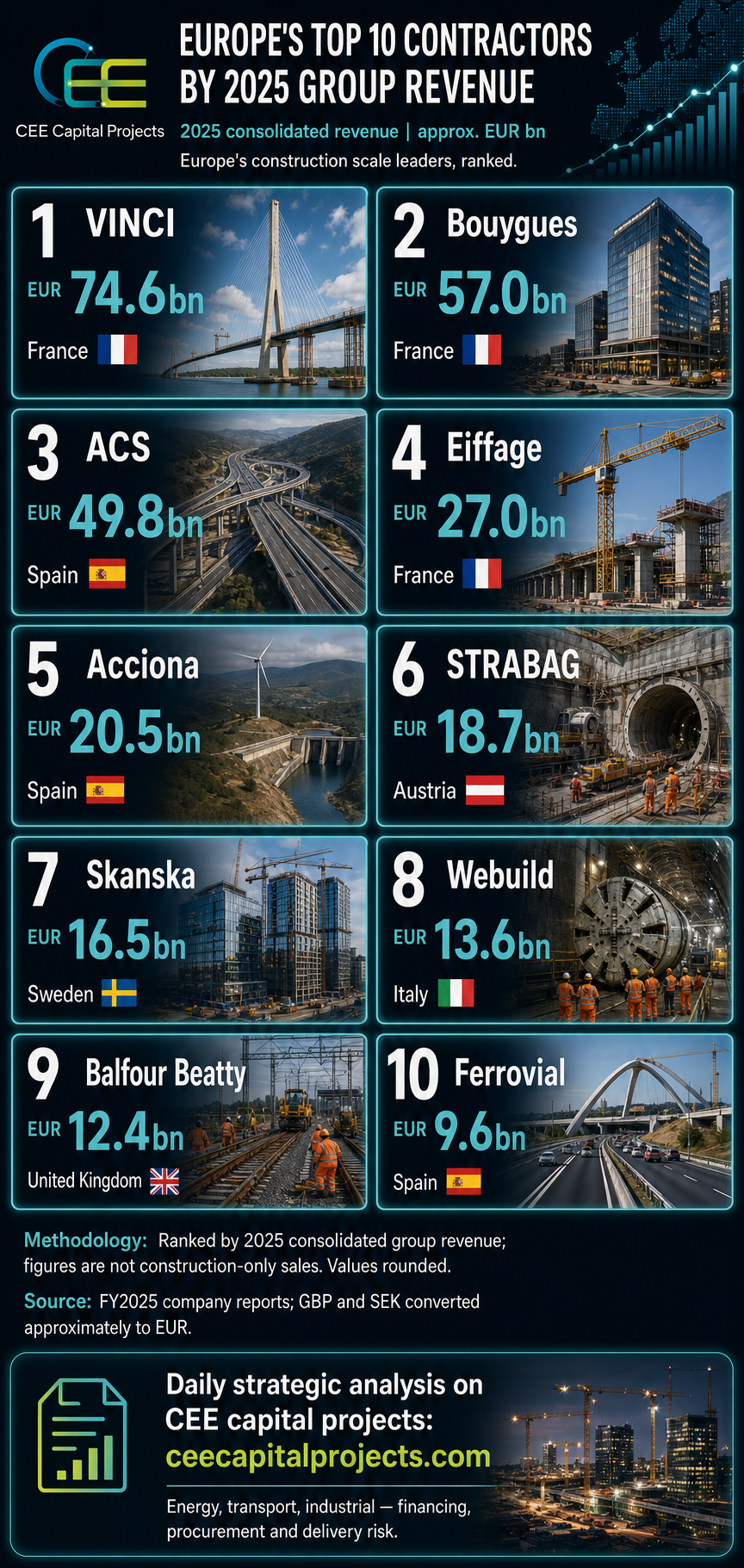
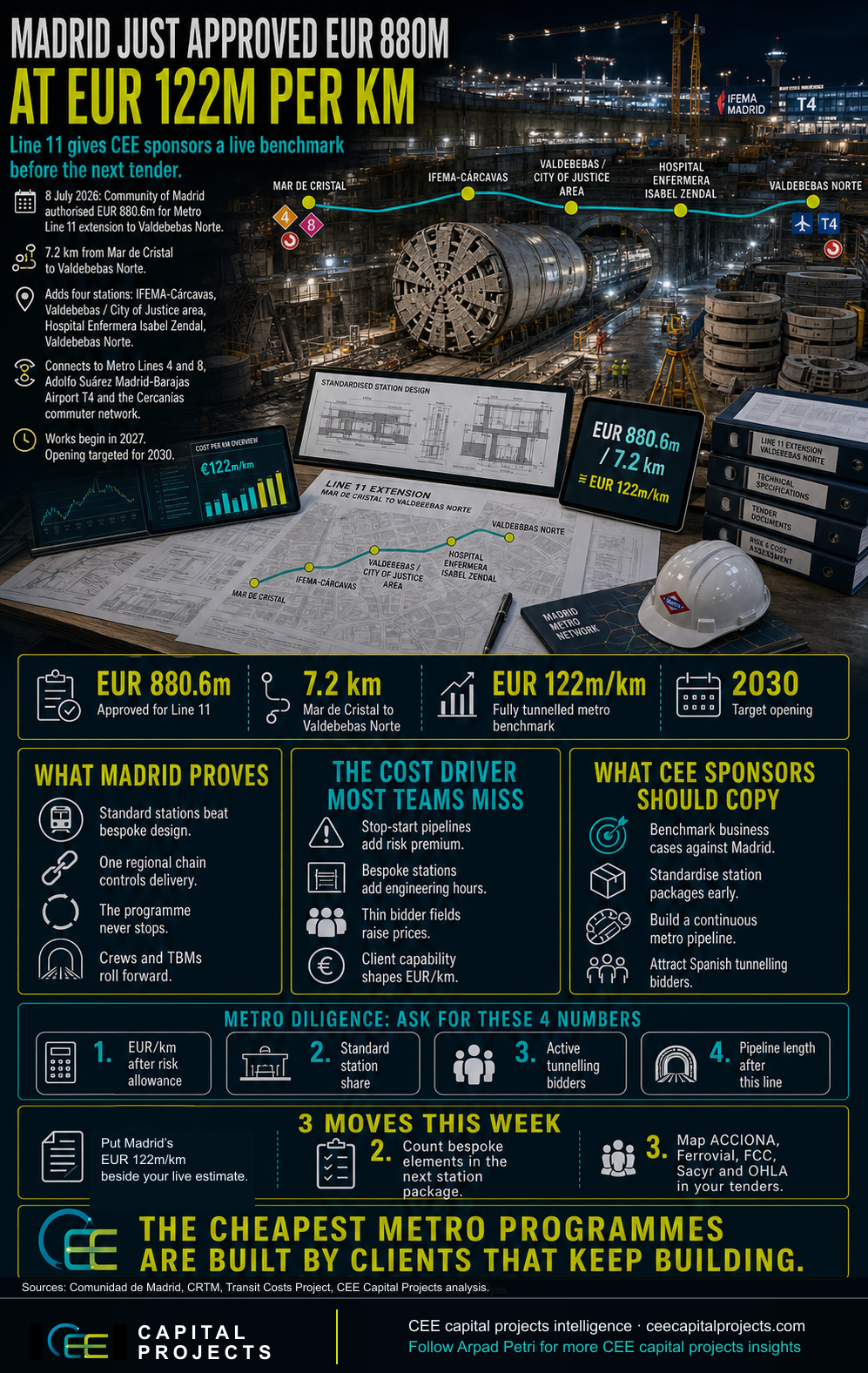
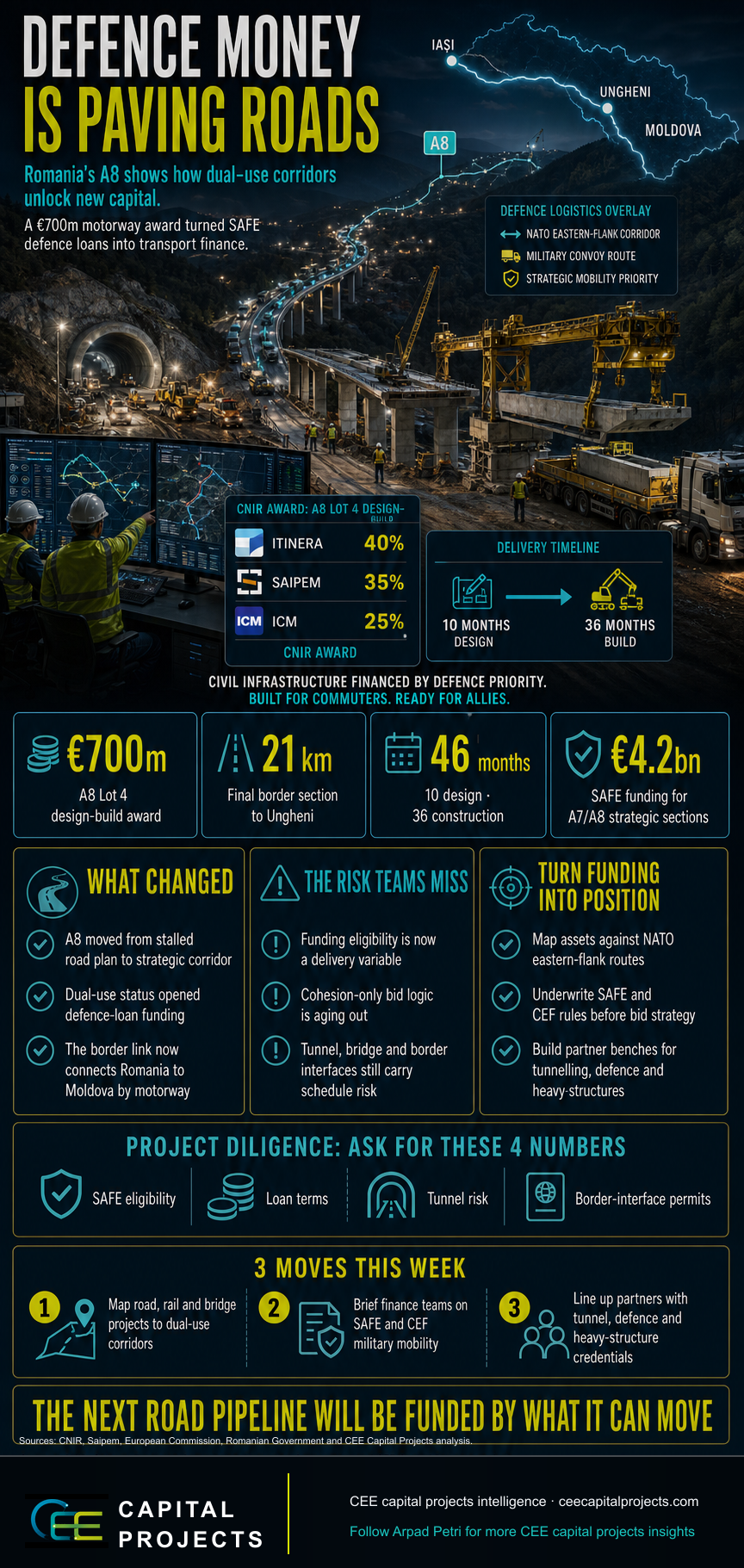
Explore our infograph library — strategic visuals for CEE capital projects leaders.
Project benchmarks, financing structures, tender dynamics and delivery risk — at a glance. Free access for investors, owners, contractors and strategy teams tracking CEE capital projects.
Browse the libraryStrategic Insights
📊 Analytics & Strategic Insight
Coal sites are becoming the most valuable option in European nuclear, and almost nobody prices them that way
The decision most in this industry are avoiding:
👉 Treating retiring coal stations as liabilities instead of options. Utilities book decommissioning provisions against these assets and race to write them off. The grid connection, cooling water rights, heat network and community consent attached to that land are close to unobtainable at any price on a greenfield today, and they are being surrendered for accounting neatness.
👉 Assuming SMR competition will be decided by reactor cost. First-of-a-kind unit costs will stay opaque and contested well into the 2030s. Site control, licensing evidence and heat offtake are decidable now, and they will determine which projects reach FID first regardless of which design wins on paper.
👉 Depending on a single technology vendor without owning a piece of it. ČEZ took 20 per cent of Rolls-Royce SMR before committing its fleet. Most utilities sign a supply agreement and hope. One arrangement captures the upside of every other country that buys the same reactor; the other pays for it.
Here's the full context:
→ 1985–2002: Czechia builds its existing nuclear base, four VVER-440 units at Dukovany and two units at Temelín, together supplying about a third of national electricity.
→ July 2024: The Czech government selects KHNP as preferred bidder for two new gigawatt-scale units at Dukovany, setting up a parallel large-reactor programme.
→ October 2024: ČEZ selects Rolls-Royce SMR to deploy up to 3 GW in Czechia and takes a 20 per cent equity stake in the company, converting a supplier relationship into ownership.
→ June 2025: The Dukovany EPC contract is signed for two APR-1000 units at a projected CZK 407 billion (USD 18.6 billion), with construction targeted from 2029; Rolls-Royce SMR is separately selected as the UK's preferred SMR technology.
→ Most recent: On 21 July 2026 the Czech industry ministry, ČEZ and Rolls-Royce SMR sign a memorandum to start preparatory work at the Tušimice and Dětmarovice coal sites, giving a route to at least six 470 MWe reactors and around 3 GW, with Škoda JS already named as one of two nuclear-island component suppliers.
What this means for infrastructure operators, contractors and investors:
✅ Site rights are becoming a tradeable asset class of their own. Grid connection capacity, water abstraction rights and heat-network access on brownfield industrial land now carry scarcity value independent of whatever gets built on top. Value them separately in any thermal asset sale or closure decision.
✅ The early money in SMR is in remediation, ground investigation and demolition, not reactors. Coal-to-nuclear conversion front-loads exactly the work European civils contractors already do well, years before any nuclear-qualified scope opens. That pipeline is bookable long before FID.
✅ Fleet supply beats host-country status. Škoda JS supplying nuclear-island components for a design deployed in Britain, Sweden and Czechia earns from every unit built anywhere. Getting qualified into a fleet supply chain early is worth more than the domestic content share of one project.
3 moves you can make this week:
1️⃣ Inventory the site rights you already hold. For every thermal, industrial or logistics asset on your books, list the connection capacity, water rights, heat contracts and consented footprint. Price them before anyone asks you to surrender them.
2️⃣ Get your ground-works credentials in front of SMR developers now. Contamination surveys, ash lagoon remediation, geotechnical and seismic investigation are the first packages awarded on coal-to-nuclear sites, and the shortlists are being formed during the preparatory phase, not after FID.
3️⃣ Audit your single-vendor exposure. Where your pipeline depends on one technology owner, ask what an equity stake, a fleet-supply qualification or an exclusivity clause would cost, and compare it against the margin you will hand over across the next decade.
Related analyses
- Energy & Power
Constellation's $4.3bn Nuclear Uprate Deal With Google: 890 MW, No New Site, and a Finite Pool
Constellation will invest more than $4.3bn to lift 890 MW out of 11 existing reactors under a 20-year Google power purchase agreement, at roughly half the per-kilowatt cost of recent American new build. The point for Europe is that the national uprate pool runs to three to five gigawatts, ČEZ banked its Dukovany headroom by 2009, and the only route left to fresh capacity is a CZK 407bn new build.
Read analysis → - Energy & Power
NEK's EUR 350 Million Yadenitsa Dam Tender Turns Bulgaria's Chaira Storage Fix Into a Civils Job
Bulgaria's NEK has put EUR 350m on the market for the Yadenitsa dam and a six kilometre tunnel at the 864 MW Chaira pumped storage plant, with bids due 4 November 2026 and 60 months to build. The civil works are costed at more than three times the EUR 102m reconstruction of all four of the plant's machines.
Read analysis → - Energy & Power
EIB and BNP Paribas Guarantee EUR 700m of Grid Equipment Bonds: Europe's Network Bottleneck Moves to the Balance Sheet
The EIB and BNP Paribas signed a EUR 700m counter-guarantee portfolio on 29 September 2026, covering advance payment and performance bonds for European manufacturers of electricity grid components. The instrument is small, and it points at the constraint that now sets delivery dates on Europe's grid build: bonding capacity rather than factory floor.
Read analysis →
Is your project leaking money through its subcontractors?
Most owners lose 3–8% in vendor packages without noticing. Tell us about your project — we'll tell you where we'd look first.