We Help International Investors and Project Owners Deliver Major CEE Projects Without Expensive Surprises
Independent project intelligence and advisory across energy, transport, real estate and industrial construction.
Baltic Power Delivers Poland's First Offshore Wind Electricity: Why the Next 6 GW Just Got Cheaper to Finance
Poland's first offshore wind farm, the 1.2 GW ORLEN–Northland Baltic Power project, fed its first electricity into the national grid on 10 July 2026 with 54 of 76 turbines installed and completion due this autumn. First power in a first-time market resets the financing maths for the 3.4 GW auction wave queuing behind it.
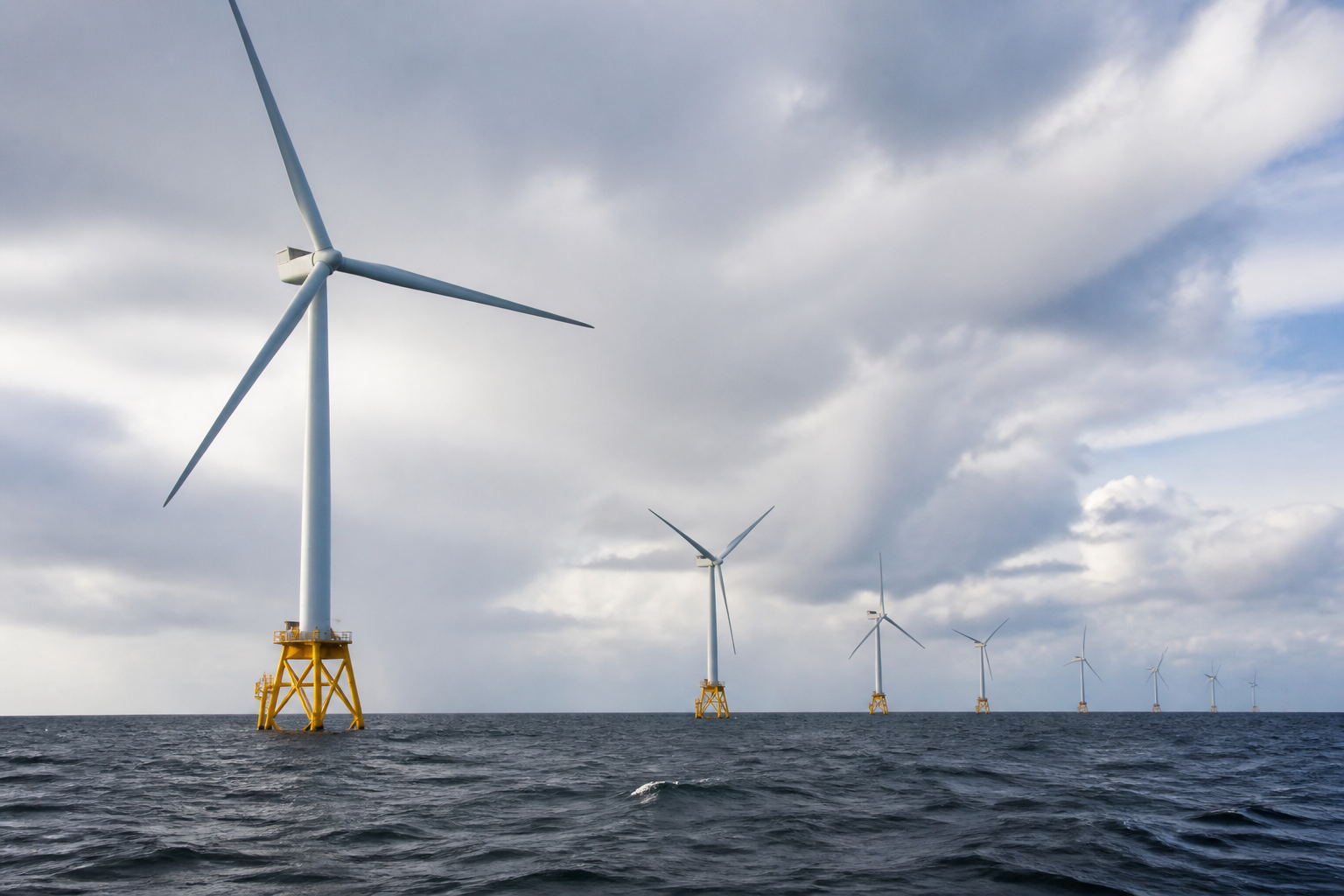
Poland still generates roughly half of its electricity from coal, the highest share in the European Union. On 10 July 2026, the same grid absorbed something it had never carried before: power from offshore wind. The first of Baltic Power's 76 turbines began feeding the national system, eighteen months after offshore installation started, on schedule and, according to co-owner Northland Power, with costs aligned with original expectations.
The milestone in numbers
Baltic Power, the 1.2 GW joint venture between Polish state energy group ORLEN and Canada's Northland Power, confirmed first power on 10 July. According to the sponsors' announcement (via offshoreWIND.biz, 10 July 2026), 54 of 76 Vestas V236-15.0 MW turbines are installed, all 350 kilometres of inter-array and export cables are laid, both offshore substations stand complete, and the onshore substation at Choczewo is ready. More than 100 vessels and over 5,300 crew and contractors have worked on the project. Construction is scheduled to finish this autumn.
Once fully commissioned, the farm — 130 square kilometres of Baltic Sea some 23 kilometres off Choczewo and Łeba — will produce around 4 TWh a year, roughly 3% of Polish electricity demand and the equivalent of more than 1.5 million households, while avoiding up to 2.8 million tonnes of CO2 annually versus conventional generation.
Eighteen months from first steel to first power
Offshore installation began at the start of 2025. All 76 monopiles were in the seabed by February 2026, transition pieces followed in March, and the turbine campaign has now erected 54 units. Northland Power's 10 July statement said the project remains on track for commercial operations in the second half of 2026, with costs aligned with original expectations.
That sentence deserves more attention than the ribbon-cutting. Offshore wind's recent record reads as a list of write-downs, cancelled offtakes and renegotiated strike prices. A first-of-its-kind project, in a market with zero offshore construction history, delivered by a state oil company and a Canadian IPP, hitting first power on schedule is the strongest evidence yet that the sector's cost problem is project-specific rather than structural.
Why the finance desks are watching
Baltic Power closed a debt package of roughly EUR 4.4 billion in 2023, one of the largest project financings ever arranged for a Polish energy asset. First power starts the de-risking cascade every project financier knows by heart: construction risk begins converting into operating risk, the refinancing window opens, and every megawatt-hour delivered narrows the spread a lender can justify charging the next Polish offshore borrower.
The queue behind is substantial. In December 2025, Poland's Energy Regulatory Office (URE) concluded the country's first offshore wind auction, awarding 25-year two-way contracts for difference to three projects totalling 3.4 GW. Five further farms with a combined capacity of just over 6 GW are planned in the Polish Baltic, including ORLEN's Baltic East, the PGE–Ørsted Baltica programme and a Polenergia–Equinor development. Under the national energy and climate plan approved in June 2026, offshore wind is to supply 18–21% of Polish electricity by 2040.
The supply-chain dividend
ORLEN CEO Ireneusz Fąfara framed the project inside a PLN 380 billion group investment programme, the largest in the history of Poland's energy sector. The turbines' nacelles were manufactured in Poland, the Łeba maintenance base will run operations for around 30 years, and Warsaw rolled out a local content framework in April 2026 after flagging the low domestic share in the first wave. Energy minister Paulina Hennig-Kloska was candid at the launch ceremony: offshore wind costs more than onshore wind or solar, but it competes well with gas and coal.
What first power changes for the second wave
For operators, contractors and investors, the reading is direct. Poland now has a completed offshore reference asset, a tested grid connection at Choczewo, a functioning O&M port and an auction regime with 3.4 GW already contracted. The construction premium that made Polish offshore expensive to finance starts expiring this autumn, with certification and the generation licence from the regulator. Prime Minister Donald Tusk supplied the strategic framing at the ceremony: Polish wind will blow regardless of what happens in Iran or Moscow. The commercial framing is simpler: the second wave will be won by the firms that positioned themselves while everyone else was watching the first.
Share it with your peers
Help your network stay ahead of CEE capital projects.
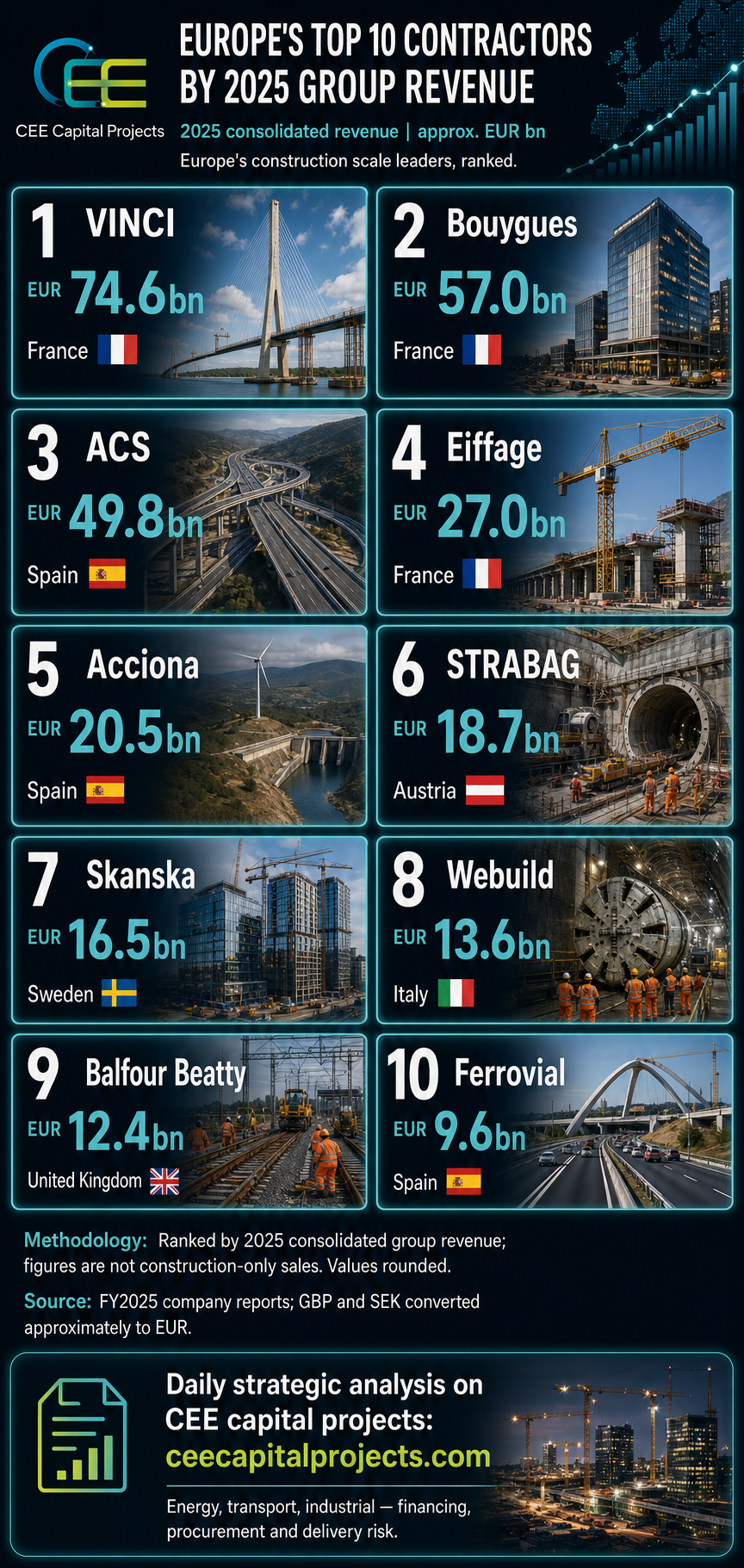
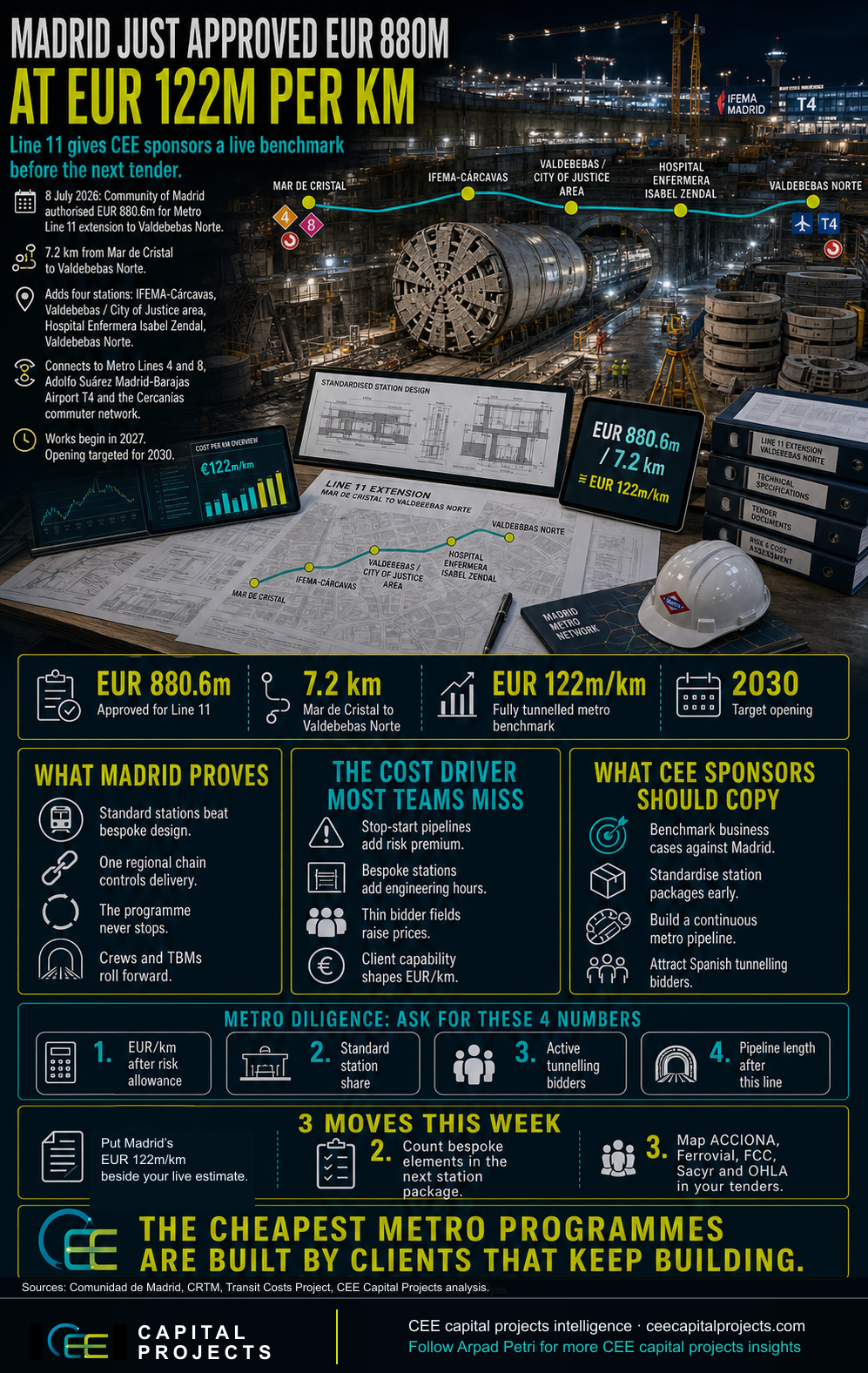
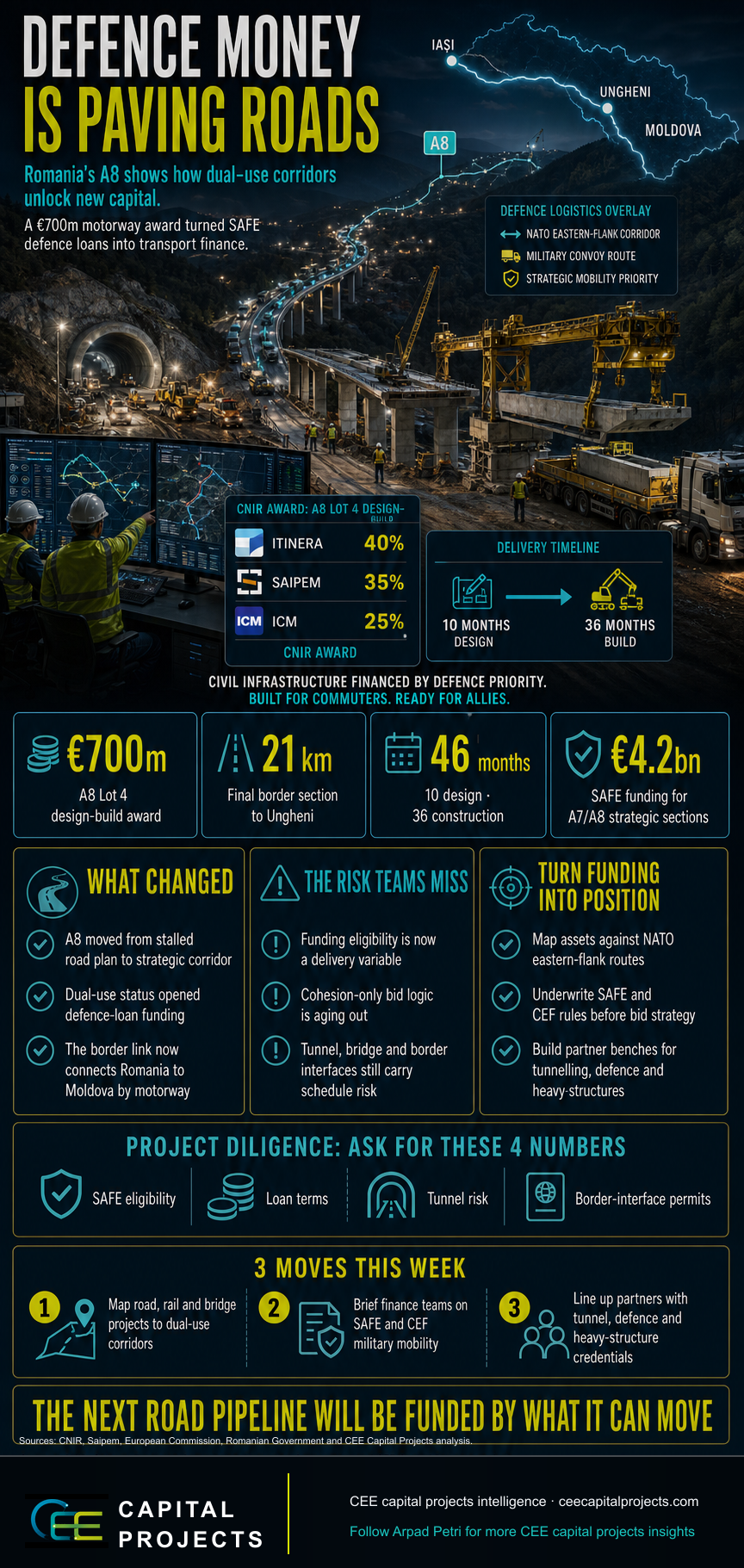
Explore our infograph library — strategic visuals for CEE capital projects leaders.
Project benchmarks, financing structures, tender dynamics and delivery risk — at a glance. Free access for investors, owners, contractors and strategy teams tracking CEE capital projects.
Browse the libraryStrategic Insights
📊 Analytics & Strategic Insight
A completed reference project reprices an entire national pipeline
The decision most in this industry are avoiding:
👉 Treating first-time markets as uninvestable until someone else proves them. The proof happened on 10 July. The entry discount that came with Polish offshore construction risk is now expiring, and latecomers will pay operating-asset prices for what early movers bought at greenfield prices.
👉 Waiting for full commercial operations before acting. De-risking is a cascade, and it started at first power. Refinancing mandates, stake sales and supplier framework positions are being decided now, months before the certification paperwork completes.
👉 Dismissing local content rules as bid-stage paperwork. Poland flagged the low domestic share of the first wave and rolled out a framework in April 2026. Whoever builds Polish manufacturing, port and service positions now will hold a scoring advantage across the 6 GW second wave.
Here's the full context:
→ 2023: Baltic Power closes a roughly EUR 4.4 billion debt package, one of the largest project financings in Polish energy history, for the country's first offshore wind farm.
→ Early 2025: Offshore installation begins — monopiles, cables and substations progress through the year while much of the global offshore sector is still digesting write-downs and cancelled offtakes.
→ December 2025: Poland's Energy Regulatory Office concludes the first offshore wind auction, awarding 25-year two-way CfDs to three projects totalling 3.4 GW.
→ February–April 2026: All 76 monopiles and transition pieces installed; government publishes a local content framework after criticising the low domestic share in wave one.
→ Most recent: On 10 July 2026, Baltic Power delivers Poland's first offshore wind electricity — 54 of 76 turbines installed, costs aligned with original expectations, completion due in autumn (ORLEN / Northland Power, 10 July 2026).
What this means for infrastructure operators, contractors and investors:
✅ Lenders now have a Polish offshore reference asset. Expect construction-risk spreads on second-wave financings to compress and a refinancing or partial sell-down of Baltic Power itself to test institutional appetite within 12–18 months.
✅ The contractor window for the 3.4 GW auction wave is open now. Vessel slots, foundation packages, cable supply and port capacity for the Baltica programme, Baltic East and the Polenergia–Equinor project will be committed long before first steel; registers and prequalifications decide who participates.
✅ Offshore wind now competes with gas and coal on Polish economics. The energy minister said so explicitly. For industrial offtakers and utilities, that puts Baltic-backed PPAs on the table as a hedge against both carbon costs and imported-fuel volatility.
3 moves you can make this week:
1️⃣ Map your exposure to Poland's second wave. List the three auction winners from December 2025 plus Baltic East and Baltica, then check which supplier registers, prequalification lists and framework agreements you are missing.
2️⃣ Reprice regional construction risk in your models. If your credit or investment papers still price Polish offshore at pre-2026 risk premia, rerun them with a completed 1.2 GW comparator delivered on schedule and on budget.
3️⃣ Read Poland's local content framework before you bid. Assess what a Polish manufacturing, assembly or O&M footprint would cost you now versus what tender scoring will charge you for not having one.
Related analyses
- Energy & Power
Constellation's $4.3bn Nuclear Uprate Deal With Google: 890 MW, No New Site, and a Finite Pool
Constellation will invest more than $4.3bn to lift 890 MW out of 11 existing reactors under a 20-year Google power purchase agreement, at roughly half the per-kilowatt cost of recent American new build. The point for Europe is that the national uprate pool runs to three to five gigawatts, ČEZ banked its Dukovany headroom by 2009, and the only route left to fresh capacity is a CZK 407bn new build.
Read analysis → - Energy & Power
NEK's EUR 350 Million Yadenitsa Dam Tender Turns Bulgaria's Chaira Storage Fix Into a Civils Job
Bulgaria's NEK has put EUR 350m on the market for the Yadenitsa dam and a six kilometre tunnel at the 864 MW Chaira pumped storage plant, with bids due 4 November 2026 and 60 months to build. The civil works are costed at more than three times the EUR 102m reconstruction of all four of the plant's machines.
Read analysis → - Energy & Power
EIB and BNP Paribas Guarantee EUR 700m of Grid Equipment Bonds: Europe's Network Bottleneck Moves to the Balance Sheet
The EIB and BNP Paribas signed a EUR 700m counter-guarantee portfolio on 29 September 2026, covering advance payment and performance bonds for European manufacturers of electricity grid components. The instrument is small, and it points at the constraint that now sets delivery dates on Europe's grid build: bonding capacity rather than factory floor.
Read analysis →
Facing a decision on a CEE capital project?
Describe the situation in a few sentences. Within 72 hours you get an experienced read: the risks we see, what we'd check, and whether we can help — no calls, no obligation.