We Help International Investors and Project Owners Deliver Major CEE Projects Without Expensive Surprises
Independent project intelligence and advisory across energy, transport, real estate and industrial construction.
ACCIONA Energía Sold 21-Year-Old Wind Farms for €432m While Its Own Power Prices Fell 27%. Selling Plants Now Pays Better Than Running Them
ACCIONA Energía booked an €18m attributable loss running its plants in H1 2026 and around €310m of capital gains selling two of them in July. The 361MW Spanish wind portfolio sold to Galp fetched roughly €1.2m per MW at an average asset age of 21 years, about 70% above the market rate.
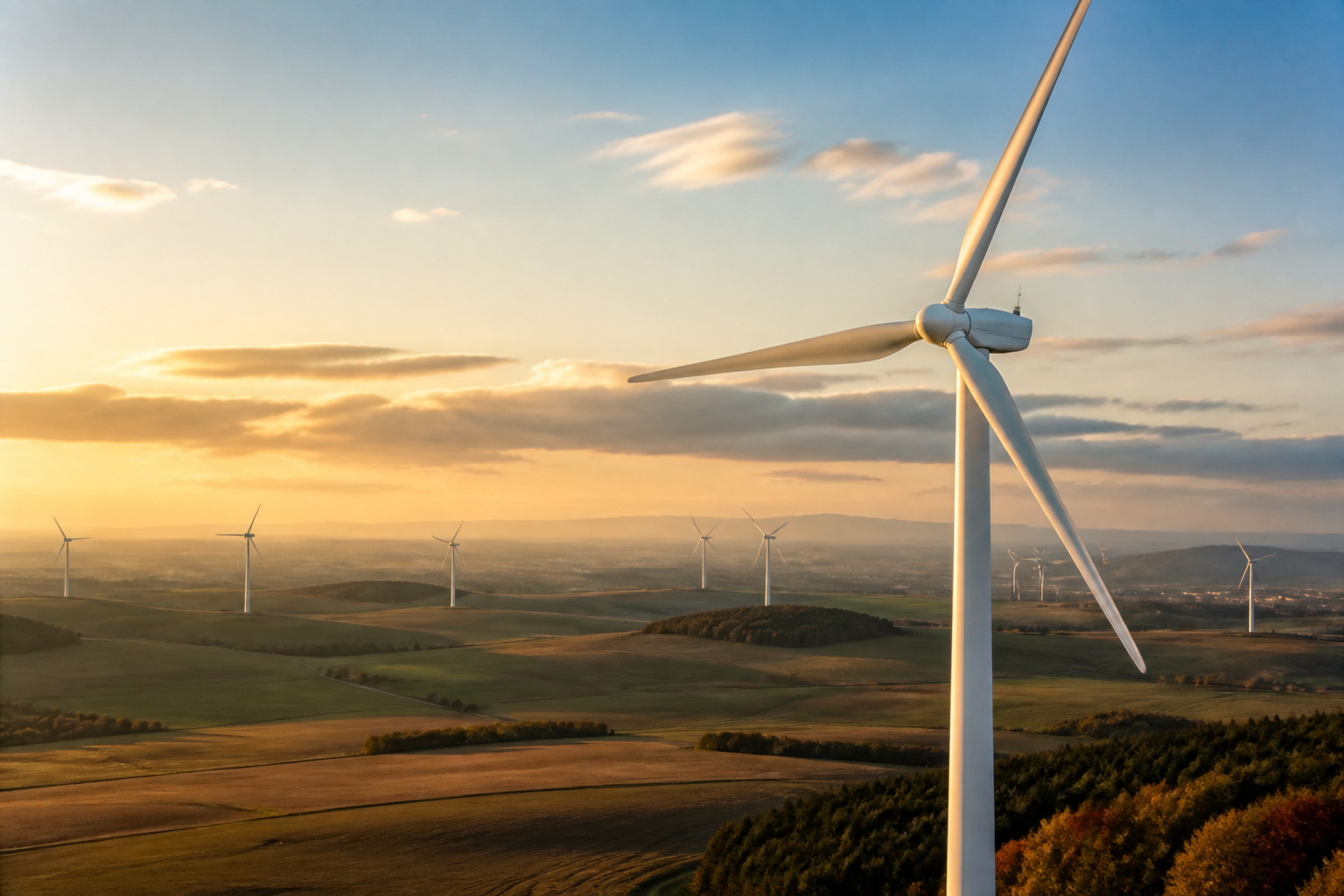
In the six months to 30 June, running ACCIONA Energía's power plants produced an attributable loss of €18 million. In three weeks of July, selling two of them produced roughly €310 million of capital gains. Both numbers reached the market in the same week.
The Spanish renewables group reported H1 2026 results on 30 July 2026: revenue down 12% to €1,288 million, generation revenue down 10% to €687 million, EBITDA from operations down 17% to €388 million, and an attributable net loss of €18 million against a €423 million profit in H1 2025. Three days earlier it had closed the sale of a 361MW Spanish wind portfolio to Galp New Energies for an equity value of €432 million, with an estimated capital gain of €255 million.
The capture price did the damage
ACCIONA Energía's average achieved price fell 27% to €59.3/MWh. The unhedged wholesale price it captured in Spain fell 39% to €47.0/MWh; its regulated price fell 31% to €86.7/MWh. Volume was not the problem. Price was.
Spain recorded 397 hours of negative day-ahead prices in Q1 2026, against 48 in the same quarter of 2025. February alone produced 148 negative hours, up from none in February 2025. European solar generation set a Q2 record in 2026 at 129 TWh, close to 20% above any previous second quarter. A fleet long on midday output and short on storage sells into the hours when everyone else is selling too.
Two one-off items sharpened the result: a €15 million write-down on the Moura PV plant in Portugal and a €21 million restructuring provision. Full-year guidance was left unchanged.
What a 21-year-old wind farm is worth
The Galp portfolio is 15 wind farms across Navarra, Zaragoza, Ciudad Real, Palencia, Guadalajara and Seville, average operating age 21 years, with no financial debt inside the transaction perimeter. Signing and completion happened simultaneously and full proceeds were received at closing. BNP Paribas advised ACCIONA Energía; Baker McKenzie was legal adviser.
At €432 million of equity value for 361MW, the price is roughly €1.2 million per MW for turbines with an average commissioning date around 2005, selling merchant power into the market described above. Enerdatics, which records the enterprise value at €420 million, puts that at $1.36 million per MW against a $0.80 million median for Spanish operating wind transactions since the start of 2023 — the top of a $0.59 million to $1.36 million range, and 70% above the middle of it.
The sharpest comparison comes from the same seller. ACCIONA Energía sold 791MW of Spanish operating wind to Opdenergy in July 2025 at $0.78 million per MW. Twelve months later a smaller, older portfolio fetched almost twice that per megawatt.
The buyer, not the asset, set the price
Galp is an integrated energy company with refining, fuel retail and a power supply book. Physical megawatt-hours from Spanish wind sit against a position it already holds, which makes merchant exposure worth more on its balance sheet than on a fund's. Galp has said the deal brings capacity growth forward and reduces future organic investment, substituting for development spend rather than adding to it.
It has now paid that price twice. Galp bought 351MW of Spanish wind in April 2026 from Bankinter Investment and Plenium Partners at the identical dollar figure per MW, taking its 2026 Spanish wind buying to 712MW for roughly €829 million against guided pro-forma renewables EBITDA of about €110 million. That is close to 7.5 times.
Why ACCIONA is selling into weakness
Net financial debt stood at €4,442 million at 30 June, up from €4,161 million at end-2025, against a year-end target below €3 billion. Including the July disposals the pro-forma figure is around €3.9 billion. The 64MW of Spanish run-of-river hydro sold to White Summit Capital on 2 July for €66 million added €55 million of gains.
Since 2024 the company has agreed sales of more than 3GW of renewable capacity across Spain, Peru, Costa Rica, South Africa, the United States and Mexico for €3.7 billion, a deleveraging programme running on asset gains while the operating business absorbs a price shock.
What CEE should read off the Spanish tape
Poland is two or three years behind Spain on the same curve. Negative-price hours in April rose to 87 from 75 a year earlier, the solar capture factor fell to about 0.40 from 0.54, and 28.5% of Polish solar output was generated during negative-price periods. Hungary printed minus €500/MWh at 14:00 on 26 April 2026.
The CEE deal that priced well this summer looked nothing like the Spanish one. Actis bought Klara Renewables from CVC DIF on 2 July 2026 — 171MW of operating Polish wind backed by contracts for difference running to 2038-39, with roughly 275MW of hybridisation headroom for co-located solar and batteries at sites that are already connected. Contract cover and connection headroom, not youth, are what buyers are paying for.
For sponsors, the exit assumption inside a merchant model is now buyer-specific: an integrated offtaker and an infrastructure fund will not bid within 70% of each other. For lenders, the merchant tail beyond a contracted PPA is repricing faster than most base cases assume. For contractors and EPCs, volume is moving toward repowering, hybridisation and storage retrofits at existing connection points, where the residual value now sits. Anyone modelling a CEE renewables exit on 2023 Spanish comparables should redo the work.
Share it with your peers
Help your network stay ahead of CEE capital projects.
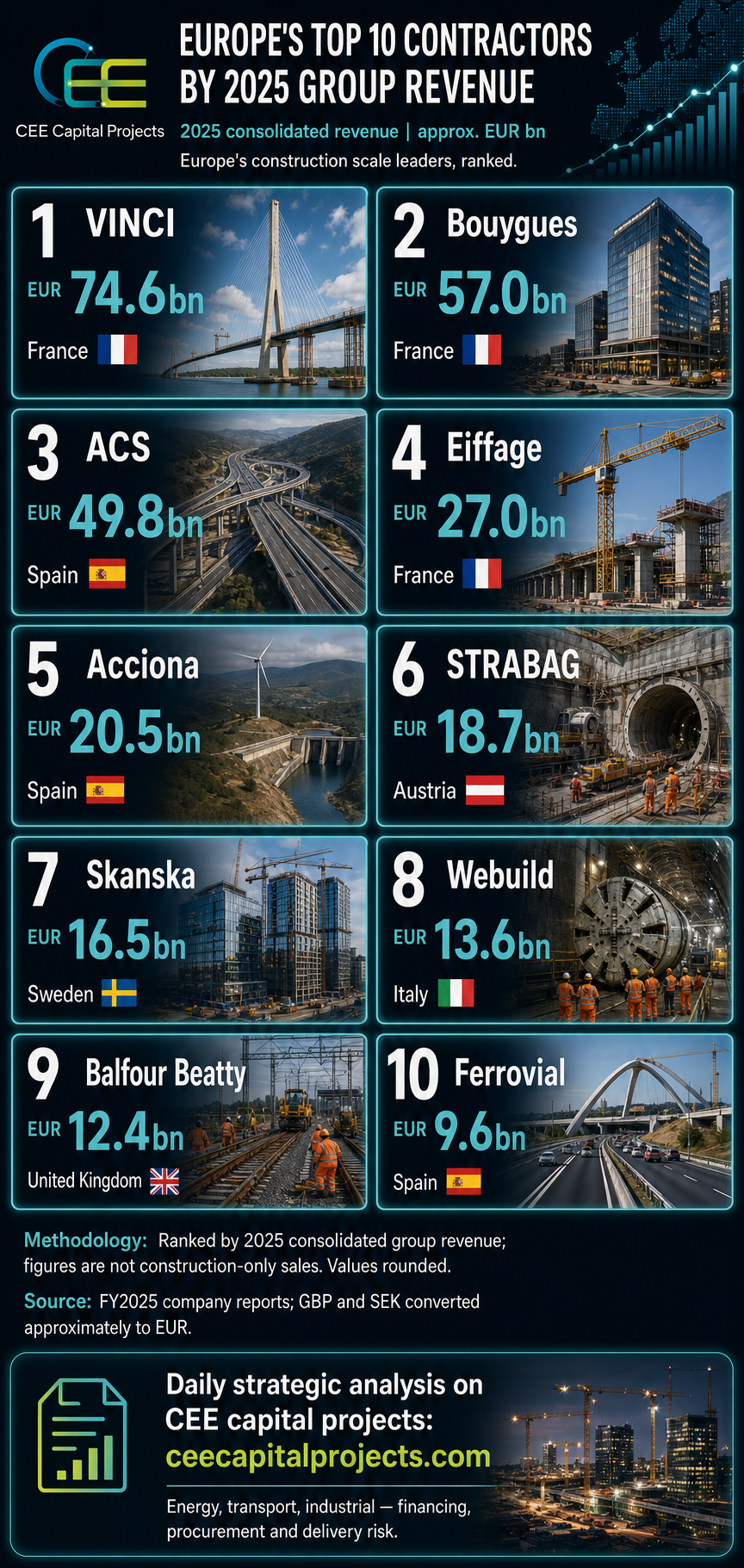
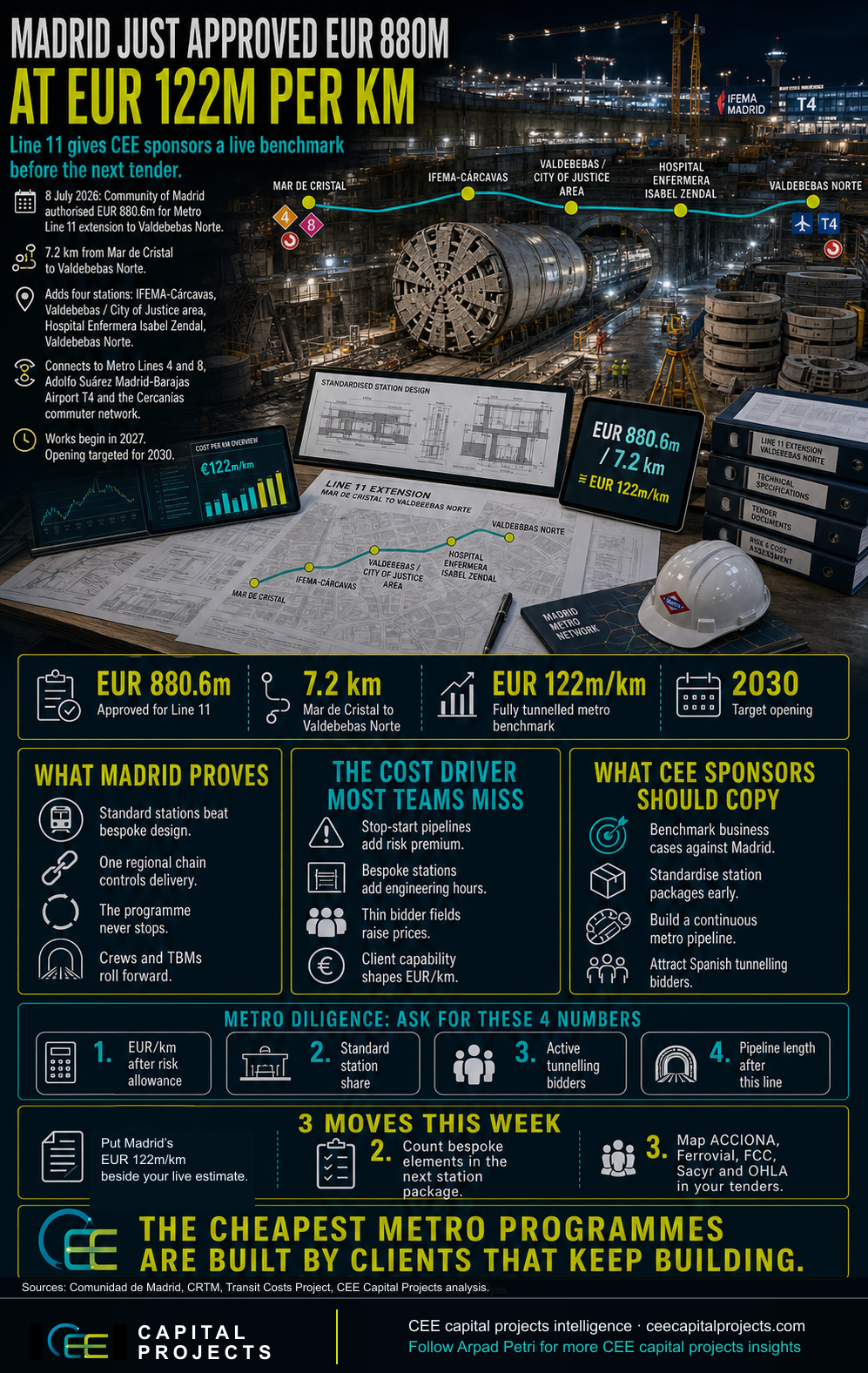
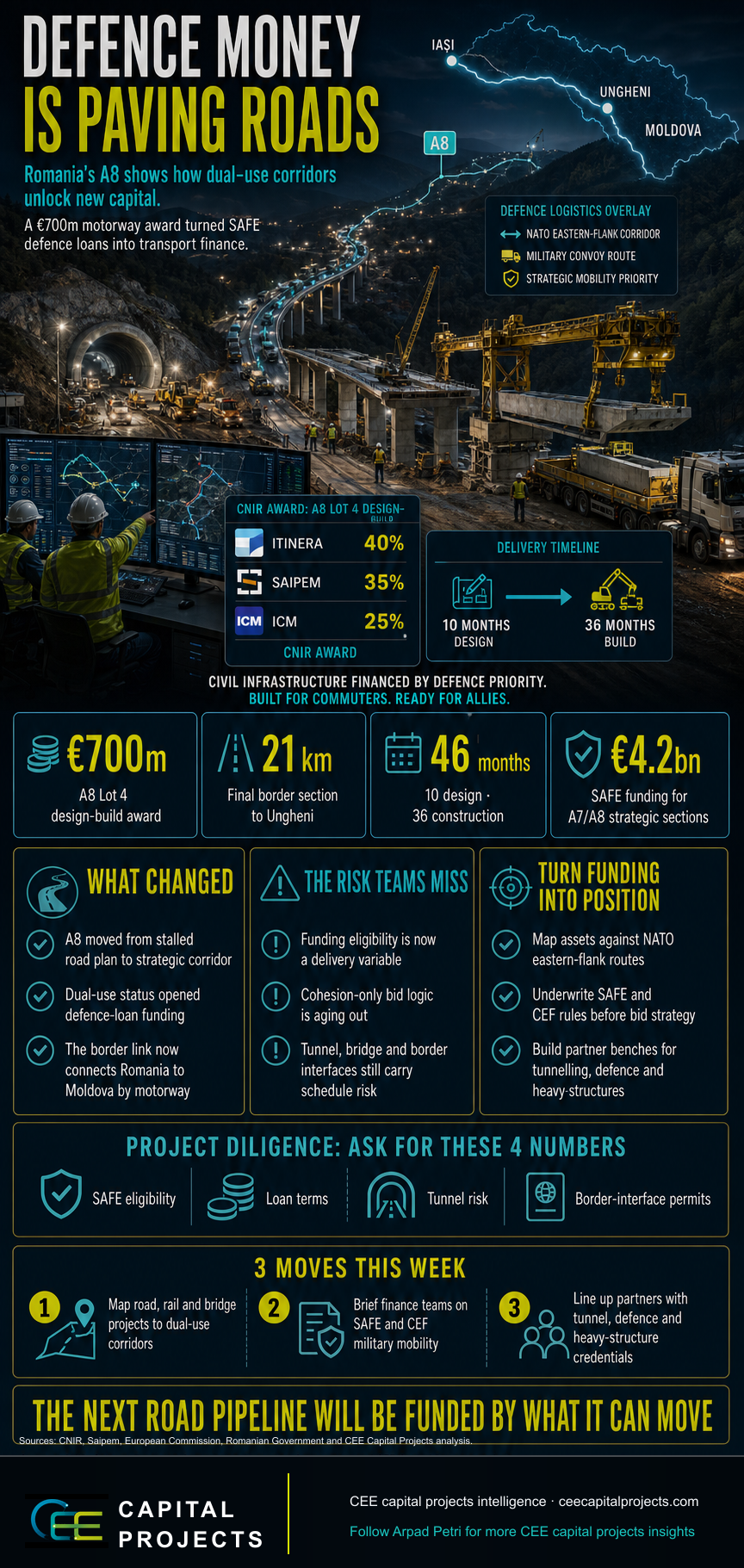
Explore our infograph library — strategic visuals for CEE capital projects leaders.
Project benchmarks, financing structures, tender dynamics and delivery risk — at a glance. Free access for investors, owners, contractors and strategy teams tracking CEE capital projects.
Browse the libraryStrategic Insights
📊 Analytics & Strategic Insight
Selling power plants now pays better than running them. That tells you what is broken.
The decision most in this industry are avoiding:
👉 Old plants can be worth more than new ones. A 21-year-old wind farm just sold for about €1.2 million per MW. The turbines are not the value. The grid connection is. A new project has to queue years for one of those, and an old site already has it.
👉 Who is buying matters more than what is bought. An oil and fuel company paid 70% more than a fund would have. Same wind farms. Same power prices. Different buyer. Most sale models still assume one price for everyone.
👉 Money from selling plants is not the same as money from running them. ACCIONA lost €18 million running its plants for six months and made about €310 million selling two of them in three weeks. One of those can be repeated every year. The other runs out when the good assets are gone.
Here's the full context:
→ 2005: The wind farms in this deal were built. Spain was paying good money for wind power back then, and there was very little solar on the system.
→ 2023: Working Spanish wind farms changed hands for about $0.80 million per MW on average. That was the going rate.
→ July 2025: ACCIONA sold 791 MW of Spanish wind to Opdenergy at $0.78 million per MW, right on that going rate.
→ Early 2026: Spain had 397 hours in three months when the power price fell below zero. A year earlier it had 48. Too much solar arrives at midday and nobody can store it.
→ Most recent: On 27 July 2026 ACCIONA sold 361 MW to Galp for €432 million, about €1.2 million per MW. Three days later it reported a loss for the half year.
What this means for infrastructure operators, contractors and investors:
✅ Know your buyer before you build. A power company that sells electricity to customers needs the output and will pay up for it. A fund only buys the cash flow and will pay less. Work out which one you are selling to at the start, not at the end.
✅ The grid connection is now the asset. If a site is already wired in, you can put newer turbines, solar panels or batteries on it without joining the queue. That headroom is worth real money and most valuations still ignore it.
✅ Old power price forecasts will hurt you. Prices at midday now fall to zero or below far more often than they did two years ago. Any model built on 2023 numbers is too high, and the banks lending against it will work that out before you do.
3 moves you can make this week:
1️⃣ Count your negative-price hours. Pull last year of half-hourly prices for each site you own or lend against. Count the hours below zero. Compare that with the number in your business case. If the gap is big, say so now.
2️⃣ List the spare capacity at every connection you hold. Write down the connection size and how much of it you actually use. The unused part is the cheapest growth you own, and it costs nothing to find out.
3️⃣ Split your profit into two lines. One line for money earned running plants, one for money earned selling them. Show both to your board. If the second line is bigger, you are shrinking, not growing.
Related analyses
- Energy & Power
Constellation's $4.3bn Nuclear Uprate Deal With Google: 890 MW, No New Site, and a Finite Pool
Constellation will invest more than $4.3bn to lift 890 MW out of 11 existing reactors under a 20-year Google power purchase agreement, at roughly half the per-kilowatt cost of recent American new build. The point for Europe is that the national uprate pool runs to three to five gigawatts, ČEZ banked its Dukovany headroom by 2009, and the only route left to fresh capacity is a CZK 407bn new build.
Read analysis → - Energy & Power
NEK's EUR 350 Million Yadenitsa Dam Tender Turns Bulgaria's Chaira Storage Fix Into a Civils Job
Bulgaria's NEK has put EUR 350m on the market for the Yadenitsa dam and a six kilometre tunnel at the 864 MW Chaira pumped storage plant, with bids due 4 November 2026 and 60 months to build. The civil works are costed at more than three times the EUR 102m reconstruction of all four of the plant's machines.
Read analysis → - Energy & Power
EIB and BNP Paribas Guarantee EUR 700m of Grid Equipment Bonds: Europe's Network Bottleneck Moves to the Balance Sheet
The EIB and BNP Paribas signed a EUR 700m counter-guarantee portfolio on 29 September 2026, covering advance payment and performance bonds for European manufacturers of electricity grid components. The instrument is small, and it points at the constraint that now sets delivery dates on Europe's grid build: bonding capacity rather than factory floor.
Read analysis →
Facing a decision on a CEE capital project?
Describe the situation in a few sentences. Within 72 hours you get an experienced read: the risks we see, what we'd check, and whether we can help — no calls, no obligation.