We Help International Investors and Project Owners Deliver Major CEE Projects Without Expensive Surprises
Independent project intelligence and advisory across energy, transport, real estate and industrial construction.
Sacyr Signed a GBP 1.5bn English Hospital That Will Not Break Ground Until 2028. UK Contract Awards Jumped 169% While Site Starts Went Nowhere
British contractors booked GBP 33.1bn of new work in the three months to end-July 2026, with main contract awards up 169% year on year, yet project starts fell 7% on the quarter. The gap between signature and spade is now the most important number in European building construction.

British contractors booked GBP 33.1bn of new work in the three months to the end of July. Almost none of it reached a site.
Glenigan's August Construction Review, published on 18 August 2026, put UK main contract awards up 17% on the preceding quarter and up 169% against the same period in 2025. Construction News, working the same dataset on 18 August, counted GBP 33.1bn of awards over the period, with major schemes of GBP 100m or more up 434%. In the same three months, project starts fell 7% quarter on quarter and came in level with 2025.
Awards at a multi-year high. Starts at a standstill. The distance between those two lines is the most useful number in European building construction right now, and Britain is only where it shows up first.
Sacyr signed a GBP 1.5bn hospital with a 2028 start date
On 30 July the NHS New Hospital Programme signed eleven long-term partnerships under its GBP 37bn Hospital 2.0 alliance. Spain's Sacyr took Frimley Park in Surrey, replacing a 1970s estate that serves more than 900,000 people across Surrey, north-east Hampshire and Berkshire. Sacyr put the value above GBP 1.5bn (EUR 1.751bn) when it confirmed the signature on 3 August 2026, and said construction begins in 2028 or 2029.
Skanska took two schemes, at James Paget and Queen Elizabeth King's Lynn. VINCI Building and Sir Robert McAlpine took Leighton through their Integrated Health Projects joint venture. Laing O'Rourke, Kier, Graham, Willmott Dixon, Morgan Sindall, Bovis and Dragados took the rest. Across the first wave, construction is scheduled to begin between 2027 and 2030.
Every one of those signatures lands in a 2026 award total. None of them lands in 2026 output. The awards series describes a market that will exist in three years. The starts series describes the one contractors have to survive until then.
The gap runs through every sector, not only health
Health is the loudest case in the Glenigan data: awards up 634%, detailed planning approvals up 65%, starts up 32%. Elsewhere the divergence is wider and far less comfortable.
Residential main contract awards rose 60% while starts fell 39%. Private housing starts dropped 52% to GBP 2,434m, private apartments fell 23% to GBP 1,630m, social housing softened 27% to GBP 821m. Hotel and leisure awards rocketed 787% while starts eased 17%. Education awards rose 204% and starts fell 44%. Industrial starts fell 43% even as approvals surged 147%. Offices held starts almost flat, down 3%, on approvals up 54%.
Only civil engineering behaved conventionally, with starts up 171% and awards up 85%, which is the tail of an earlier award cycle finally converting into activity.
Allan Wilen, Glenigan's economics director, made the point plainly in the 18 August release: conversion into actual starts "remains the litmus test" of sector performance over the back end of the year. Glenigan still forecasts an 11% sector-wide improvement in 2027.
A dated backlog is a different asset
Order books are quoted as a single number and read as though the work is imminent. Increasingly it is not. A backlog with a weighted average start date two years out behaves nothing like one that mobilises next quarter.
Three things change. Revenue arrives long after the announcement, so a record order book can sit alongside falling turnover for two reporting years, which is exactly the pattern BAM and Ferrovial have both had to explain to investors this year. Price risk lengthens: a fixed-price or target-cost figure agreed in 2026 for a 2028 start carries two extra years of labour and materials escalation, and the indexation clause becomes the most important page in the contract. And capacity has to be held. Crews, plant and preferred subcontractors are either parked on thin work or released, and when mobilisation finally arrives the supply chain has to be rebuilt at whatever the market charges then.
Spain is already demonstrating the other end of that problem. El Espanol reported on 16 August 2026 that Spanish contractors are throttling activity for lack of workers. A UK pipeline that mobilises in 2028 will be competing for the same European labour pool that is short today.
What to watch between award and site
The interval between signature and spade is where value quietly leaves projects. Scope gets trimmed, phasing gets stretched, a later wave slips out of the funding envelope, and the number that was announced is not the number that gets built. For public sponsors running multi-year programmes against fixed budgets, that is the default outcome unless the mobilisation date is contractually protected.
The read-across to Central and Eastern Europe is direct. Cohesion and Recovery and Resilience Facility deadlines have pushed a wave of awards into 2026 across Poland, Romania and Hungary, and the same question applies to all of them: how much is signed work, and how much is started work. Investors pricing contractors on backlog, and lenders sizing facilities against it, should be asking for the order book split by mobilisation year rather than by headline value. On current UK evidence, those two numbers are telling different stories.
Share it with your peers
Help your network stay ahead of CEE capital projects.
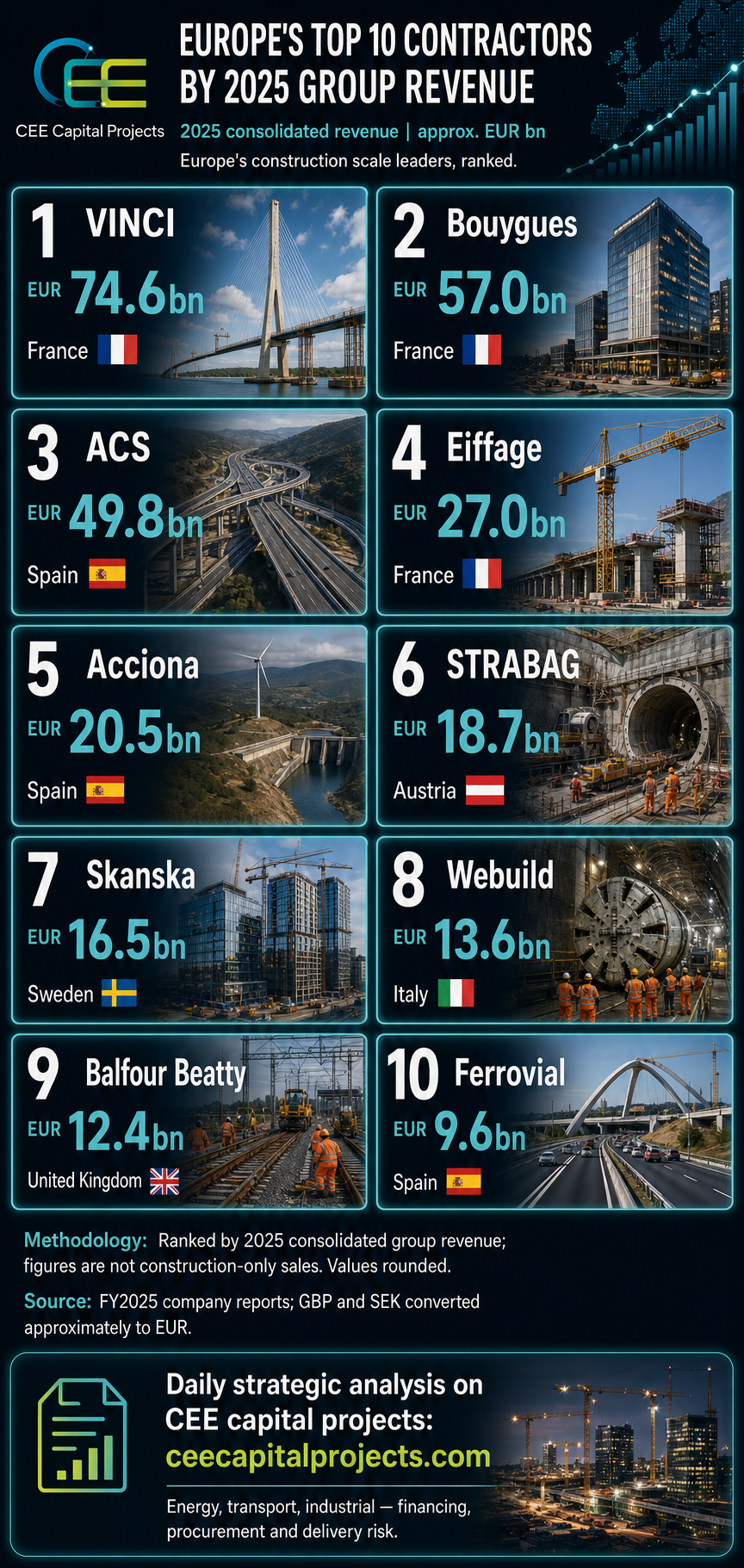
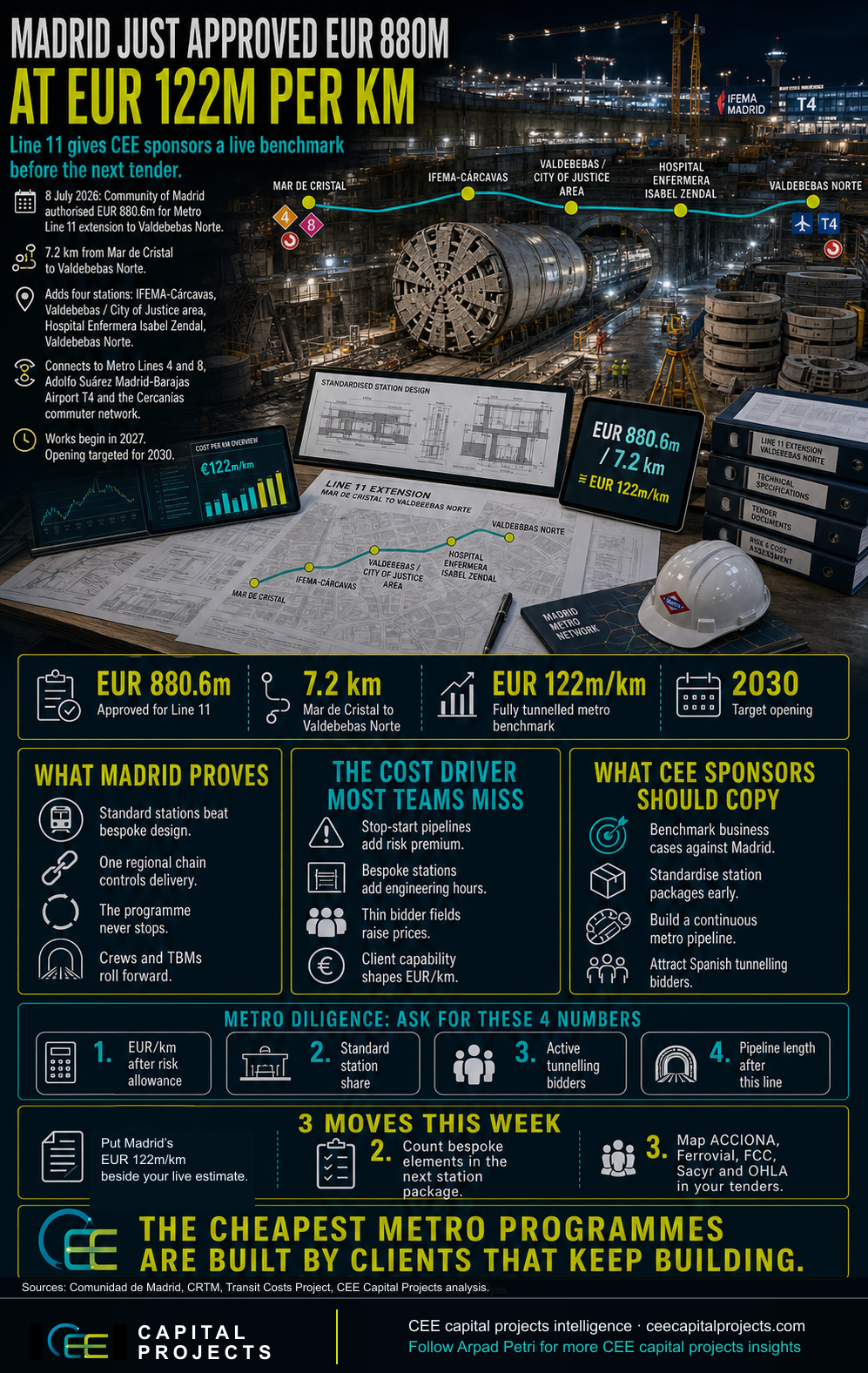
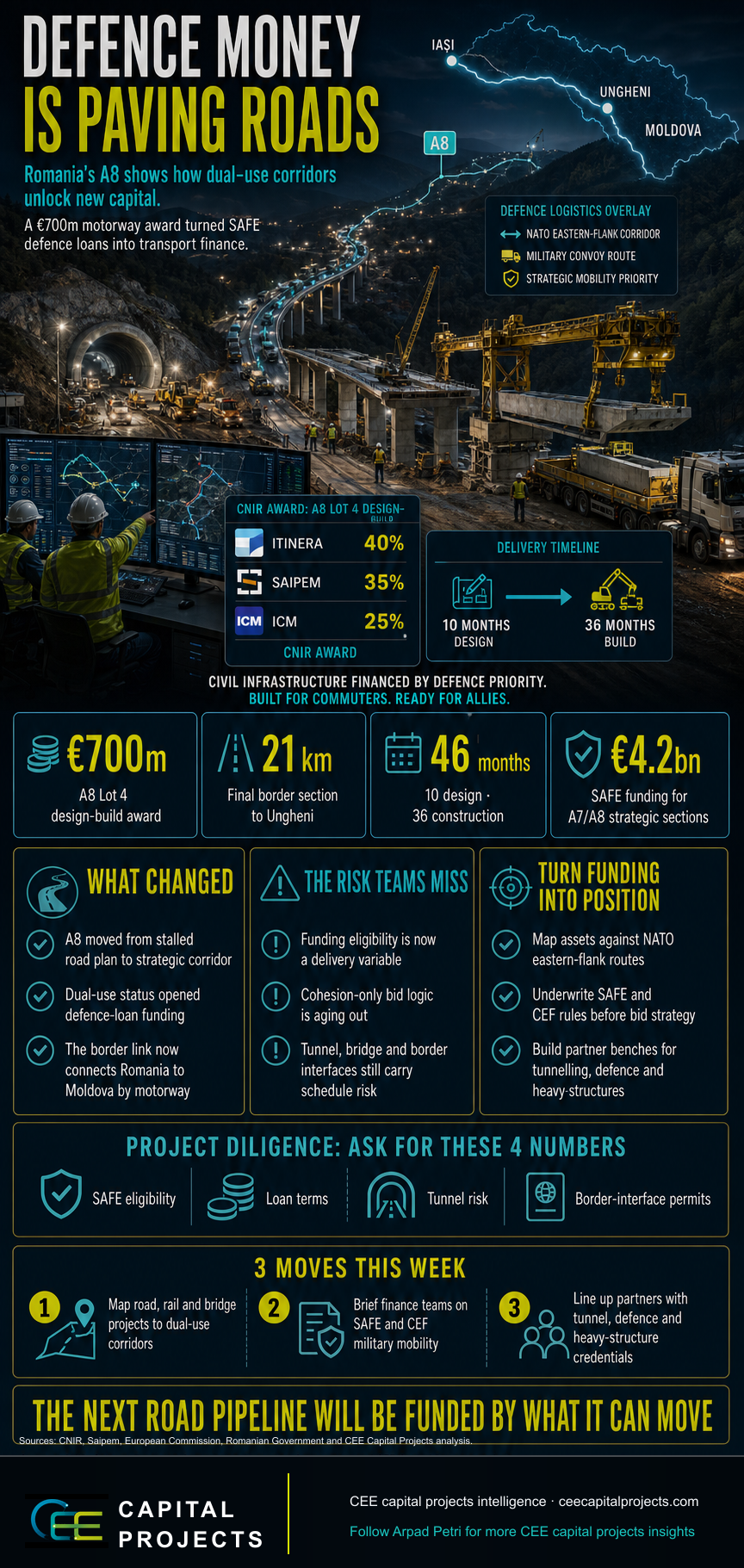
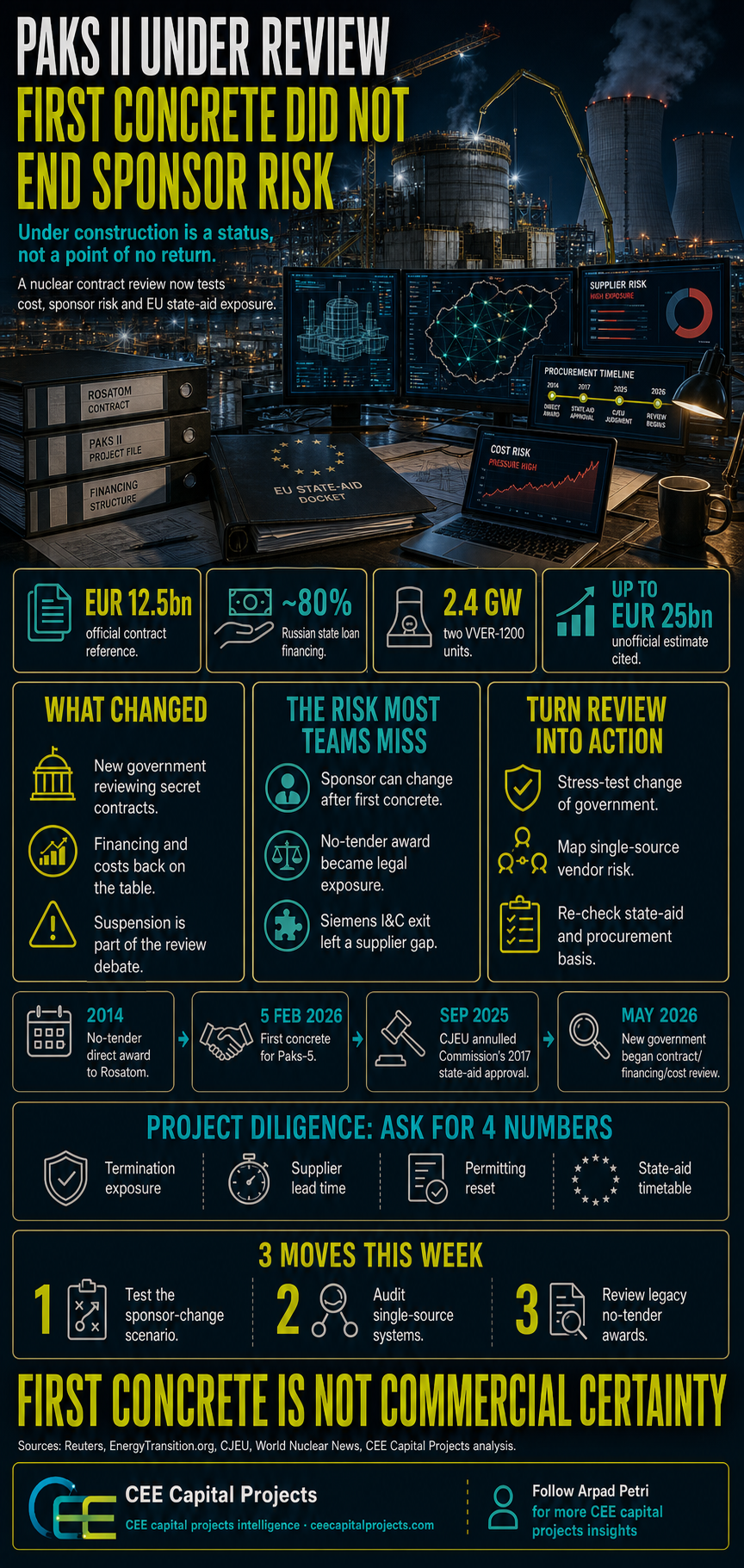
Explore our infograph library — strategic visuals for CEE capital projects leaders.
Project benchmarks, financing structures, tender dynamics and delivery risk — at a glance. Free access for investors, owners, contractors and strategy teams tracking CEE capital projects.
Browse the libraryStrategic Insights
📊 Analytics & Strategic Insight
The order book everyone is celebrating is dated 2028
The decision most in this industry are avoiding:
👉 Publishing the order book by mobilisation year. Every listed contractor reports backlog as one figure and a book-to-bill ratio. Almost none discloses how much of it goes to site inside twelve months. That single disclosure would reprice half the sector, which is precisely why nobody volunteers it.
👉 Pricing the wait, not the work. Bid teams model construction cost from the assumed start date and treat the pre-construction period as free. It is not. Two years of holding a design team, a bond line and a supply chain has a carrying cost, and on a three-year-deferred job it can exceed the tender margin.
👉 Telling clients that an unfunded start date is not a start date. Contractors accept programme dates that depend on a future spending review, a land assembly or a design freeze nobody has scheduled. Naming those conditions in writing at signature feels adversarial. Discovering them in year two costs far more.
Here's the full context:
→ 2023: Reinforced autoclaved aerated concrete failures forced emergency closures across the English public estate, and the hospital capital plan was effectively rewritten by the asset register rather than by demand.
→ March 2026: Ten firms were appointed to the GBP 37bn Hospital 2.0 alliance framework, moving the NHS from project-by-project competition to a long-term standardised delivery panel.
→ 30 July 2026: Eleven trust-level partnerships were signed under that framework, with Skanska taking two schemes, VINCI Building and Sir Robert McAlpine one through Integrated Health Projects, and Sacyr, Dragados, Laing O'Rourke, Kier, Graham, Willmott Dixon, Morgan Sindall and Bovis taking the remainder.
→ 3 August 2026: Sacyr confirmed Frimley Park at more than GBP 1.5bn (EUR 1.751bn), serving over 900,000 people, with construction starting in 2028 or 2029, roughly two and a half years after signature.
→ Most recent: Glenigan's 18 August 2026 Construction Review put main contract awards up 169% year on year and up 17% on the quarter, while project starts fell 7% on the quarter and finished level with 2025.
What this means for infrastructure operators, contractors and investors:
✅ Backlog quality now means backlog timing. The old test was margin and client credit. The new test is when the work mobilises, because a contractor with a record book and no 2027 starts still has a 2027 revenue problem and a 2027 overhead problem.
✅ Indexation is the commercial battleground of this cycle. When two to three years separate price agreement from site mobilisation, the escalation mechanism decides the outcome more than the tendered rate does. A capped index that does not track the actual basket is a loss written in advance.
✅ Labour is the binding constraint on the conversion, not capital. Spain is already slowing sites for want of workers. If the UK, Iberian and CEE award waves all mobilise into 2028, they draw on one European labour pool, and the firms with retained, certified crews will set the price.
3 moves you can make this week:
1️⃣ Rebuild your order book as a timeline. Take every awarded job, write its expected mobilisation month, and total the value by calendar year. Then show the same split to your bank and your board before somebody else calculates it for you.
2️⃣ Audit the indexation clause on every award with a start date beyond 2027. Check the index actually used, the base date, any cap, and whether it matches your real cost basket of labour, steel, concrete and mechanical and electrical packages. Escalate the mismatches now, while the client still wants the relationship.
3️⃣ Ask each client for the written conditions precedent to first day on site. Funding release, land, planning, design freeze, statutory approvals, each with an owner and a date. Any start date without that list underneath it should be treated as an estimate, and priced as one.
Related analyses
- Real Estate & Construction
Echo Investment's Owner Bid PLN 5.20 a Share for the Rest of Poland's Biggest Developer. The Market Never Came Down to Meet It
Lisala, the vehicle through which Hungary's WING controls Echo Investment, has notified Poland's regulator of a PLN 5.20 per share offer for the 37.63 per cent it does not own, about 4.4 per cent below the close that preceded it. Echo's shares have stayed above the bid, and two Polish pension funds now decide whether the country's largest developer leaves the Warsaw exchange after three decades.
Read analysis → - Real Estate & Construction
RSK Hits GBP 2.47bn Revenue With GBP 965m Net Debt: Why Clients Should Prequalify Their Engineering Advisers
RSK lifted revenue 10.3 per cent to GBP 2.47bn in the year to 5 April 2026 and reported GBP 112m of interest against GBP 18.1m of operating profit, with net debt up to GBP 965m from GBP 734m. The engineering and environmental advisers who sign designs, ground reports and consents are consolidating on borrowed money, and almost no client tests them the way it tests a contractor.
Read analysis → - Real Estate & Construction
WING Group Grew Revenue 41% While 63% of Its Assets Sat Outside Hungary
WING Group lifted first-half 2026 revenue 41 per cent to HUF 130.3bn, with 63 per cent of its assets now in Poland and Germany. Its Hungarian half year ran on standing-asset purchases while Budapest's office pipeline stayed just above 100,000 sqm.
Read analysis →
Facing a decision on a CEE capital project?
Describe the situation in a few sentences. Within 72 hours you get an experienced read: the risks we see, what we'd check, and whether we can help — no calls, no obligation.