We Help International Investors and Project Owners Deliver Major CEE Projects Without Expensive Surprises
Independent project intelligence and advisory across energy, transport, real estate and industrial construction.
Rail Baltica Bialystok-Elk: 19 Months of Tender, Three Winners, and EUR 800m of EU Funding Running Out of Calendar
PKP PLK has selected a best offer three times on the EUR 1.4bn Rail Baltica section between Bialystok and Elk, and has still signed nothing. More than EUR 800m of Connecting Europe Facility grant must be spent and settled by the end of 2029, against a 38-month construction programme.
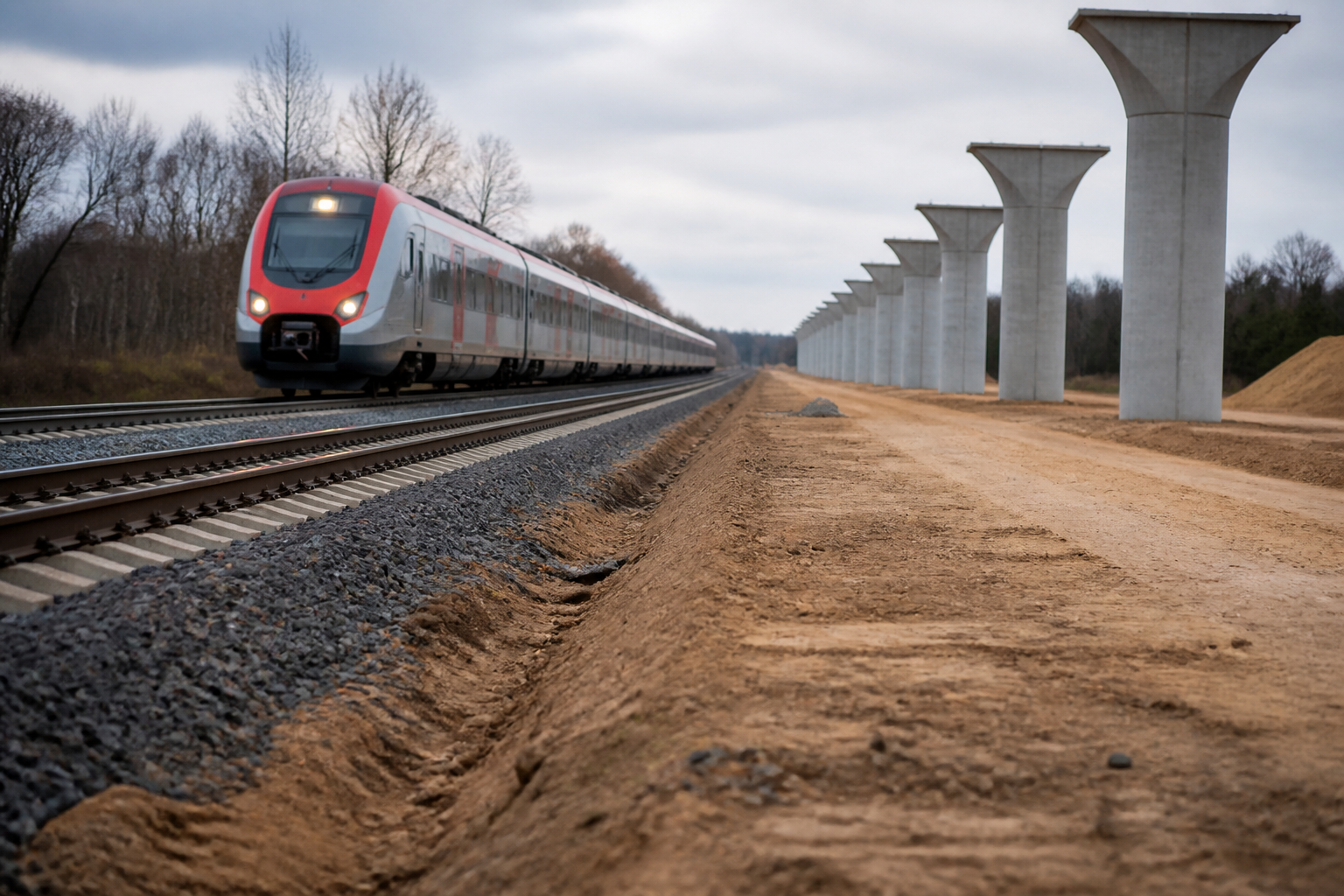
Most of the coverage treats this as a procurement fight. I read it as a countdown, and the countdown is losing. PKP Polskie Linie Kolejowe opened the tender on 9 January 2025. It covers 100 km of line 38 between Białystok and Ełk. The advertised value was about PLN 6bn, or EUR 1.4bn. Nineteen months later there is no signed contract. More than EUR 800m of Connecting Europe Facility grant is attached to the work.
Three winners, no contract
PKP PLK has chosen a best offer three times on this job. In November 2025 it picked the consortium of Torpol and Mirbud, whose bid of PLN 4.56bn was the lowest. A rival consortium of Budimex, Budimex Kolejnictwo and PORR appealed on a narrow ground. Mirbud had not declared an environmental penalty of PLN 15,000 in its European Single Procurement Document. The National Appeals Chamber, the KIO, agreed with the challenge. The infrastructure manager annulled its own selection on 20 January 2026.
Late in January 2026 PKP PLK selected the Budimex, Budimex Kolejnictwo and PORR consortium instead. A consortium led by Track Tec Construction appealed against that decision. The KIO then ordered both earlier offers rejected. On 27 April 2026 the manager named its third winner: Track Tec Construction with Intop, Intop Warszawa, Unibep and Pomorskie Przedsiębiorstwo Mechaniczno-Torowe. The KIO dismissed the appeals against that selection on 1 June 2026.
The arithmetic that decides this
The tender documents set the works durations from the date of signature. Białystok to Knyszyn runs 38 months. Osowiec to Ełk runs 29 months. Eligibility of expenditure under the CEF grant ends on 31 December 2029.
Sign in September 2026 and the 38-month package completes in November 2029. That leaves a matter of weeks to settle a grant of more than EUR 800m. Every further week of litigation comes out of that margin. Marcin Mochocki sits on the PKP PLK board and runs investment delivery. He told Rynek Kolejowy on 7 August 2026 that the wall is drawn and the company is walking towards it. The ex-ante control by the Public Procurement Office, the UZP, is also unfinished, so the manager cannot sign yet.
A PLN 15,000 penalty and a declaration form
The substance of the dispute is smaller than the sums it is holding up. Track Tec Construction issued a statement on 21 August 2026, three days after a hearing at the Warsaw Regional Court sitting as the public procurement court. Its chief executive Marita Szustak argued that the issue is the failure to pass the information to the client. A mention in a public corporate report does not discharge the duty to declare it in the tender file.
She also noted that the Supreme Administrative Court judgment of 21 April 2026 did not quash the penalty imposed by the Chief Inspectorate of Environmental Protection. It referred the appeal back to a first instance court, leaving the administrative decision in force. A second hearing, brought over the KIO ruling that removed the Budimex-led consortium, is listed for 4 September 2026.
Who pays for the calendar
The visible cost is the price gap. The Track Tec offer sits roughly PLN 650m above the earlier proposals across the base scope and the options, which puts it near PLN 5.2bn. Track Tec says the bid is inside the budget PKP PLK planned, and that a price set too low is itself a delivery risk.
The invisible cost is larger. Mochocki has said that losing the CEF grant would take about PLN 5bn out of the Polish rail investment market, because the money would have to be moved from another scheme. He has also said the line would still be built, under a fresh tender and a different timetable. In that case the winner of the current process would never break ground.
Other Polish tenders are closing quickly
This is not the universal pattern in Poland. PKP PLK took no appeals on the Łęczyca to Kutno second track, or on the Pszczółki to Pruszcz Gdański fourth track. Both start construction later.
The Białystok to Ełk package is different. The design work is done and the permits are ready to hand over. Mochocki puts mobilisation at two to three months, with construction able to start almost immediately after signature. A shovel-ready job with a fixed grant deadline is exactly the kind of contract worth fighting over, and exactly the kind that cannot absorb the fight.
What follows
Two dates now matter more than the tender documents. The UZP has to close its ex-ante control, and the Warsaw court has to rule on the two challenges. The second of those is listed for 4 September. If both land in the autumn, a signature before winter is still possible and the 38-month programme just fits. If either slips into 2027, the base case becomes a cancelled procurement and a new competition on national money.
For contractors across the region the lesson is about sequencing rather than law. Where a grant carries a hard eligibility date, the appeal calendar is part of the construction programme, and it is the part nobody prices. For sponsors, it argues for shorter packages on deadline-bound corridors, so one disputed award cannot hold a national envelope hostage. For lenders, the read is simpler: on EU-funded work the eligibility date governs the risk, and everything upstream of it is float that somebody is spending.
Share it with your peers
Help your network stay ahead of CEE capital projects.
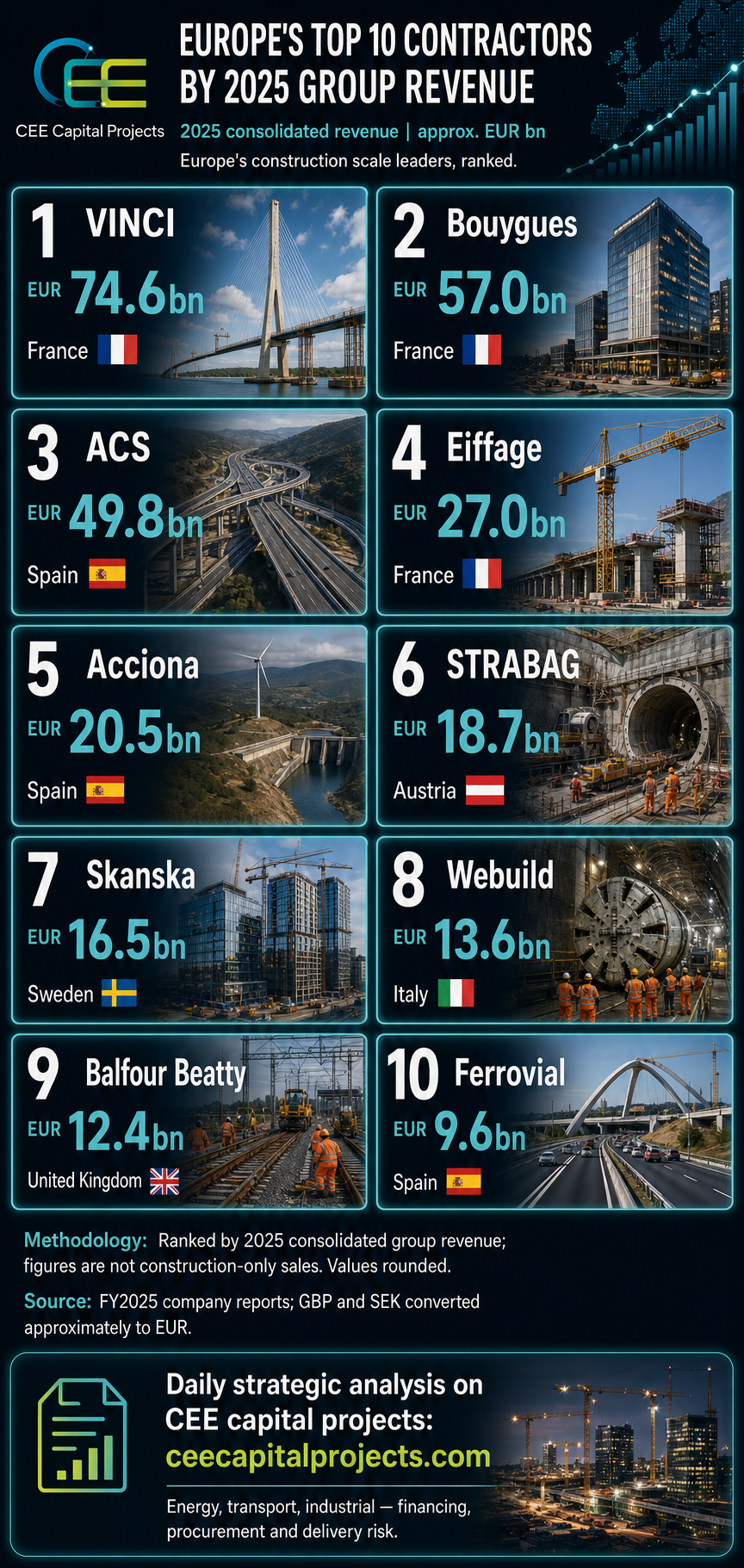
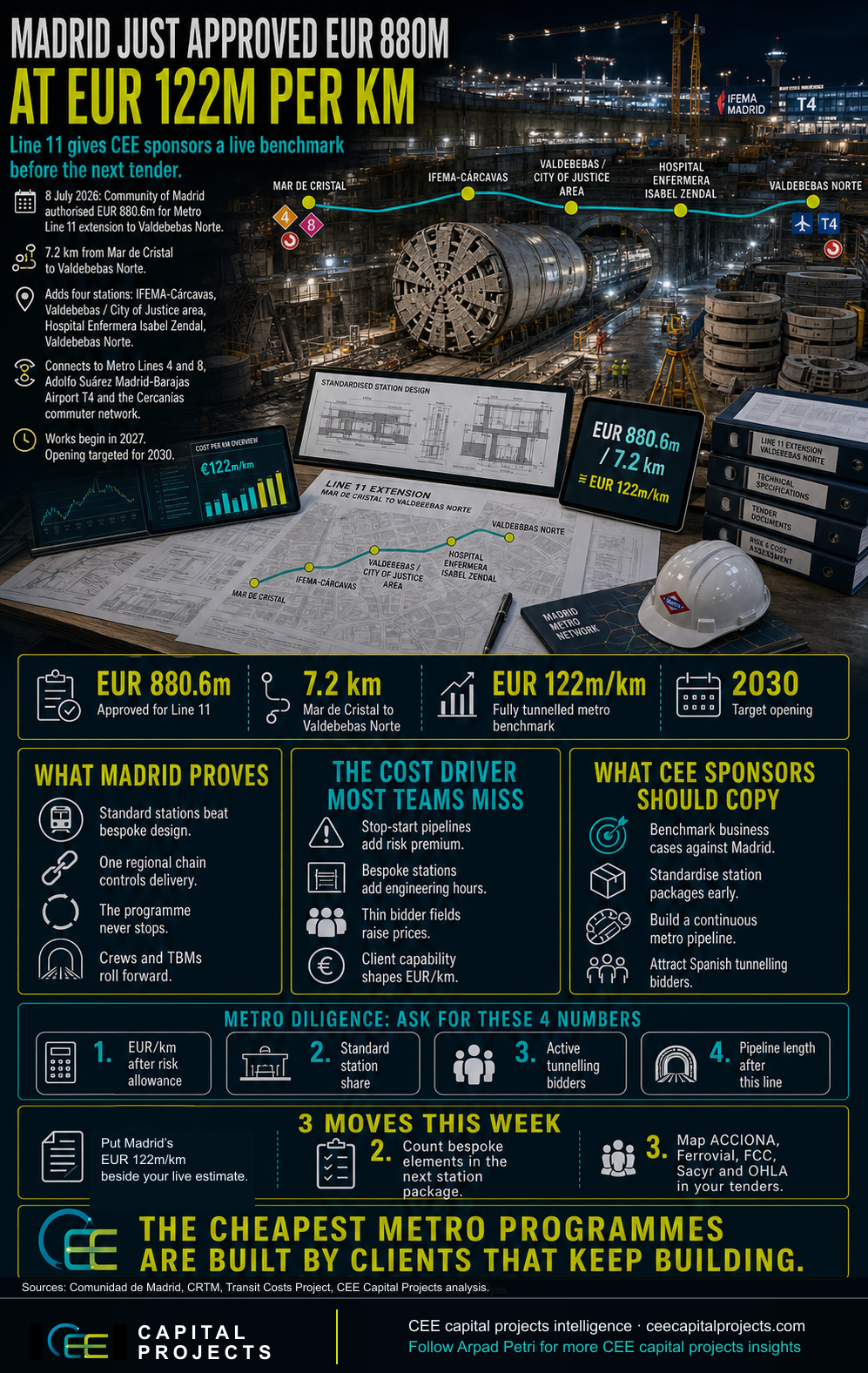
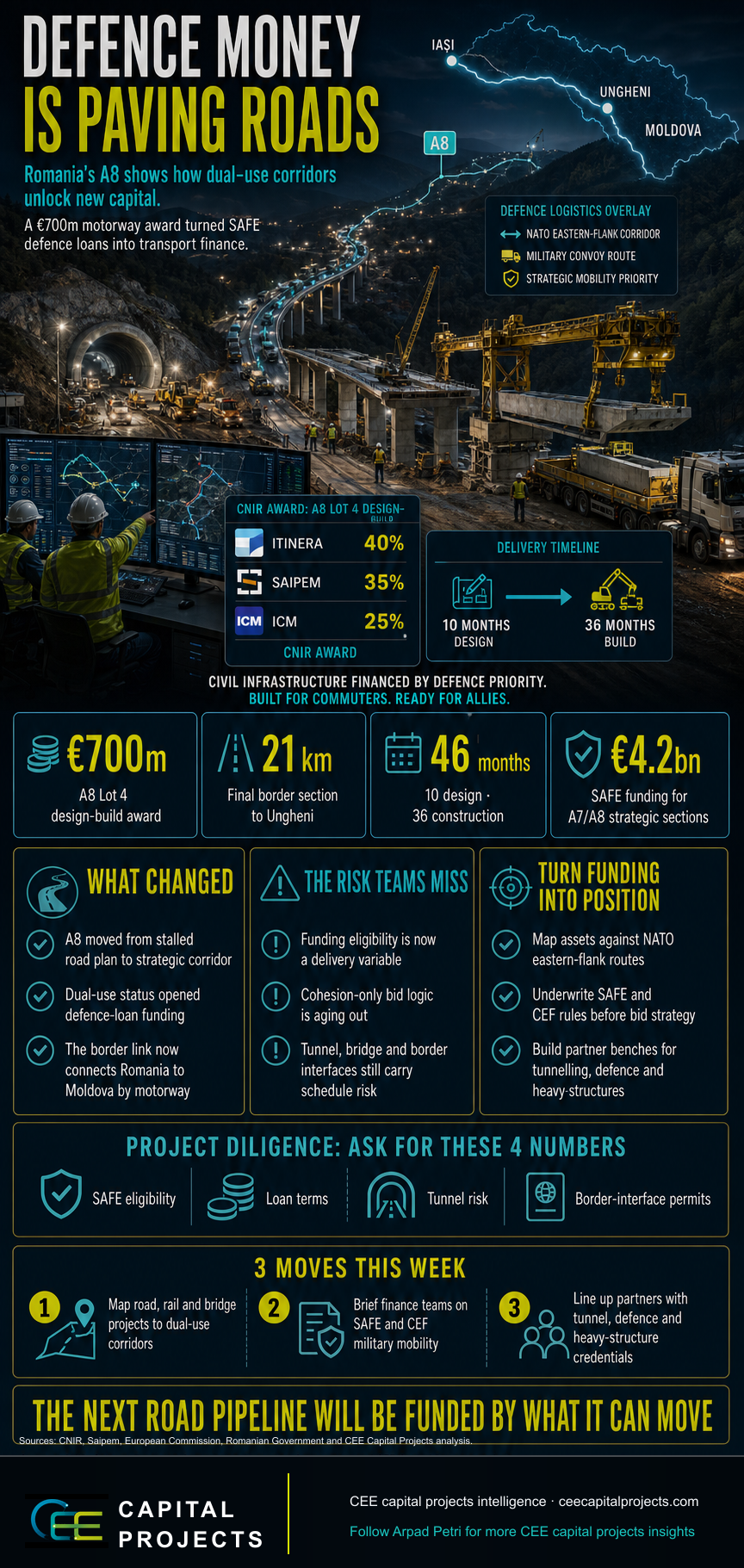
Explore our infograph library — strategic visuals for CEE capital projects leaders.
Project benchmarks, financing structures, tender dynamics and delivery risk — at a glance. Free access for investors, owners, contractors and strategy teams tracking CEE capital projects.
Browse the libraryStrategic Insights
📊 Analytics & Strategic Insight
On grant-funded corridors, the appeal calendar is the construction programme
The decision most in this industry are avoiding:
👉 Nobody prices the appeal window. Bid teams model steel, labour, weather and permits. Almost none of them put a cost on the months an award can spend inside a review body and a court. On this job that period has now run past 19 months and is worth more than the entire price gap between the bidders.
👉 A hard grant deadline turns a legal right into a schedule risk. Every bidder here acted within the rules. The combined effect of those lawful actions is that the money funding the work may expire before the work can be done. The system has no mechanism to weigh one against the other.
👉 The lowest bid stopped being the cheapest outcome long ago. The gap between the first and third selections is around PLN 650m. The exposure sitting behind the deadline is over EUR 800m of grant, plus roughly PLN 5bn of displaced investment elsewhere in the Polish rail programme.
Here's the full context:
→ 2015 to 2024: Poland rebuilds the southern Rail Baltica sections in stages, from Warsaw Rembertów through Sadowne and Czyżew towards Białystok, leaving the 100 km Białystok to Ełk stretch as the longest piece still to do.
→ 9 January 2025: PKP PLK launches the PLN 6bn tender for the section, the first in which it excludes bidders from outside the EU, the EEA and WTO procurement agreement countries, citing a CJEU judgment.
→ November 2025: Torpol and Mirbud are selected on a PLN 4.56bn bid. Budimex, Budimex Kolejnictwo and PORR appeal over an undeclared PLN 15,000 environmental penalty, and the selection is annulled on 20 January 2026.
→ January to June 2026: Budimex and PORR are chosen, then removed by the KIO. On 27 April the Track Tec Construction consortium becomes the third winner at roughly PLN 650m more, and the KIO clears that choice on 1 June.
→ Most recent: The Warsaw Regional Court hears the Mirbud challenge on 18 August 2026, the Budimex case is listed for 4 September, and on 21 August Track Tec warns publicly that more than EUR 800m of CEF funding, which must be settled by the end of 2029, is at risk of being lost for good.
What this means for infrastructure operators, contractors and investors:
✅ Read the eligibility date before the completion date. On EU-funded work the grant expiry governs everything. A programme that finishes one month after the eligibility deadline has no money behind it.
✅ Shovel-ready packages attract the hardest challenges. When design and permits are complete, the winner starts earning almost at once, which raises the value of an appeal to everyone who lost. Sponsors should assume the most prepared contracts will be the most contested.
✅ Disclosure failures now travel further than the underlying facts. A five-figure penalty, omitted from a declaration form, has held up a billion-euro contract for over a year. The compliance question in a bid file has become a bigger commercial risk than most technical assumptions.
3 moves you can make this week:
1️⃣ Put the grant expiry on the front page of your programme. Take every funded contract in the portfolio and write the eligibility date next to the completion date. Where the gap is under three months, escalate it now rather than at handover.
2️⃣ Audit your own declaration forms. Pull the last twelve ESPD or equivalent submissions and check every fine, penalty, termination and dispute across the group against what was actually declared. Fix the register before a competitor finds the omission.
3️⃣ Add an appeal-duration line to your bid model. Use the real local average from award to signature, not the statutory minimum, and price the standby cost of holding crews and plant across that window. If the number is uncomfortable, that is the point.
Related analyses
- Real Estate & Construction
Echo Investment's Owner Bid PLN 5.20 a Share for the Rest of Poland's Biggest Developer. The Market Never Came Down to Meet It
Lisala, the vehicle through which Hungary's WING controls Echo Investment, has notified Poland's regulator of a PLN 5.20 per share offer for the 37.63 per cent it does not own, about 4.4 per cent below the close that preceded it. Echo's shares have stayed above the bid, and two Polish pension funds now decide whether the country's largest developer leaves the Warsaw exchange after three decades.
Read analysis → - Real Estate & Construction
RSK Hits GBP 2.47bn Revenue With GBP 965m Net Debt: Why Clients Should Prequalify Their Engineering Advisers
RSK lifted revenue 10.3 per cent to GBP 2.47bn in the year to 5 April 2026 and reported GBP 112m of interest against GBP 18.1m of operating profit, with net debt up to GBP 965m from GBP 734m. The engineering and environmental advisers who sign designs, ground reports and consents are consolidating on borrowed money, and almost no client tests them the way it tests a contractor.
Read analysis → - Real Estate & Construction
WING Group Grew Revenue 41% While 63% of Its Assets Sat Outside Hungary
WING Group lifted first-half 2026 revenue 41 per cent to HUF 130.3bn, with 63 per cent of its assets now in Poland and Germany. Its Hungarian half year ran on standing-asset purchases while Budapest's office pipeline stayed just above 100,000 sqm.
Read analysis →
Get a second opinion before it gets expensive.
Contractor selection, tender strategy, a project drifting off track — send us the situation and we'll come back with a clear plan.