We Help International Investors and Project Owners Deliver Major CEE Projects Without Expensive Surprises
Independent project intelligence and advisory across energy, transport, real estate and industrial construction.
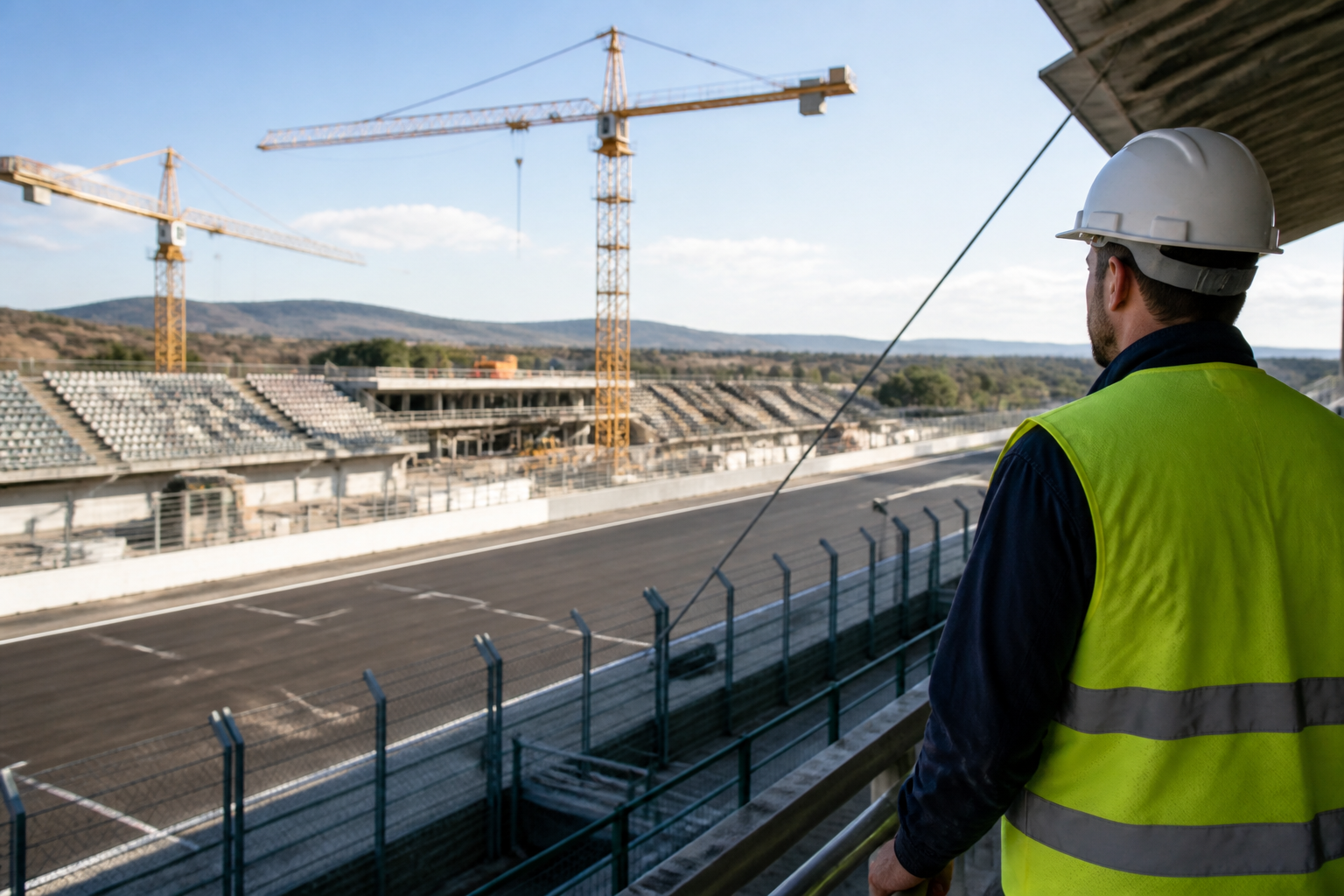
Hungaroring's HUF 79bn Rebuild: Market Építő, an Immovable Race Date and a Partner in Moratorium
Market Építő and Bayer Construct signed for HUF 78,973,138,924 and a completion date fixed by the 2026 Hungarian Grand Prix. Two months after the race, one partner entered a court moratorium, and the defects tail on a fixed-date programme changed hands.
If this had been my programme, I would have priced the calendar before I priced the concrete. A race date set by an international governing body is a harder deadline than any damages clause. The Hungaroring consortium signed for HUF 78,973,138,924 and a finish line that could not move.
Index.hu reported the award on 25 October 2023. Market Építő Zrt. and Bayer Construct Zrt. won the reconstruction on the best price to value ratio. More than 20 parties expressed interest and four valid bids arrived. The stated completion date was the 2026 Hungarian Grand Prix.
A deadline nobody could renegotiate
The scope was heavy. It covered demolition of roughly 57,000 square metres of existing structures and 125,000 cubic metres of earthworks. The new main building runs to 42,700 square metres. Inside that envelope sit 36 race garages, four technical areas, a race control centre and two pedestrian tunnels.
Market Építő puts about 9,000 workers across the full construction period. On peak days the site carried 1,200 to 1,400 people and nine tower cranes. Work was split into three phases around the 2024, 2025 and 2026 race weekends. Each of those weekends stopped construction entirely.
Magyar Építők published a detailed delivery account on 22 September 2026. Its central point will be familiar to every project director. The drawings moved as FIA and international requirements changed, and the paddock building was redesigned mid build. The date did not move at all.
The variation became a sequencing problem
On a conventional contract, a change of that kind opens a claim. Here it opened a work breakdown exercise. The designers, DVM Group and S.A.M.O. Építésziroda, divided the main building into six dilatation units. Separate crews could then build in parallel instead of in series.
The contractor also resequenced its own programme. Demolition and reconstruction of the 300 metre depot was pulled forward into phase one. The purpose was access and laydown space for everything that followed. Both moves are engineering answers to a commercial constraint.
That is the practical lesson for anyone running to an external date. Extension of time is unavailable, so float has to be manufactured inside the works. It arrives as more work faces, more parallel trades and heavier temporary works. All of it costs money that no variation order returns.
Date certainty is paid for at tender
Four valid bids from more than twenty interested parties is a thin field for a job of this size. That ratio is the market pricing the deadline. Contractors unable to carry the sequencing risk stayed out.
Employers across the region should read that number carefully. Hungary, Poland and Romania are all running works against externally fixed dates. The 2029 cohesion spend deadline and Recovery and Resilience Facility milestones behave exactly the same way. Each such date narrows the bidder field and lifts the tendered price. What the employer buys is certainty, and the premium shows up at tender.
The job ended, the liability did not
The rebuilt circuit hosted its Grand Prix weekend on 24 to 26 July 2026. Two months later the consortium looked very different. On 25 September 2026 the Budapest Metropolitan Court opened bankruptcy protection proceedings for Bayer Construct Zrt. Telex reported it the same day. The company received a six month payment moratorium. Creditors have 30 days to register their claims.
The state had already classified those proceedings as strategically significant in early September. The National Reorganisation Nonprofit Ltd. was appointed asset supervisor. The distress traces to a separate Budapest scheme. That is the Bosnyák tér office complex, valued at about HUF 300bn. The purchaser stepped away from the acquisition in August 2026. Hungarian Development Bank exposure to the group has been reported at around HUF 207bn.
None of that touches the racetrack physically. It touches the paperwork behind it. Consortium contracts of this type usually carry joint and several liability. The defects liability and structural warranty tail therefore lands on whichever partner is still standing. The employer's harder question arrives in year three, when a movement joint or a roof detail needs attention.
What sponsors should do with this
Fixed external dates are spreading across European infrastructure. Funding deadlines, grid connection dates and regulatory commissioning windows all behave alike. They convert schedule risk into a front end engineering and staffing problem. They also shrink the pool of firms able to price it.
Two practical consequences follow. Sponsors should pay for sequencing capability explicitly at tender, because that capability is what delivers a date. They should also secure the warranty tail per consortium member. Parent company guarantees and ring fenced retention do that job. A shared promise from a two firm consortium does not survive one of the two firms. A completion certificate proves the date was met. It proves nothing about who answers the phone in 2032.
Share it with your peers
Help your network stay ahead of CEE capital projects.




Explore our infograph library — strategic visuals for CEE capital projects leaders.
Project benchmarks, financing structures, tender dynamics and delivery risk — at a glance. Free access for investors, owners, contractors and strategy teams tracking CEE capital projects.
Browse the libraryStrategic Insights
📊 Analytics & Strategic Insight
When the completion date is set outside the contract, the schedule stops being a variable and the balance sheet becomes one
The decision most in this industry are avoiding:
👉 Pricing the sequencing skill, rather than the square metres. Four valid bids from more than twenty interested firms is not a procurement failure. It is the market sorting contractors by whether they can build float into a job that offers no extension of time. Employers still score these tenders mostly on price per square metre, which measures the wrong capability.
👉 Treating joint and several liability as security. A two firm consortium gives the employer one shared promise. If one firm enters a moratorium, the whole warranty tail sits with the other, whether or not that was priced. Nobody underwrites the surviving partner's ten year capacity at tender stage.
👉 Admitting that design freeze is a commercial instrument. Where the date cannot move, every late requirement change is paid for in productivity rather than in time. Sponsors who allow governing bodies, regulators or their own user groups to keep moving the brief are buying a cost they never see itemised.
Here's the full context:
→ 2023: On 25 October, Index.hu reports that the Market Építő and Bayer Construct consortium wins the Hungaroring reconstruction at HUF 78,973,138,924, with four valid bids from more than 20 interested parties and completion tied to the 2026 Hungarian Grand Prix.
→ 2024 and 2025: The works run in phases around live race weekends, with construction stopping for each Grand Prix. Peak manning reaches 1,200 to 1,400 people a day and nine tower cranes, against about 9,000 workers over the whole period.
→ Mid programme: FIA and international requirements change and the paddock building is redesigned. The designers split the main building into six dilatation units so crews can work in parallel, and the contractor pulls the 300 metre depot forward into phase one to buy site access.
→ July 2026: The rebuilt circuit hosts its Grand Prix weekend on 24 to 26 July, delivering the fixed date with the new main building, grandstand, paddock and pedestrian tunnels in use.
→ Most recent: On 25 September 2026 the Budapest Metropolitan Court opens bankruptcy protection proceedings for Bayer Construct Zrt. with a six month payment moratorium and a 30 day creditor claim window, two months after the race the company helped deliver.
What this means for infrastructure operators, contractors and investors:
✅ Externally fixed dates are becoming the norm across CEE, and they reprice tenders. Cohesion spend deadlines, Recovery and Resilience Facility milestones, grid connection dates and regulatory commissioning windows all remove the extension of time route. Expect thinner bidder fields and higher tendered prices wherever one applies.
✅ The counterparty risk on a consortium is concentrated, not diversified. Two firms sharing a contract look like two covenants until one of them files. Employers should assume the tail lands on the stronger partner and price that concentration before award rather than after completion.
✅ Delivery capability is now a distinct, purchasable commodity. The firms that can manufacture float, through work breakdown, parallel work faces and temporary works, are a small subset of the market. That scarcity is an earnings opportunity for contractors and a cost line for sponsors.
3 moves you can make this week:
1️⃣ Audit your fixed date exposure. List every live contract whose completion date is set by something outside the contract, including a funding deadline, a connection date or an event. For each one, write down what happens commercially if the brief changes next quarter.
2️⃣ Check the security behind every consortium you employ. Confirm whether you hold a parent company guarantee from each member separately and whether retention is held per member. If the answer is one shared bond, start the conversation now rather than at defects.
3️⃣ Put a sequencing question into your next tender. Ask bidders to show how they would create float without an extension of time, with a worked example of parallel work faces and temporary works. Score it, and pay for the answer you want.
Related analyses
- Real Estate & Construction
Echo Investment's Owner Bid PLN 5.20 a Share for the Rest of Poland's Biggest Developer. The Market Never Came Down to Meet It
Lisala, the vehicle through which Hungary's WING controls Echo Investment, has notified Poland's regulator of a PLN 5.20 per share offer for the 37.63 per cent it does not own, about 4.4 per cent below the close that preceded it. Echo's shares have stayed above the bid, and two Polish pension funds now decide whether the country's largest developer leaves the Warsaw exchange after three decades.
Read analysis → - Real Estate & Construction
RSK Hits GBP 2.47bn Revenue With GBP 965m Net Debt: Why Clients Should Prequalify Their Engineering Advisers
RSK lifted revenue 10.3 per cent to GBP 2.47bn in the year to 5 April 2026 and reported GBP 112m of interest against GBP 18.1m of operating profit, with net debt up to GBP 965m from GBP 734m. The engineering and environmental advisers who sign designs, ground reports and consents are consolidating on borrowed money, and almost no client tests them the way it tests a contractor.
Read analysis → - Real Estate & Construction
WING Group Grew Revenue 41% While 63% of Its Assets Sat Outside Hungary
WING Group lifted first-half 2026 revenue 41 per cent to HUF 130.3bn, with 63 per cent of its assets now in Poland and Germany. Its Hungarian half year ran on standing-asset purchases while Budapest's office pipeline stayed just above 100,000 sqm.
Read analysis →
Facing a decision on a CEE capital project?
Describe the situation in a few sentences. Within 72 hours you get an experienced read: the risks we see, what we'd check, and whether we can help — no calls, no obligation.