We Help International Investors and Project Owners Deliver Major CEE Projects Without Expensive Surprises
Independent project intelligence and advisory across energy, transport, real estate and industrial construction.
The EIB Just Put EUR 3 Billion Behind Grand Paris Express Line 15. Four Fifths of the Repayment Rides on a Paris Office Tax
The EIB made EUR 3 billion available to Société des Grands Projets on 2 September 2026 for Line 15 West. About 81% of SGP allocated tax revenue for 2026 comes from an Île-de-France floorspace tax.
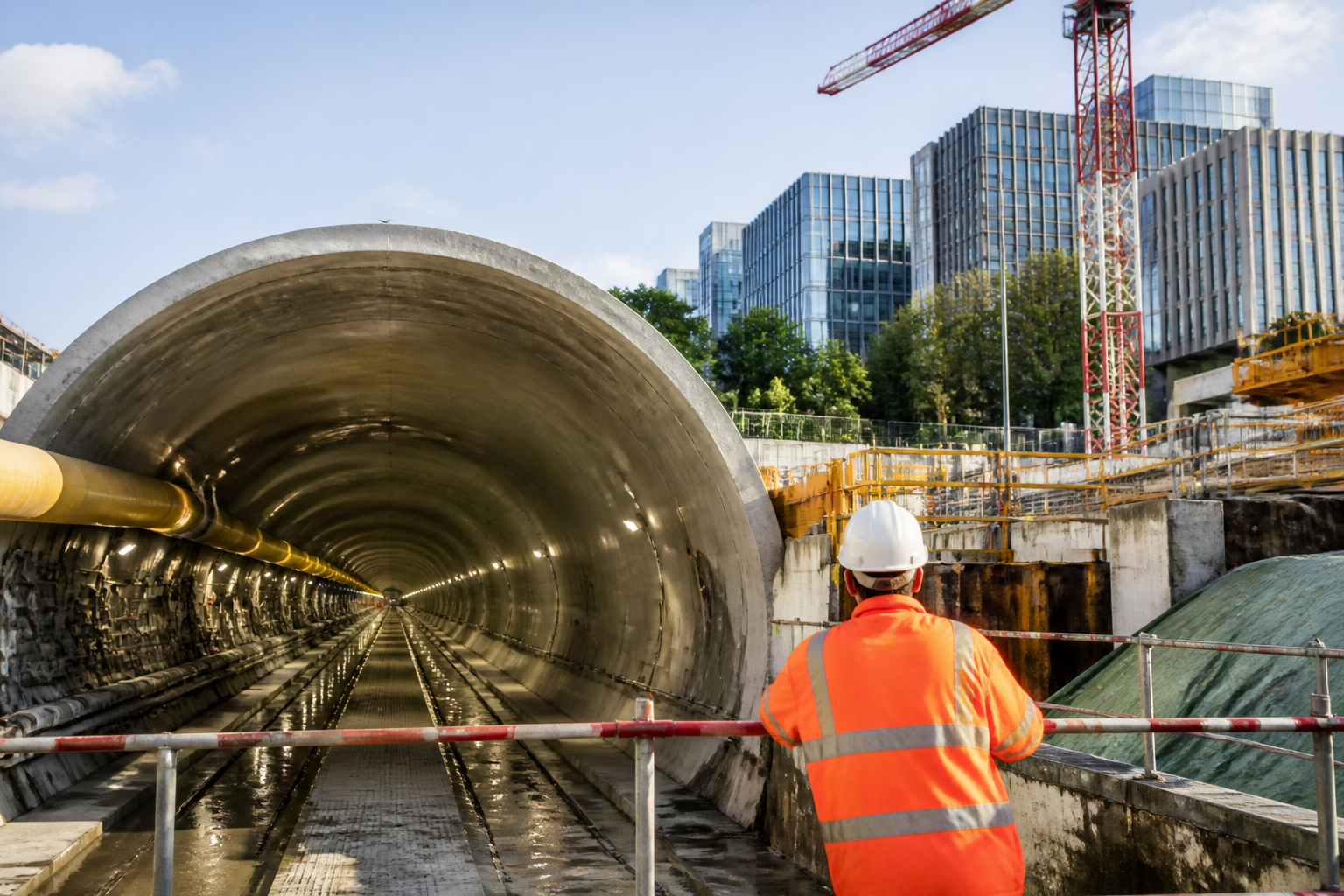
I will say this plainly. Lenders to Europe's largest urban rail scheme are taking property risk. The repayment stream is a tax on Paris office floorspace.
The European Investment Bank and Société des Grands Projets announced a EUR 3bn financing package on 2 September 2026. It funds the western section of Grand Paris Express Line 15. The first tranche of EUR 500m was signed on 30 July 2026 (EIB press release 2026-277).
What the money buys
Line 15 West runs 22.4 km between Pont de Sèvres and Saint-Denis-Pleyel. It is entirely underground and has 11 stations. The route crosses 14 municipalities in Hauts-de-Seine and Seine-Saint-Denis, including the La Défense business district. SGP expects close to 600,000 passengers a day once it opens in 2031.
The EIB has now committed EUR 6.5bn to Line 15 alone. It lent EUR 3.5bn in three packages between 2016 and 2023 for the southern section. SGP chairman Jean-François Monteils framed the new agreement around borrowing costs. He said it helps secure financing "at a time of high interest rates".
Where the repayment comes from
SGP is an amortisation fund. It borrows through construction and repays from a basket of taxes set by law. The French Senate finance committee put that basket at EUR 984m for 2026. That is 0.6% above the 2025 figure.
Within that total, the tax on offices, shops, storage and parking is forecast at EUR 793m. That is about 81% of the basket. The special equipment tax adds EUR 67m and the rolling stock levy EUR 86m. Parking surfaces and the tourist tax supply the rest (Sénat, Rapport général n° 139, 24 November 2025).
User revenue is small beside that. Île-de-France Mobilités pays SGP an infrastructure fee of EUR 0.8m per year per kilometre. That fee was about EUR 8m in 2025. It reaches roughly EUR 140m a year only when the whole network is handed over.
A tax that survives vacancy
The Île-de-France floorspace tax sits in article 231 ter of the tax code. The owner pays it every year, whether the space is let or empty. Tariffs for offices in 2026 run from about EUR 5.82 to EUR 26.11 per square metre by zone.
That design matters for a lender. Immediate office supply in Île-de-France stood at about 6.2 million square metres at the start of 2026. Roughly 43% of it had been empty for four years or more. None of that vacancy reduces the tax bill by itself.
The base is the exposure
The exposure is the floorspace itself. France introduced an exemption in 2025 for vacant premises converted into housing, subject to works completed within four years. Public policy is pushing the same way. Office space authorised for conversion to housing reached 184,000 square metres in 2024. The ten-year average is 85,000.
In April 2026 the state selected 61 conversion schemes out of 101 applications in Île-de-France, for 8,269 potential homes. Every square metre converted leaves the tax base that repays the metro. So the revenue is protected against a soft letting market and thinned by a policy the same state funds.
Thirty billion of debt and a 2071 horizon
The scale explains why a public bank is the lender. SGP held EUR 30.6bn of debt at the end of June 2025. Its plan raises borrowing until 2030 and begins repayment towards 2071. The whole Grand Paris Express has been costed at EUR 36.1bn since October 2021.
Annual spending is running near the top of its range. SGP spent EUR 4.9bn in 2024 and budgeted EUR 5.1bn for 2026. Delivery has slipped as well. Line 15 South moved back a year to the end of 2026. First sections of lines 16 and 17 moved to the first quarter of 2027.
What sponsors elsewhere should take from it
Hypothecated tax funding is now a working model for large public rail in Europe. SGP already advises 16 regional express schemes across France. Investment needs for those are put at EUR 20bn to EUR 30bn. Sponsors in Poland, Czechia, Romania and the Baltics face the same design question.
The lesson sits in the tax base. A dedicated tax is durable while the thing being taxed keeps growing. Anyone underwriting a metro on office floorspace should model the conversion pipeline as carefully as the ridership forecast.
Ceilings move too. The 2026 finance bill lifted the office tax cap to EUR 832.5m against an expected yield of EUR 793m. Parliament resets that number every year. A twelve-month revenue decision is now carrying a liability that runs to 2071.
Share it with your peers
Help your network stay ahead of CEE capital projects.




Explore our infograph library — strategic visuals for CEE capital projects leaders.
Project benchmarks, financing structures, tender dynamics and delivery risk — at a glance. Free access for investors, owners, contractors and strategy teams tracking CEE capital projects.
Browse the libraryStrategic Insights
📊 Analytics & Strategic Insight
Hypothecated tax funding moves the risk from the farebox to the floorplate
The decision most in this industry are avoiding:
👉 The credit sits in the floorplate. A metro funded by a floorspace tax is underwritten by the office stock it serves. Ridership forecasts move headlines. The square metre count moves the money.
👉 Vacancy is the wrong worry. An owner-paid floorspace tax keeps running through an empty building. The risk that bites is stock leaving the base through conversion or demolition.
👉 An annual revenue is carrying a fifty-year liability. Ceilings and rates are reset in each finance law. A debt horizon of 2071 rests on twelve-month decisions.
Here's the full context:
→ 2010: The law of 3 June 2010 created Société du Grand Paris to design and deliver the Grand Paris Express.
→ 2021: The updated cost of the Grand Paris Express was set at EUR 36.1bn in October, after several revaluations.
→ 2023: The regional express services law renamed the body Société des Grands Projets and widened its remit across France.
→ 2025: SGP debt reached EUR 30.6bn by the end of June, with repayment running towards 2071.
→ Most recent: The EIB made EUR 3bn available for Line 15 West on 2 September 2026. A first EUR 500m tranche was signed on 30 July.
What this means for infrastructure operators, contractors and investors:
✅ Long money comes from public banks. A EUR 30.6bn book amortising to 2071 has few private lenders. EIB capacity is the binding constraint on schemes of this shape.
✅ Contractor visibility here is annual. SGP budgeted EUR 5.1bn of spend for 2026. Order books built on hypothecated tax should be stress-tested against the finance bill as well as the programme plan.
✅ Fee income arrives late. The infrastructure fee paid by the transport authority reaches about EUR 140m a year only at full handover. Cash from users lands years after the debt is drawn.
3 moves you can make this week:
1️⃣ Map the tax base behind any hypothecated scheme you are exposed to. Ask what is being taxed, who pays it, and whether that stock is growing or shrinking.
2️⃣ Read the finance bill line for the ceiling and the yield. A cap set above the expected yield tells you where the sponsor thinks its headroom is.
3️⃣ Put the handover date on your cash forecast. Usage fees on public rail typically start at handover. Model the gap between drawdown and first fee income.
Related analyses
- Real Estate & Construction
Echo Investment's Owner Bid PLN 5.20 a Share for the Rest of Poland's Biggest Developer. The Market Never Came Down to Meet It
Lisala, the vehicle through which Hungary's WING controls Echo Investment, has notified Poland's regulator of a PLN 5.20 per share offer for the 37.63 per cent it does not own, about 4.4 per cent below the close that preceded it. Echo's shares have stayed above the bid, and two Polish pension funds now decide whether the country's largest developer leaves the Warsaw exchange after three decades.
Read analysis → - Real Estate & Construction
RSK Hits GBP 2.47bn Revenue With GBP 965m Net Debt: Why Clients Should Prequalify Their Engineering Advisers
RSK lifted revenue 10.3 per cent to GBP 2.47bn in the year to 5 April 2026 and reported GBP 112m of interest against GBP 18.1m of operating profit, with net debt up to GBP 965m from GBP 734m. The engineering and environmental advisers who sign designs, ground reports and consents are consolidating on borrowed money, and almost no client tests them the way it tests a contractor.
Read analysis → - Real Estate & Construction
WING Group Grew Revenue 41% While 63% of Its Assets Sat Outside Hungary
WING Group lifted first-half 2026 revenue 41 per cent to HUF 130.3bn, with 63 per cent of its assets now in Poland and Germany. Its Hungarian half year ran on standing-asset purchases while Budapest's office pipeline stayed just above 100,000 sqm.
Read analysis →
Get a second opinion before it gets expensive.
Contractor selection, tender strategy, a project drifting off track — send us the situation and we'll come back with a clear plan.