We Help International Investors and Project Owners Deliver Major CEE Projects Without Expensive Surprises
Independent project intelligence and advisory across energy, transport, real estate and industrial construction.
Budimex Will Finish Bydgoszcz's Stalled Biziel Hospital for PLN 211m. The Shell Cost PLN 76m
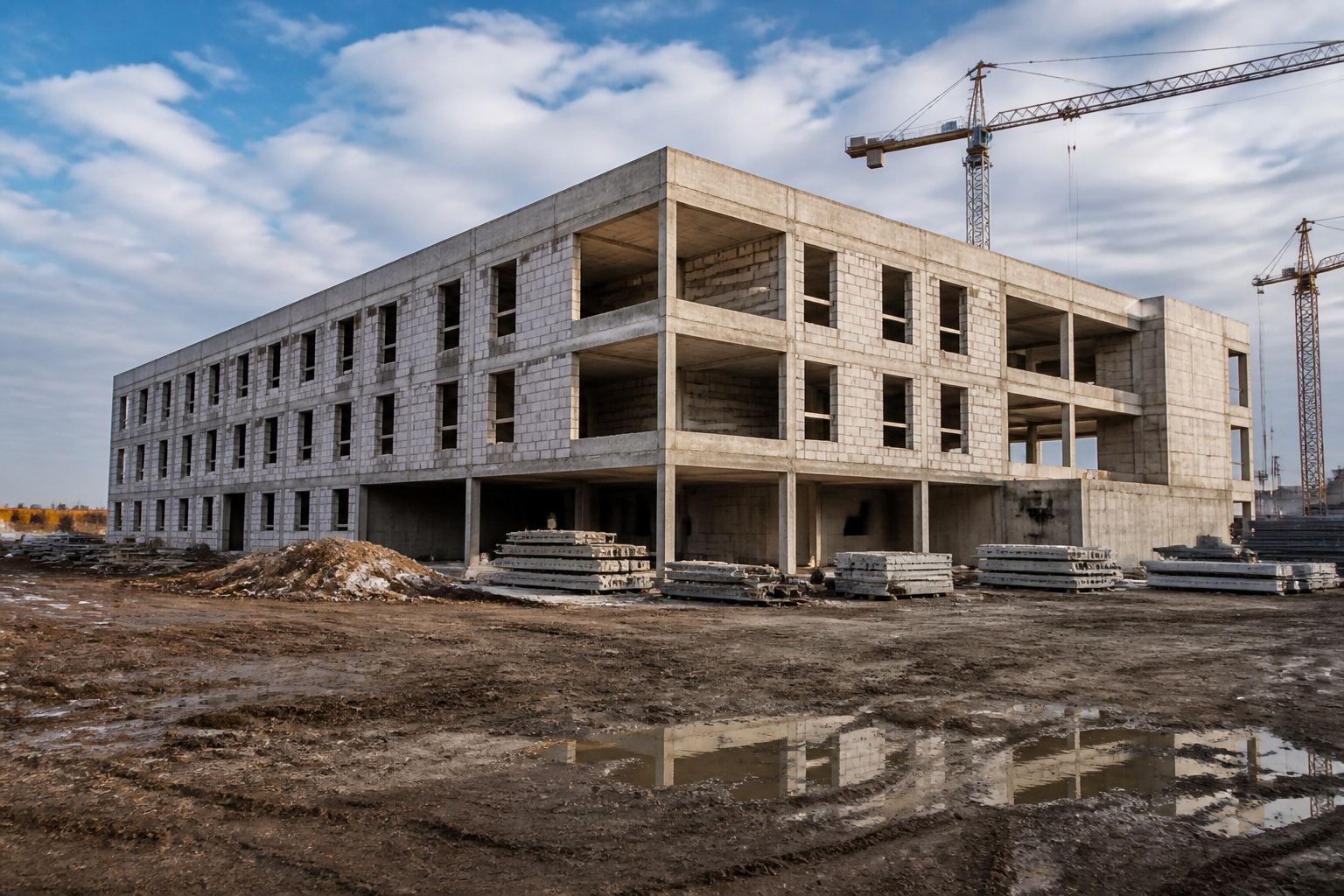
Budimex signed a contract worth close to PLN 211m on 17 September 2026 to finish the stalled expansion of University Hospital No. 2 in Bydgoszcz, where more than PLN 76m had already been spent before works stopped in 2024. The restart shows where hospital value sits, because the weathertight shell is standing and the expensive half of the job has yet to start.
I had the Bydgoszcz hospital down as a job nearly finished. Then I put the two numbers side by side. The shell absorbed over PLN 76m, and finishing it costs nearly PLN 211m.
On 17 September 2026 the Nicolaus Copernicus University in Torun signed a contract with Budimex SA. It covers completion of the expansion of University Hospital No. 2 in Bydgoszcz. Express Bydgoski reported the signing on 18 September and put the value at close to PLN 211m gross. Works are due to end in March 2028.
More than PLN 76m has already gone into the build. A further PLN 90m is reserved for equipment. The site has stood still since 2024.
The shell is not the progress
The new wing sits at weathertight shell stage. Structure, roof covering, facade and partition walls are complete. To a passing eye that looks like most of the job.
Hospitals do not work that way. The value concentrates in fit-out and engineering services. Eleven operating theatres, two of them hybrid, sit inside this building. So do an intensive care unit, a central sterilisation department and a haematology ward with transplants.
The wing runs to nine storeys and roughly 87,200 cubic metres. It will hold 144 beds. An elevated helipad for the air ambulance service goes on the roof.
Budimex must also build a transformer station, rebuild internal roads and adapt rooms in the working hospital. A new circulation core will join the old and new buildings. All of that happens while the hospital keeps treating patients.
The restart is a redesign, and it is priced as one
Read the Budimex scope and the point lands. Before building anything, the contractor must inventory what already stands on site.
It then prepares fresh documentation and obtains a decision amending the building permit. Only after that does it design the remaining works and deliver them. Urbanity set out this sequence on 18 September.
That is a design commission sitting in front of a construction contract. It also means the amended permit is on the critical path. Nothing of substance happens on site until a planning office signs.
The contract runs under Poland's design-and-build formula. Design risk therefore sits with a contractor who did not draw the original design. The completion warranty sits with a firm that did not pour the frame. Budimex also carries two years of service on the equipment it installs.
Why the first contractor walked
Works began in spring 2021 with a finish date at the end of 2023. That date moved several times. The contract with Alstal ended after mediation and the site closed in 2024.
Polityka Zdrowotna reported on 20 September that the firm gave up the job. It cited sharp rises in material and labour costs. That is the 2022 cost shock landing on a price agreed before it. The sponsor then spent two years turning a contractor's loss into a public one.
The sponsor pays for the gap twice
The expansion belongs to a multiannual medical programme worth over PLN 426m and running from 2018 to 2028. The health ministry funds close to PLN 397m of it. Around PLN 26.6m comes from the Operational Programme Infrastructure and Environment, and over PLN 3m from the university.
Express Bydgoski also reported during the re-tender that bids came in above the available money. The sponsor had to go looking for more funding before it could award. That search is the first payment for the stoppage.
Rector Andrzej Tretyn said at the signing that the whole investment has been running for about ten years. A decision taken in his first term will now complete in his third.
What Bydgoszcz tells the rest of the market
Poland is carrying more half-built public buildings than its programme reporting shows. Each one holds the same arithmetic. A stopped site loses value quietly, because the next contractor prices an unknown and charges for it.
For public sponsors the lesson sits in the pause clause rather than the award. Decide now who owns the design, the permit and the as-built record if works halt. For contractors, completion work is becoming a real market with its own skill set. For lenders and ministries, the restart premium belongs in the original business case, because someone always pays it.
Share it with your peers
Help your network stay ahead of CEE capital projects.




Explore our infograph library — strategic visuals for CEE capital projects leaders.
Project benchmarks, financing structures, tender dynamics and delivery risk — at a glance. Free access for investors, owners, contractors and strategy teams tracking CEE capital projects.
Browse the libraryStrategic Insights
📊 Analytics & Strategic Insight
The restart contract is where the bill for a stopped site finally arrives
The decision most in this industry are avoiding:
👉 A weathertight shell buys less than it looks like. On a hospital the frame is the cheap part. Fit-out, medical engineering and commissioning carry the cost and the risk.
👉 The as-built record is the handover asset. When a contract ends mid-build, the drawings and the survey matter most. They are worth more than the plant left behind. Few contracts name who owns them.
👉 Sponsors buy their own stoppage back at a premium. The incoming contractor prices workmanship it cannot see but must warrant. That premium is the price of the pause, and it never appears as a line item.
Here's the full context:
→ 2018: The multiannual medical programme for the Bydgoszcz teaching hospitals is set at over PLN 426m to 2028.
→ 2021: Works start in spring on a new wing with an elevated helipad, aiming at a 2023 finish.
→ 2023: The completion date slips and is extended several times as costs rise.
→ 2024: The contract with Alstal ends after mediation and the site stops at weathertight shell stage.
→ Most recent: On 17 September 2026 Budimex signs a PLN 211m contract to finish the wing by March 2028.
What this means for infrastructure operators, contractors and investors:
✅ Completion contracts are a distinct product line. They need survey capability, documentation skills and permit handling before any trade arrives. Contractors that build the team early will win work others cannot price.
✅ Design-and-build on a restart moves more risk than it looks. The incoming firm inherits a design it did not author and a structure it did not build. Price that inheritance, or decline the job.
✅ Public programme reporting hides the stalled stock. A paused project keeps its budget line and quietly loses value. Ministries and investors should ask how many shells are standing, and what each would cost to finish today.
3 moves you can make this week:
1️⃣ Count your shells. List every project of yours that is paused above ground. Put a today-price on finishing each one, and compare it with the carried budget.
2️⃣ Write the stop protocol into live contracts. Name who holds the design rights, the as-built survey and the permit if works halt. Agree the handover pack now, while both sides still want the job to work.
3️⃣ Test one restart price with the market. Ask two contractors what they would charge to complete a job someone else started. The gap between their number and your budget is your real exposure.
Related analyses
- Real Estate & Construction
Echo Investment's Owner Bid PLN 5.20 a Share for the Rest of Poland's Biggest Developer. The Market Never Came Down to Meet It
Lisala, the vehicle through which Hungary's WING controls Echo Investment, has notified Poland's regulator of a PLN 5.20 per share offer for the 37.63 per cent it does not own, about 4.4 per cent below the close that preceded it. Echo's shares have stayed above the bid, and two Polish pension funds now decide whether the country's largest developer leaves the Warsaw exchange after three decades.
Read analysis → - Real Estate & Construction
RSK Hits GBP 2.47bn Revenue With GBP 965m Net Debt: Why Clients Should Prequalify Their Engineering Advisers
RSK lifted revenue 10.3 per cent to GBP 2.47bn in the year to 5 April 2026 and reported GBP 112m of interest against GBP 18.1m of operating profit, with net debt up to GBP 965m from GBP 734m. The engineering and environmental advisers who sign designs, ground reports and consents are consolidating on borrowed money, and almost no client tests them the way it tests a contractor.
Read analysis → - Real Estate & Construction
WING Group Grew Revenue 41% While 63% of Its Assets Sat Outside Hungary
WING Group lifted first-half 2026 revenue 41 per cent to HUF 130.3bn, with 63 per cent of its assets now in Poland and Germany. Its Hungarian half year ran on standing-asset purchases while Budapest's office pipeline stayed just above 100,000 sqm.
Read analysis →
Building in Central Europe?
Tell us what you're building. We'll tell you what can go wrong — and how to prevent it.