We Help International Investors and Project Owners Deliver Major CEE Projects Without Expensive Surprises
Independent project intelligence and advisory across energy, transport, real estate and industrial construction.
BAM Hit a 6.9% Margin With Revenue Up Just 3%. Europe's Contractors Have Stopped Buying Work
Royal BAM Group's UK civil engineering arm turned over 1% less in the first half of 2026 and earned nearly half as much again in EBITDA. The inversion of volume and profit is now the defining operating model of European contracting, and the order book is the tell.

BAM's UK civil engineering business turned over 1% less in the first half of 2026 than it did a year earlier. Its earnings rose by almost half. That inversion, less work for more money, is the clearest single picture of what European contracting has become.
The numbers
Royal BAM Group reported first-half 2026 results on 30 July. Group revenue rose 3% to €3.5bn. Adjusted EBITDA rose 36% to €240m, lifting the margin to 6.9% from 5.2% a year earlier. The board raised full-year guidance to an adjusted EBITDA margin above 6.5%, against a standing target of 5.0%. The order book stood at €12.6bn (The Construction Index, 30 July 2026).
The divisional detail is where it gets interesting. In the UK and Ireland, revenue rose 4% to €1,733m while adjusted EBITDA jumped from €66m to €98m. Inside that, Civil Engineering UK grew EBITDA to £59m on revenue of £780m, down 1%, taking its operating margin to 7.6% from 5.1%. The building arm, Construction UK, more than doubled EBITDA to £18m on revenue up 6% to £473m, restoring a 3.8% margin from 1.5% (Construction Enquirer, Aaron Morby, 30 July 2026).
A 7.6% margin on UK civils work is not a normal number. For most of the last decade the large UK contractors fought over jobs at 1-2% and lost money on a fair share of them.
Where the margin came from
BAM attributed the civils performance to claim settlements and a high-quality order book weighted to rail and energy transition work. Read that carefully. A meaningful part of the profit uplift came from the commercial function rather than the production function: entitlement recovered on jobs already built, rather than efficiency won on jobs in progress.
That is a legitimate way to earn money, and on FIDIC and NEC forms it is exactly what the contract machinery exists to do. It is also lumpy. A settled claim lands once. The question every analyst and every client-side commercial director should be asking is what the margin looks like stripped of settlements, because that is the number that repeats next year.
The building arm's recovery is the more durable signal. Construction UK spent two years absorbing the fall-out from the Co-op Live arena in Manchester. Getting back to 3.8% is delivery working again.
Everyone is doing it
BAM has plenty of company, and the same fortnight makes the point. VolkerWessels UK crossed a 4% margin with profit above £70m, explicitly prioritising margin over turnover (Construction Enquirer, 27 July 2026). JN Bentley lifted its margin to 4.8% while warning that the water sector is heading into a labour and specialist-skills crunch (28 July 2026). Equans returned to profit in the UK after exiting new-build housing altogether (28 July 2026).
The counterpoint arrived on 29 July, when Torsion Construction, a £165m-turnover contractor, went into administration. Turnover of that size is no protection. It has not been for years.
The order book is the tell
BAM's UK and Ireland order book fell to €6.1bn from €6.9bn at the end of 2025. The company expects several large civils awards in the second half and points out that more than 70% of its civil engineering opportunities sit with existing strategic clients.
A shrinking order book alongside a rising margin is what deliberate selectivity looks like. It is also what a thinning pipeline looks like. From the outside the two are indistinguishable for about three quarters, and then they are not.
This is the real test of the margin era. Discipline is easy when demand is strong across energy, transport, water, healthcare, education and defence, which is where BAM says its demand sits. Discipline gets expensive when a division has crews to keep busy and the next framework call-off slips a quarter. Every contractor that has ever bought work did it in that moment, never in a boardroom.
What this means going into 2027
For clients and public sponsors, the era of picking up a 1% bid is closing. UK construction confidence hit its highest level of the year in July, and contractors sitting on net cash (BAM finished the half with €300m) can walk away from a badly drafted risk allocation. Procurement teams that still write unlimited design liability or uncapped delay damages into a shell-and-core package will find their bid lists getting shorter and their prices getting higher.
For contractors, the strategic question is what to do with margin once you have it. BAM is putting some of it into a plug-and-play compact substation designed to cut installation time by 75% and halve the specialist labour required. That is the right instinct: convert a cyclical margin into a structural one before the cycle turns.
For investors, the discipline is worth paying for only if it survives the first soft quarter. Watch the ratio of order intake to revenue, watch how much of EBITDA is settlement-derived, and watch what happens the first time a large contractor loses a framework seat it expected to keep.
Share it with your peers
Help your network stay ahead of CEE capital projects.
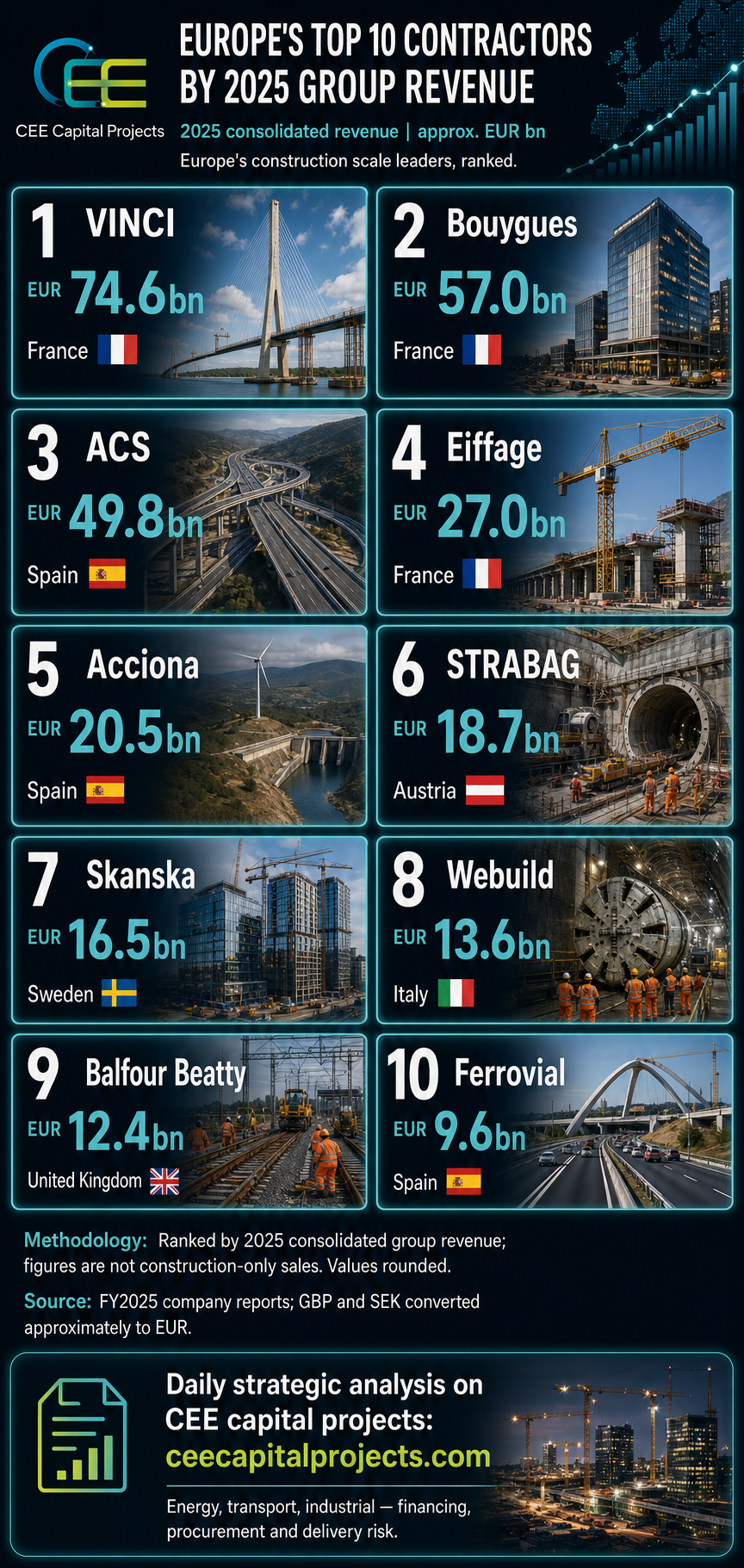
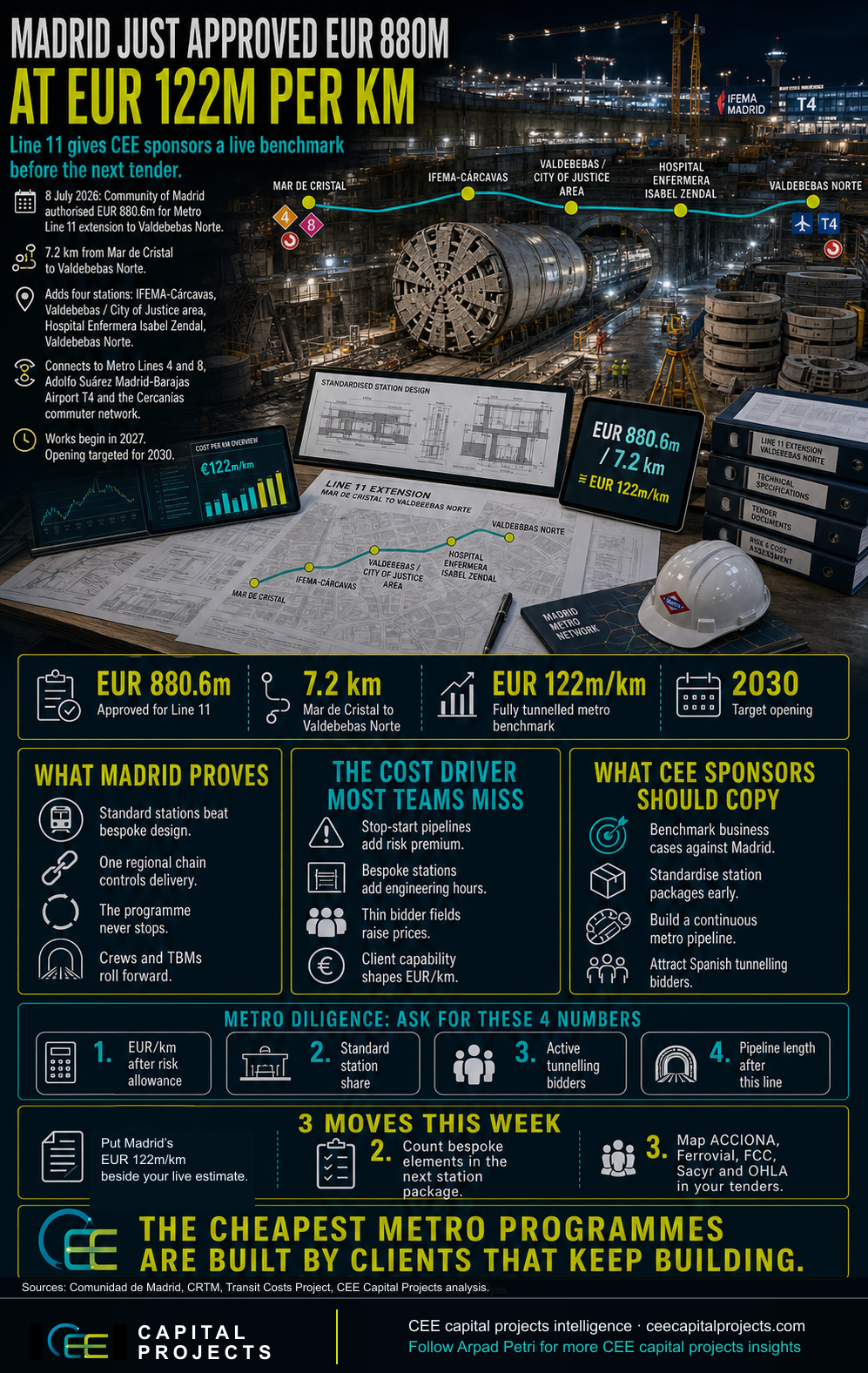

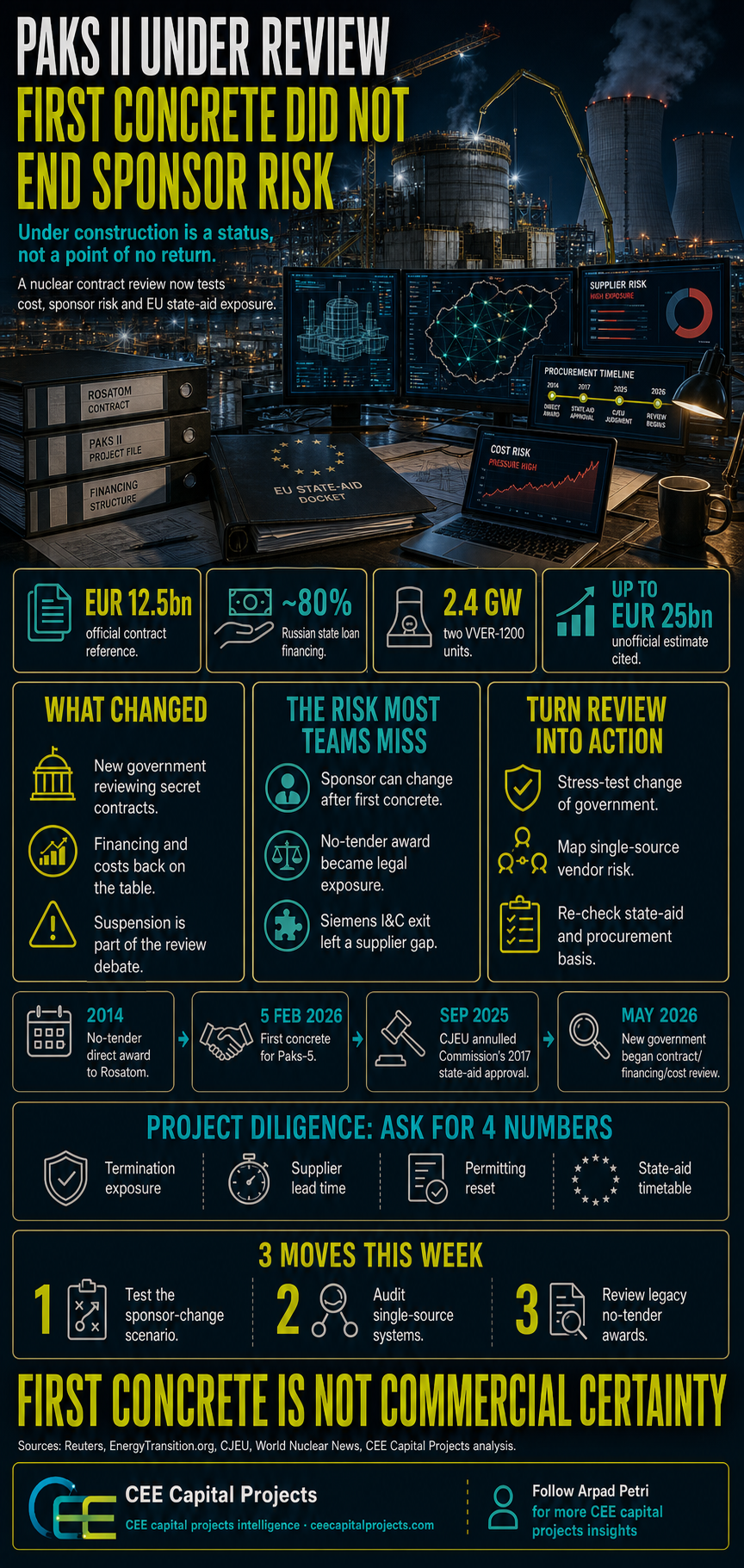
Explore our infograph library — strategic visuals for CEE capital projects leaders.
Project benchmarks, financing structures, tender dynamics and delivery risk — at a glance. Free access for investors, owners, contractors and strategy teams tracking CEE capital projects.
Browse the libraryStrategic Insights
📊 Analytics & Strategic Insight
Margin discipline has become the operating model. Nobody has tested whether it survives an empty yard
The decision most in this industry are avoiding:
👉 Splitting reported margin into earned and recovered. Almost every contractor board reports one blended EBITDA figure. Claim settlements and production efficiency behave completely differently across a cycle: one lands once, the other compounds. A business that cannot say which half of its margin came from where cannot forecast the next half-year.
👉 Setting the walk-away price before the crews go idle. No contractor has ever bought work in a strategy session. It happens in week three of a thin programme, when a regional director is holding forty people and a plant fleet. The decision has to be made and signed off while the order book still looks comfortable.
👉 Reading a falling order book honestly. A shrinking backlog next to a rising margin is the signature of deliberate selectivity. It is also the signature of a market that is quietly running out of funded work. Most boards assume the first without ever writing down the test that would reveal the second.
Here's the full context:
→ 2018: Carillion's collapse ends the UK's tolerance for buying turnover at 1-2% margins, but the bidding behaviour that caused it survives across most of the European tier one.
→ 2022-2023: Material and labour inflation lands on fixed-price backlogs signed before the shock. Contractors across Europe take write-downs and start repricing risk transfer rather than absorbing it.
→ 2024: BAM's UK building arm absorbs the fall-out from the Co-op Live arena in Manchester; its operating margin sits near 1.5%, a level that leaves no room for a single bad job.
→ 2025: BAM delivers €400m of adjusted EBITDA for the full year as the sector shifts toward selective bidding, framework positions and repeat strategic clients over open competition.
→ Most recent: On 30 July 2026 BAM reports H1 adjusted EBITDA of €240m, up 36%, a 6.9% group margin, and raises full-year guidance above 6.5% from a 5.0% target. UK civils hits a 7.6% margin on revenue down 1%, helped by claim settlements. Two days earlier VolkerWessels UK crossed 4% on profit above £70m; the day before that, Torsion Construction went into administration on £165m of turnover.
What this means for infrastructure operators, contractors and investors:
✅ Risk transfer now has a visible price. Contractors with net cash can decline a package. Uncapped delay damages, unlimited design liability and single-point ground risk will shorten bid lists and raise tender prices rather than sit unpriced in a contractor's margin.
✅ Certified specialist labour is the binding constraint, not capital. BAM is investing margin into a compact substation designed to halve specialist labour needs; JN Bentley is warning of a water-sector skills crunch. Programme risk on energy and water work is now a headcount question before it is a funding question.
✅ Contractor credit is splitting in two. A £165m-turnover firm went under in the same week that peers raised full-year margin guidance. Balance sheet, not revenue scale, is the insolvency predictor. Supply-chain vetting and parent guarantees should be re-cut on that basis.
3 moves you can make this week:
1️⃣ Re-cut your last four half-years of EBITDA. Separate production margin from settlement and variation margin, and report the two lines separately from now on. The gap between them is your real forward guidance.
2️⃣ Write down the walk-away price for your top three pursuits. Fix the minimum acceptable risk terms and get them signed off before the tender documents land, while nobody is under pressure to fill a programme gap.
3️⃣ Ask your five largest clients which call-offs are funded and dated. Framework value is a ceiling, not a commitment. A backlog figure tells you less about next year than a list of jobs with a budget line and a start date.
Related analyses
- Real Estate & Construction
Echo Investment's Owner Bid PLN 5.20 a Share for the Rest of Poland's Biggest Developer. The Market Never Came Down to Meet It
Lisala, the vehicle through which Hungary's WING controls Echo Investment, has notified Poland's regulator of a PLN 5.20 per share offer for the 37.63 per cent it does not own, about 4.4 per cent below the close that preceded it. Echo's shares have stayed above the bid, and two Polish pension funds now decide whether the country's largest developer leaves the Warsaw exchange after three decades.
Read analysis → - Real Estate & Construction
RSK Hits GBP 2.47bn Revenue With GBP 965m Net Debt: Why Clients Should Prequalify Their Engineering Advisers
RSK lifted revenue 10.3 per cent to GBP 2.47bn in the year to 5 April 2026 and reported GBP 112m of interest against GBP 18.1m of operating profit, with net debt up to GBP 965m from GBP 734m. The engineering and environmental advisers who sign designs, ground reports and consents are consolidating on borrowed money, and almost no client tests them the way it tests a contractor.
Read analysis → - Real Estate & Construction
WING Group Grew Revenue 41% While 63% of Its Assets Sat Outside Hungary
WING Group lifted first-half 2026 revenue 41 per cent to HUF 130.3bn, with 63 per cent of its assets now in Poland and Germany. Its Hungarian half year ran on standing-asset purchases while Budapest's office pipeline stayed just above 100,000 sqm.
Read analysis →
Is your project leaking money through its subcontractors?
Most owners lose 3–8% in vendor packages without noticing. Tell us about your project — we'll tell you where we'd look first.